Transgender troops honored in historic retirement ceremony
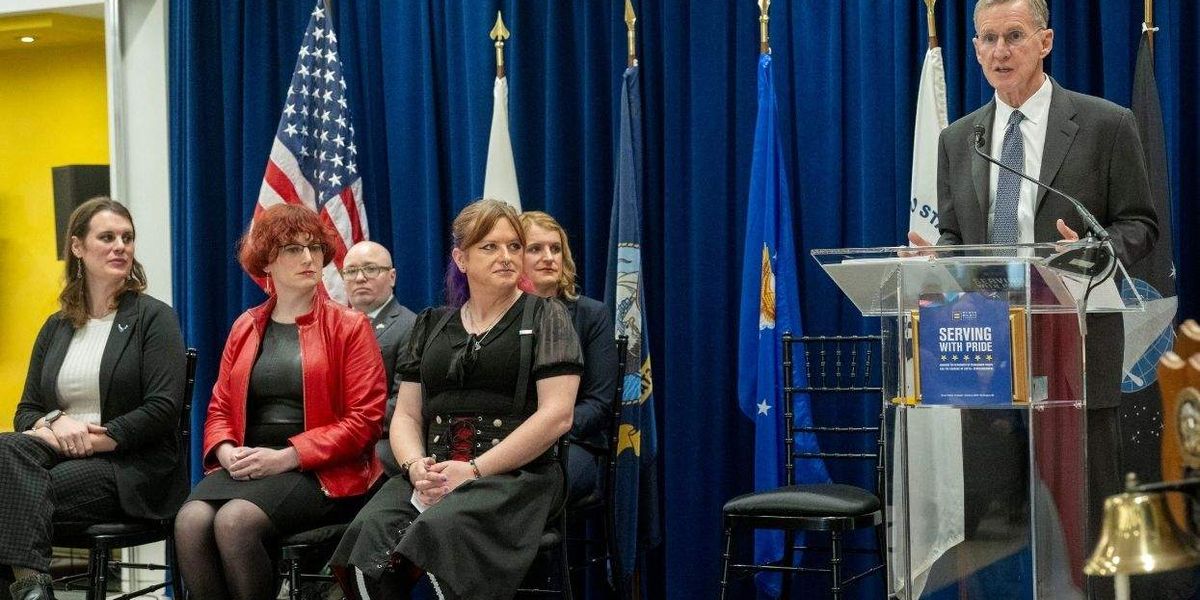
On Thursday, the Human Rights Campaign dedicated its headquarters in Washington, D.C., to transgender military members and veterans, where people gathered to reckon with what advocates are calling one of the most consequential civil rights reversals in modern U.S. history.Keep up with the latest in LGBTQ+ news and politics. Sign up for The Advocate's email newsletter.At the organization’s Equality Forum, the day began with a policy panel titled Serving With Pride: The Future of LGBTQ+ Veterans’ Benefits & Recognition. It concluded with a retirement ceremony honoring five transgender service members whose distinguished careers were abruptly cut short by the Trump administration’s renewed transgender military ban.An unprecedented retirement ceremonyThe official party entered the Equality Forum as retired Air Force Maj. Allison Hartsfield sang the national anthem, her voice echoing across a room filled with military families, advocates, and lawmakers. Roughly 200 people gathered for what would become one of the most unusual retirement ceremonies in modern U.S. military history. Gen. Tammy Smith opens the retirement ceremony for five members of the U.S. military who were forced out because they are transgender.Christopher Wiggins for The AdvocateRetired Maj. Gen. Tammy Smith, the master of ceremonies, stepped forward and formally called the room to order. Her opening words framed the moment not as routine, but as reckoning.“This ceremony is unprecedented — not because your careers fell short in any way, but because you shined so brightly in a military that cast you aside as unworthy,” Smith told the room.Related: Air Force veteran stripped of retirement under Trump's transgender purgeRelated: Sarah McBride slams Republicans for blocking amendments on trans military service in defense billShe then yielded the podium to Shawn Skelly, a transgender retired commander and former assistant secretary of defense for readiness and a member of HRC’s board, who welcomed the audience on behalf of the organization and warned that transgender service members have again become legal and political targets — “canaries in the coal mine of our democracy,” she said — as civil rights groups wage fresh court battles against the Trump administration’s renewed ban. Shawn Skelly addresses transgender service members at their retirement ceremony.Kevin Wolf/AP Content Services for Human Rights CampaignFrom there, the ceremony moved into a sequence of institutional acknowledgments that underscored the gravity of the moment.Congressman Mark Takano of California, the ranking Democrat on the House Veterans Affairs Committee and chair of the Congressional Equality Caucus, apologized to the retirees on behalf of the federal government. “I am sorry this administration has chosen to target you for no reason other than cruelty,” he said. U.S. Rep. Mark Takano speaks to retiring transgender members of the U.S. military.Kevin Wolf/AP Content Services for Human Rights CampaignCongresswoman Sarah McBride of Delaware, the nation’s first out transgender member of Congress, followed, calling the policy that forced the retirees out “immoral,” “unfair,” and “un-American,” and reminding the room that “service is not diminished by authenticity — it is enhanced by it.”Related: Trans service members have always been part of U.S. historyRelated: Air Force rescinds early retirement approvals for transgender service members kicked out by TrumpFrank Kendall, who was secretary of the Air Force under the Biden administration, called the forced retirements “a huge injustice” and “an enormous loss to the nation,” telling the audience he had never participated in a retirement ceremony for service members who had not chosen to leave and who had failed no standard. U.S. Rep. Sarah McBride addressed the retiring transgender service members.Kevin Wolf/AP Content Services for Human Rights CampaignPresiding official retired Gen. Stanley McChrystal delivered senior remarks with stark simplicity. "I can’t express my gratitude for all you’ve done," he told the retiring troops.He explained that the military is stronger when it represents the diversity of those it serves."The purpose of our military is to defend our fellow citizens,” McChrystal said. “It is to provide a safe and secure environment for all the opportunities we want to give each other and our children and our grandchildren. And what that means is we’ve got to leverage every bit of talent that this nation has. We don’t have the luxury of saying, ‘you’re too tall, you’re too short, you’re the wrong color, you’re the wrong religion, you’re the wrong sexual orientation.' We need the talent. We need the talent that shares the courage, commitment, and character to serve. That’s what we want our sons and daughters to follow. Those are the people we want shoulder to shoulder with us on the battlefield. Those are the values we want to communicate. This isn’t complicated."Related: Transgender Air Force members sue Trump administration over revoked retirements Lt. Col. Erin Krizek (left), Commander Blake Dremann, Sergeant First Class Cathrine Schmid, Col. Bree Fram and Chief Petty Officer Jaida McGuire attend their retirement ceremony at the Human Rights Campaign.Kevin Wolf/AP Content Services for Human Rights CampaignChief Petty Officer Jaida McGuire, whose 23-year Coast Guard career was formally ended in October, described the strange cruelty of being forced into retirement by the same institution now applauding her. She told the room she had delayed holding a ceremony because she did not want congratulations from “the same voices that gave me the choice to retire or lose everything that I had earned,” until HRC offered what she called “a ceremony that I can truly be proud of.”“Being transgender never kept me from deploying,” McGuire said. “I never failed to fulfill my duties.”Sgt. 1st Class Cathrine Schmid, who spent two decades in Army intelligence and counterterrorism roles, spoke of integrity as an obligation. “Twenty years of showing, maintaining, and keeping the standard, not because it’s some abstract rule written on a page, but because it protects the people who sign their name on the line,” she said. Cathrine Schmid receives an American flag to mark her retirement from the U.S.Army.Christopher Wiggins for The AdvocateAir Force Lt. Col. Erin Krizek said she was being separated “not because my performance, commitment, or ideals have been found lacking, but because the policy changed on who could serve.”Navy Cmdr. Blake Dremann reflected on the military’s long arc — from the repeal of "don’t ask, don’t tell" to women in submarines — and warned against reversing progress. “Pushing the assumptions and navigating change is challenging, often exhausting, but deeply engaging,” he said.And Col. Bree Fram, a Space Force officer and aerospace engineer who helped shape joint space requirements and deployed in support of Operation Iraqi Freedom, closed the recognition with words that would echo long after the applause faded. Jaida McGuire receives an American flag to mark her retirement from the U.S. Coast Guard.Christopher Wiggins for The Advocate“Our uniforms are not coming off because we failed in our duty,” Fram said. “They are coming off because we did it so well that what we represented could not be hidden away.” She paused. “We may be done with our military service. We are not done serving.”The ceremony concluded with a saber-sheathing ritual and the reading of “The Watch,” before the official party departed and guests moved quietly into a reception, carrying with them the unmistakable truth that the careers honored that afternoon had not ended by choice, but by decree. Erin Krizek receives an American flag to mark her retirement from the U.S. Air Force.Christopher Wiggins for The Advocate‘We needed this’: What the retirees told The Advocate afterwardMinutes after the formal program ended, the five retirees gathered quietly with their families in the lobby outside the Equality Forum. The medals had been pinned. The photographs were finished. What remained was the ache of finality and, for many, the first chance to speak plainly about what the day had meant.Fram, her family pressing close, said the ceremony had been both a privilege and a reminder of those who were denied even this last measure of dignity.“This moment was denied to so many,” Fram told The Advocate. “There are so many others that didn’t get what we got today — they got nothing but a kick-out door.” She said the ceremony’s pageantry stood in stark contrast to the way many transgender service members were dismissed: quietly, abruptly, and without recognition. Blake Dremann eceives an American flag to mark his retirement from the U.S. Navy.Christopher Wiggins for The AdvocateFor Krizek, the ceremony offered a sense of closure she had not known how to claim.“The culmination of a career like this was very disheartening,” she said. “I didn’t know how to have a retirement ceremony after this happened.” She said HRC’s decision to host the ceremony allowed the retirees to “come together in such a way as a family,” and reminded her that “there’s still a lot of fight to be had.”McGuire said the ceremony crystallized what many had long hoped would be reversed.“There was always this running thought that maybe they’ll change it and they’ll call us back,” she said. “When they were reading ‘The Watch,’ that’s when it really hit me — the finality of it.” But she added that the shared experience was also comforting. “I’m not alone. I have these wonderful people here who are all going through the same thing.”Dremann described a complicated mix of grief and resolve. Bree Fram receives an American flag to mark her retirement from the U.S. Space Force.Christopher Wiggins for The Advocate“I’m relieved,” he said, explaining that he plans to continue public service in civilian roles similar to the work he performed on active duty. “But it feels good to see shipmates, friends, family — people who’ve been with us since the beginning — come out to celebrate with us.”For Schmid, who had spent seven months in administrative limbo before her retirement became official, the ceremony provided something no memo ever had: closure.“This feels like some kind of closure,” she said. “I needed this so I could move on.” She described the significance of hearing McChrystal tell her he was proud of her. “I wouldn’t have been the same without it.”Later, when asked about the families gathered in the room — spouses, children, parents, and lifelong friends — the retirees returned to a shared refrain: that their service had mattered. Blake Dremann (left), Cathrine Schmid, Bree Fram, Erin Krizek and Jaida McGuire pose for a photo after their retirement ceremony at the Human Rights Campaign headquarters in Washington, D.C.Christopher Wiggins for The Advocate“Our service mattered,” Dremann said. “It’s our country too.” He said the ceremony allowed his family to witness the arc of his career, and ahe ffirmed that “it may be the end of our service in uniform, but it’s not the end of our service.”Krizek noted that some colleagues who are still in the military stayed away out of fear that being seen at the ceremony could jeopardize their own careers — a reality, she said, that demonstrates how much remains at stake. Still, she said, the outpouring of messages afterward left her “very touched.” Kevin Wolf/AP Content Services for Human Rights CampaignMcGuire framed the legacy of their service in simpler terms.“Our service matters if for no other reason than the fact that we have left a trail of thousands of people that we have mentored,” she said. “We defended the Constitution, even when the very rights that allow people to criticize us were being used against us.”Fram gathered the group together as the conversation wound down.“We may be done with our military service,” she said softly, echoing her words from the stage. “But we are not done serving.”A morning call to actionThe morning panel discussion underscored the breadth of harm the ban has inflicted not only on service members but on their families and communities. LGBTQ+ advocates join the Human Rights Campaign for a discussion about transgender people's service in the U.S. armed forces. Christopher Wiggins for The AdvocateFormer Army infantry officer Kara Corcoran, now executive director of Sparta Pride, pointed to the wealth of evidence that transgender troops historically met — and in many cases exceeded — the same readiness and performance standards as their peers.“It’s unfathomable that we would kick qualified Americans out,” Corcoran told attendees, criticizing the ban as a political decree rather than a decision grounded in troop effectiveness.Ashley Carothers, executive director of the Modern Military Association of America, warned that the policy’s consequences extend beyond dismissals. Families, she said, are leaving the military voluntarily because they can no longer secure safe access to medical care for loved ones in many states. “It’s not just that they’re kicking people out,” Carothers said. “People are choosing to leave because they can’t take care of themselves.” LGBTQ+ advocates join the Human Rights Campaign for a discussion about transgender people's service in the U.S. armed forces. Christopher Wiggins for The AdvocateWest Point graduate and longtime equality advocate Sue Fulton described the current policy as part of a painful historical pattern in which the military needlessly wastes talent — a reference to past exclusionary policies from banning women from combat to “don’t ask, don’t tell.”Panelists urged Congress to codify nondiscrimination protections into federal law, rather than relying on executive orders that future presidents can unravel — a point that resonated loudly given what unfolded later in the day.A reversal of nearly a decade of progressOn January 20, 2025, the first day of his second presidency, Trump signed Executive Order 14168, titled “Defending Women From Gender Ideology Extremism and Restoring Biological Truth to the Federal Government.” The directive rescinded federal recognition of gender identity, required that all federal documents and programs reflect a strict male or female binary based on sex assigned at birth, and ended federal funding for gender-affirming care in many programs.A week later, on January 27, Trump signed Executive Order 14183, “Prioritizing Military Excellence and Readiness,” which directed the Department of Defense to rewrite military policy to exclude anyone who is trans.The order asserted that identifying as transgender “conflicts with a soldier’s commitment to an honorable, truthful, and disciplined lifestyle, even in one’s personal life,” and charged the Pentagon with redefining eligibility standards accordingly.Within weeks, the Defense Department issued policy guidance that disqualified anyone with a current diagnosis or history of gender dysphoria from serving, and paused all gender-affirming medical care within military medical facilities.Thousands of transgender troops found themselves in uncertainty, as the Pentagon began to identify personnel subject to separation. Early memoranda promised honorable characterizations of service and a choice of voluntary early retirement, but only within narrow deadlines.Legal challenges sprang up almost immediately. Civil rights groups filed suits alleging that the policy violated the Constitution’s equal protection guarantees. At times, federal district courts issued nationwide preliminary injunctions blocking enforcement of the ban. But in May 2025, the U.S. Supreme Court allowed the Trump administration to lift those injunctions and let the policy take effect while appeals proceed, clearing the way for the Pentagon to begin removing transgender service members from the force.By mid-summer, the policy had been implemented across all branches, with administrative separation boards identifying and discharging transgender military members whose careers had previously been protected.The Pentagon has not publicly released the number of transgender service members separated under the policy.