Poverty, AI and migration discussed as Séamus Boland has ‘extraordinary honour’ of audience with Pope Leo XIV
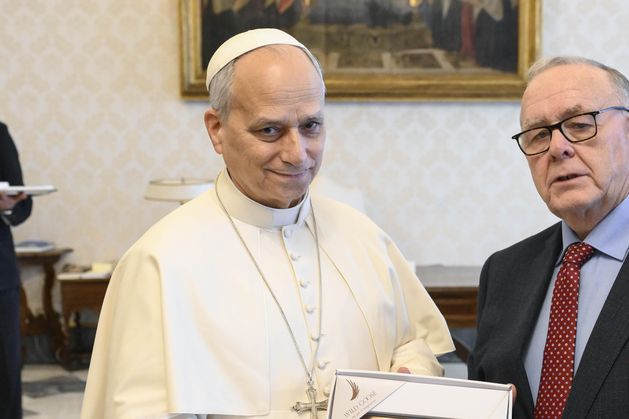
Mr Boland, a farmer and long-time civil society activist from Ballycumber, Co Offaly, was elected to his role in the EESC last October for a term of two-and-a-half years.The EU body gives voice to trade unions, employers and civil society organisations in the shaping of EU policy.Mr Boland told the Irish Independent it was “an extraordinary honour” to meet with the Pope, who he said expressed empathy across the range of topics they discussed.“I met a very human Pope, a very human person, a person who seriously cares about people in disadvantage,” he said.“He clearly had empathy with my mandate, which is to bring civil society to the heart of Europe in terms of policy making.”The issue of poverty was discussed as a matter of urgency, with 21pc of people in Europe facing poverty and social exclusion, amounting to some 90 million people.Mr Boland recalled a period from 2010 to 2020 when the EU led major efforts on the eradication of poverty, and he told the Pope this is a “debate that needs to be rekindled again.”“We didn’t discuss housing today, but housing across Europe is causing enormous poverty among young, working people and older people.“We in the EESC have called for the EU to declare an emergency in terms of housing, because frankly, the reality for people who can’t afford housing is that they are the fertile ground for extremism.EESC president Séamus Boland meets with Pope Leo XIV at the Vatican. Photo: © Vatican Media“If current governments, whether governments of the EU members or the EU Commission itself, don’t deliver real measures to get people back into housing, we are going to drive them away from democratic institutions."We talk about Europe being the biggest peace project on Earth. Well, we’re driving people away because we’re not delivering, and that really needs to be tackled.”On the topic of AI, Mr Boland described AI tools used to create deepfakes as “the newest tragedy” and a threat to young people on social media."I was able to say the EU has been strongly in favour of very, very forceful regulation in terms of AI, but we also know that’s not agreed around the world.“The mental health of young people is becoming a major issue, and again, the Pope shared empathy on the plight of young people in those circumstances.”AI also looms large for workers who could see their livelihoods impacted as the technology advances, and the Pope has previously called for ethical usage and regulation of AI.Mr Boland rejected the comparisons drawn between AI and Gutenberg’s printing press as revolutionary technologies.“We need a greater sense of urgency from political leaders around Europe, not just in the EU Commission, in terms of how we manage the change of employment."AI is a long way from perfection and can be unreliable. AI reliance may actually undermine health professionalism, legal professionalism, journalistic professionalism."Protection for workers could mean a major use of resources in compensation, in re-education, because if we ignore the livelihoods of workers who lose their jobs because of AI, we are creating a spike in employment almost at rates we’ve never known before.”EESC president Séamus Boland meets with Pope Leo XIV at the Vatican. Photo: © Vatican MediaDuring his time in the Vatican, Mr Boland praised the ‘Angels Unaware’ sculpture in St Peter’s Square, a monument dedicated to migrants and refugees, unveiled in 2019 by the late Pope Francis.“It’s quite an impressive sculpture of a boat full of people. You get straight away the message Pope Francis was sending.“He [Pope Leo XIV] is on record saying we must be kind to foreigners. From an EESC perspective, we’re asking for a proper debate on migration.“Managing migration badly can be a bigger threat to human dignity. The Pope talks a great deal about human dignity.“Migration is an essential part of normal life; it always has been. The problem is always that we mismanage it."We have to accept that many countries in Europe need migrants. What we don’t need is uncontrolled management of the system, which brings migrants into the country, where their dignity is not upheld, or they are put in situations of horrible accommodation.“It’s not something to be banned, but it is something to be managed, bearing in mind human dignity and rights.“That’s the challenge, and maybe it hasn’t been made clear enough by the political establishment.”Reflecting on the meeting, Mr Boland said he was able to deliver a message to the Pope in line with his mandate as EESC president.“We talked about allowing civil society in its proper form into the heart of policymaking. I talked about Storm Éowyn with the Pope, and how civil society organisations were first on the ground during the storm.“I was able to say that the place for civil society is not always at the end result, dealing with the disaster, but in the planning for the disaster.”