Behold This Massive Airborne Wind Turbine Hovering Over China
If you thought ground-based wind turbines were imposing, wait until you see what Chinese energy company Linyi Yunchuan has cooking.
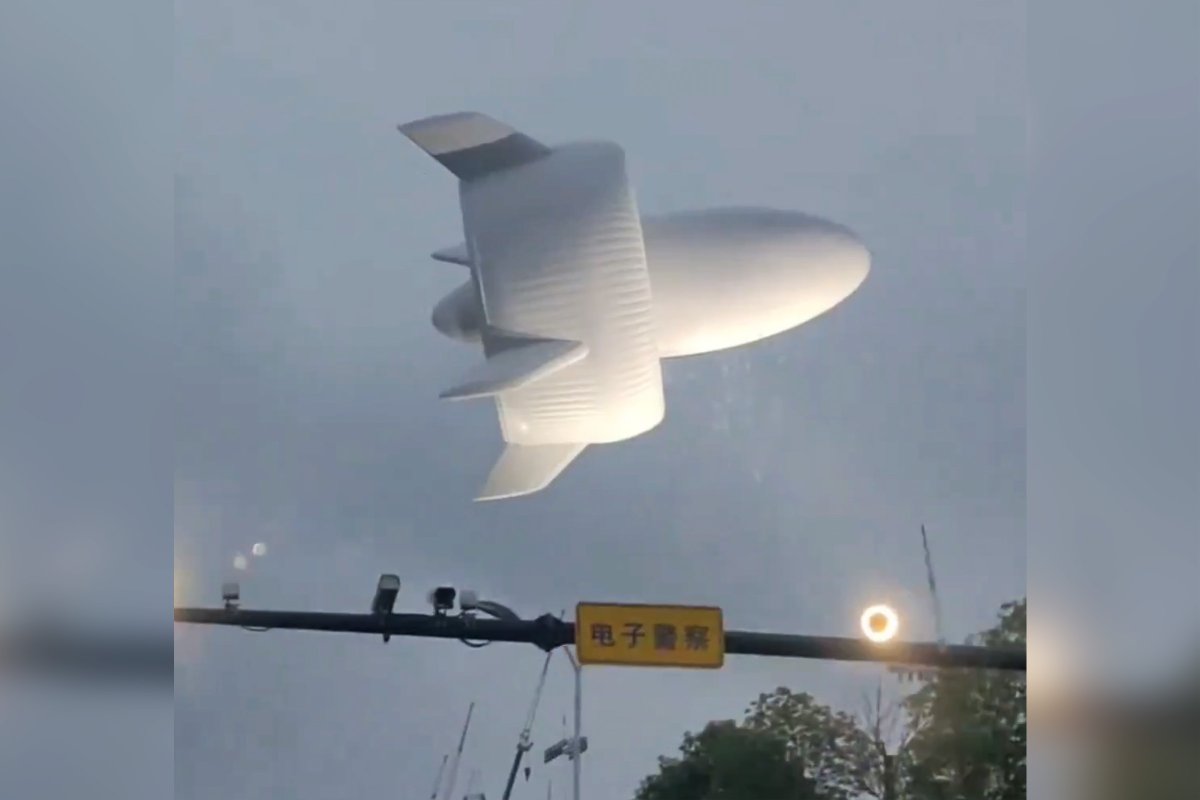
A video shared earlier today by Chinese journalist Li Zexin captured a massive airborne wind turbine (AWT) dominating the skyline over China’s Sichuan Province.
“New unreal airborne wind turbines that float to harness high-altitude winds are being used in China,” Li wrote on X-formerly-Twitter. “Though already the world’s top, China’s ambitious green energy pace has never decreased.”
“Unreal” is definitely one word for it. The device appears to be a prototype of Linyi Yunchuan’s “Stratospheric Floating Wind Power Systems” (SAWES), an AWT platform designed in partnership with Tsinghua University and the Institute of Aeronautics and Astronautics of the Chinese Academy of Sciences, among others, according to a company profile.
Specifically, the Global Times has identified it as the SAWES S2000, reporting that the unit successfully completed a test flight on Monday. It’s said to be the “world’s first megawatt-class high-altitude wind power system designed for urban deployment,” with a maximum power output of about 3 megawatts.
This particular S2000 was only airborne for 30 minutes, generating about 385 kilowatt-hours of electricity and reaching an altitude of around 6,500 feet. Though it wasn’t up for very long, it did connect to the local power grid, according to the GT, a world first for AWTs.
“At its current output level, one hour of operation can generate enough electricity to fully charge approximately 30 top-spec electric vehicles from zero to full,” Dun Tianrui, chief designer of the system, told the publication.
Dun told the GT that the S2000 can easily be transported and stored in shipping containers, and took eight hours to reach full inflation. If they were to coordinate with local gassupply chains to obtain the helium needed — a finite gas in limited supply — Dun said the entire deployment could be shaved down to four or five hours.
Functionally, AWTs are similar to airships, though instead of transporting passengers, they remain relatively static, lifting 12 lightweight turbine-generators into high-altitude wind streams. There, the generators are powered by strong prevailing winds. Electricity is then transmitted down to the ground through a tether, where it’s fed into an electrical substation.
In September, the SAWES team successfully flew an earlier S1500 unit, which has a generator capacity of 1.2 megawatts. That particular blimp is said to be “about the size of a basketball court and as tall as a 13 story building,” according to the South China Morning Post. It was the first turbine of its kind to generate a full megawatt of power, which it achieved during its maiden voyage.
The test deployments come months after as China’s CO2 emissions fell for the first time year over year, driven by green energy sources like wind and solar infrastructure. China is currently the world-leader in solar power and offshore wind energy, so while the massive floating turbines may present an eye-catching image, they certainly come at no surprise.
More on China: Chinese Fusion Reactor Achieves Plasma Density Previously Thought to Be Impossible