The World Was an Option, Transylvania Was Home — A Conversation with István Baloga on Water Polo
The following is a translated and edited version of an article by Botond Somogyi, originally published in Hungarian in Krónika. Translated by Ildikó Antal-Ferencz.
His life story is at once a sports chronicle, an account of international experience, and a testimony to community commitment. From the pools of Kolozsvár (Cluj-Napoca, Romania) to the American college championships, and then back to Transylvania: as a water polo player, university lecturer, and father, István Baloga is guided by perseverance, learning, and value creation. We discuss how he first encountered sport, his years as a student in the United States, the decision to return home, the challenges of youth development, and why he believes that sport shapes not only the body, but character as well.
***
When and how did sport enter István Baloga’s life?
I started swimming together with my younger sister when I was ten, which is considered relatively late. I learned to swim at CSM (Club Sportiv Municipal, local/county sport club) under Enikő Pál. I owe my love of sport to my grandmother and my father: they often took us to the city’s public swimming pool and to the Black Sea. My sister later achieved podium finishes in breaststroke.
When did water polo come into the picture?
I had already been swimming for two and a half years when one of my classmates—who played water polo—invited me to a training session. I loved it immediately. For two years, I swam and played water polo simultaneously. There were times when my water polo coach hid me in a locker so that my swimming coach wouldn’t see that I was staying on for water polo training… Swimming was from four to six in the afternoon, water polo from six to eight. After a while, I dropped swimming and focused on water polo—it is a much more dynamic and complex sport.
Scholarship Years in America
What results did you achieve as a player?
In the youth age group, we won the national championship in Bucharest with the local Sports School. Later, I played for several teams in Kolozsvár: the Sports School, CSS Viitorul (Club Sportiv Școlar Viitorul, Future Sport School Club), CSM, Voința (Grit), and Politehnica (University of Technology), which still has a first-division team today. I also played abroad: in Israel (Jerusalem), and in the United States, where I was captain of the City University of New York (CUNY) Queens College university team and also played for the New York Athletic Club. I also competed as a swimmer in Romania and later in the American college championships.
Was it water polo that took you to the United States?
Yes. I received a scholarship that covered tuition fees, but the cost of living was very high. Alongside two training sessions a day, I had to study and also work—as a waiter—in order to be able to pay for accommodation. In the early 2000s, even a single textbook cost more than 100 dollars… With the university team, we won the Eastern Championship, defeating universities such as Harvard, Princeton, Brown, and the Navy’s team, too. We qualified for the NCAA Division I Final Four in Los Angeles, where we finished third after Stanford, Berkeley, and ahead of UC San Diego—which was a huge achievement. Our team was extremely diverse: alongside Americans, we played with Olympic athletes from Croatia, Brazil, Turkey, Australia, and Kazakhstan.
With the City University of New York – Queens College university team PHOTO: István Baloga’s personal archive/Krónika
How long did you live in the United States?
For more than ten years. First as a student, and later I also worked there. I met my wife at the university, we got married there, and our first two children were born there as well.
What did you study during this time?
In Kolozsvár, I studied physical education at Babeș-Bolyai University. In the United States, I studied economics at CUNY, Queens College. Upon returning home, I completed a master’s degree in sociology and then earned a PhD in economics and management.
What was life and the sporting environment like there?
Very intense. One of the conditions of the scholarship was maintaining a good academic average; otherwise, you lost the scholarship and had to go home. Training started at six in the morning, then we had classes, then training again in the afternoon, and in the evening I went to work as a waiter—often arriving home at one in the morning and getting up again at dawn. It was exhausting, but it gave me a lot. The team was multicultural; Queens is one of the most diverse areas of New York. We were in a good environment, and I gained strong professional and personal experience.
Many people do not return home after such a life. Why did you decide to do so?
Once you have a family, priorities change. When my wife first visited Kolozsvár, she declared that under no circumstances would she move to Europe, and especially not to Transylvania. We tried Asia and America, and finally decided to return to Kolozsvár for the sake of our children. We felt that here we could devote more time to one another and to the children. Moreover, the city has visibly developed a great deal over time.
How did your wife’s family react to the decision?
On both sides, there were questions, as we come from different cultures. My wife is from the Philippines. Her mother passed away just before our first child was born. Her father, however, came to see where we’d be moving to. My parents also visited us in America and Asia. Today, it is natural that we visit each other every year.
Why was economics important to you alongside sport?
New York is one of the world’s financial centers. I worked for a New York City committee responsible for international relations connected to the United Nations, and later for the investment bank Merrill Lynch. At home, I took a job at an insurance company, but I realized that the office world was not for me. Teaching sport and passing on experience—what I know best—is much closer to my heart.
István Baloga: Water Polo Is Not Football
What are you doing at present?
I’m a university lecturer: I teach swimming, hydrokinetic therapy, water sports, and sport management. In addition, about two years ago, we launched ASA (Aqua Sports Academy, Cluj Academy of Water Sports)—where we work with children aged nine to 13, mainly in water polo. As a visiting lecturer, I have taught in Budapest and New York, and have been to the universities of Granada, Cádiz, and Murcia in Spain, as well as the University of Coimbra in Portugal.
The Cluj-based ASA (KVSA) youth water polo team coached by István Baloga PHOTO: István Baloga’s personal archive/Krónika
Why is youth development in water polo particularly difficult?
Water polo is a long-term investment. At least two years of swimming are needed, followed by another two years of basic training—rules, treading water—before a child can play in an official match. It is not like football, where after a few weeks of training, there is already a championship. Next year, we would like to enter the league, but for this, we need sponsors. We warmly welcome parents and company managers who would support this Olympic sport in Kolozsvár.
What values do you consider most important in sport?
Discipline, endurance, and character building. I consider team spirit and commitment to shared goals essential in sport—in my view, this is what young people should be educated towards. With children, results are not the priority; what matters is that they learn perseverance, respect, and thinking in terms of community.
Where do your children study, and what language do you speak at home?
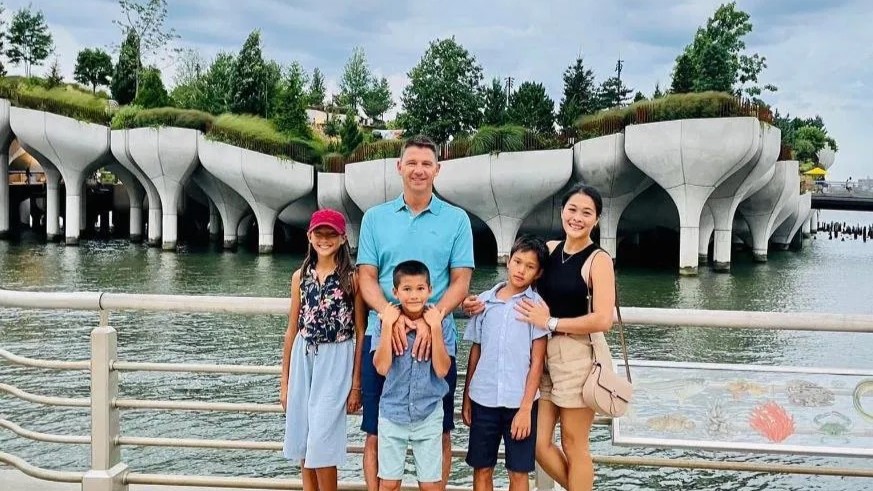
I have three children: Izabella is 15, Ádám is 13, and Dani is 11. All three attend the Báthory István Lyceum. At home, we mostly speak Hungarian. I also speak English with my wife; she understands Hungarian, but speaks it less confidently.
What does she do?
She works in accounting for a company based in the United States. She starts in the afternoon and works late into the night, as she has to work in that time zone. She starts working when the children are just coming home, which is sometimes not the most convenient for us.
How does senior water polo feature in your life?
Actively. With the Politehnica team, we compete in the national championship and in international tournaments as well. In 2009, we became European champions in Oradea, in 2019, world champions in South Korea, and in 2024, in Doha, Qatar.
How did you become a member of the presbytery of the Reformed congregation in Törökvágás?
István Bibza baptized my younger son and me, and he also married my parents. When his son, Dr. Gábor Bibza—with whom I was confirmed years ago in a small prayer house together with about 60 other children—asked me to become a presbyter, I felt it was my duty to accept. I feel that I must take part in the religious and congregational life of the parish; my children also attend religious education in the Törökvágás congregation. Although my wife and our first two children are Catholic, we attend both Reformed and Catholic churches together. I believe that balance requires family, school, church, and sport alike.
What advice would you give to young people who are looking for their path in sport?
Sport is a healthy way for people to belong together and find a common goal. My own children have tried all kinds of individual and team sports, and now we are trying to narrow down this wide range, so that each of them ends up with just one. The difficulty is that all three children train in different parts of the city. Anyone with children knows how logistically complicated this is. Still, it is important to make the sacrifice for them, because I believe that starting sports early helps keep them occupied in a healthy way during adolescence and keeps them away from harmful activities.
‘Sport is a healthy way for people to belong together and find a common goal’
Is there any thought that was left out of our conversation?
I regret that I wasn’t able to progress further as an international referee, because I could have pursued that path when my children were born, and refereeing involves a great deal of travel. At the same time, I’m still active as a referee in the Romanian first division in water polo, as well as in the American college championships. I also regret that nowadays fewer people attend sporting events and training sessions than in the past. I always encourage my students to watch games, attend training sessions, and take notes, so that they can get closer to the sport.
From father to son: István Baloga with his younger son, Dani, who also plays water polo PHOTO: István Baloga’s personal archive/Krónika
We grew up at the swimming pool, and it was full of people. Today, this is hard to imagine; I often compare those crowds to the congestion of car parks at today’s shopping centers, so that students can see the change. My father used to tell me that entrance to the pool used to cost 50 bani (~0.11 EUR / ~0.12 USD), while a liter of milk cost 1.2 lei (~0.25 EUR / ~0.28 USD). Today, a pool ticket costs 50 lei (~10.5 EUR / ~11.5 USD). A shared swim or skating session costs families a fortune. I regret that children cannot practice sports regularly.
What would you consider important for the future?
That a Hungarian sports complex for all age groups is established in Kolozsvár—especially for the healthy development of children. I envision a place where Hungarian instructors help young people with integration into the community and with understanding the technical language of sport. The complex could also include a swimming training facility, with greater emphasis on developing our Hungarian national sport, water polo.
István Baloga’s Sports Awards and Related Achievements
1992 – National youth champion in water polo (CSS Viitorul Cluj, Bucharest)2001 – Academic All-American, NCAA Division I2003 – National college championship, 3rd place (NCAA Division I, Los Angeles)2009 – Senior European champion in water polo (LEN)2013 – Senior national champion in water polo2019 – Senior world champion in water polo (FINA, Gwangju, South Korea)2024 – Senior world champion in water polo (World Aquatics, Doha, Qatar)
Related articles: