Resilience in the kitchen: 3 F&B operators who kept cooking despite failure, loss and illness
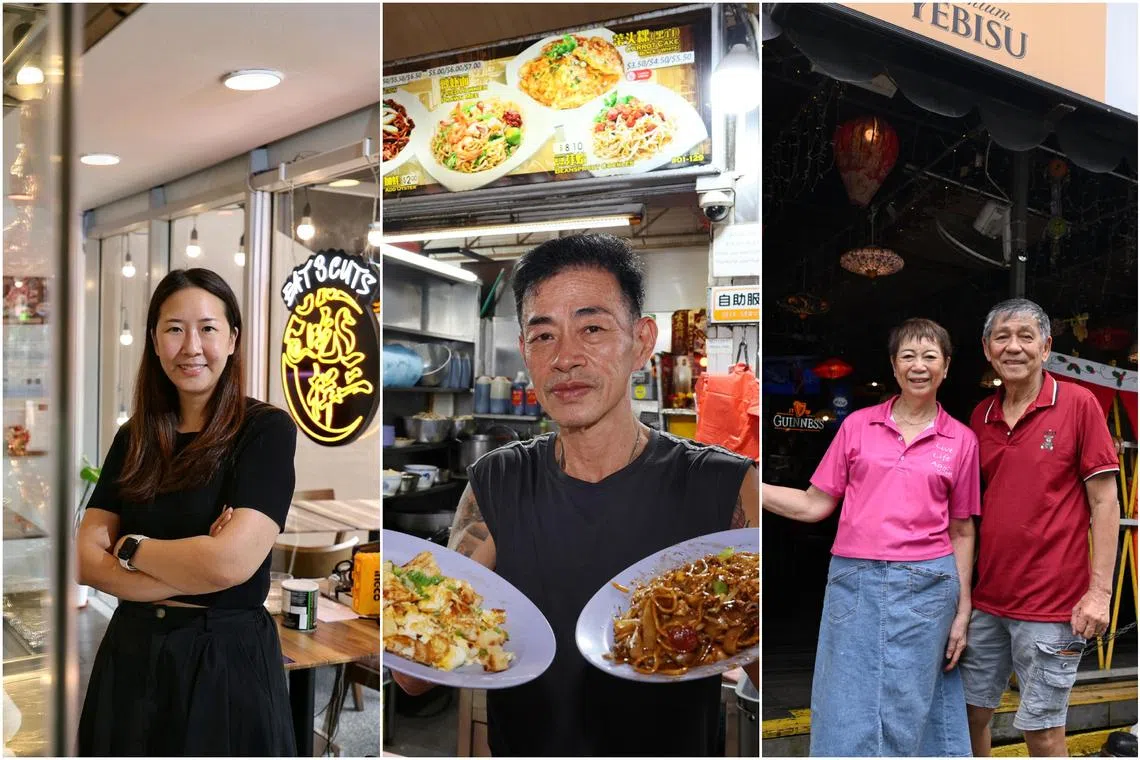
SINGAPORE – In the cut-throat food and beverage industry, resilience may be less a virtue than a condition for survival.Ms Sharon Poon, co-owner of recently opened roast meat eatery Eat 3 Cuts, worked through about $200,000 in losses across a series of failed ventures before taking the plunge again. Hawker cook Teo Chye Huat, who fries carrot cake and char kway teow at Hai Nan Zai, kept reporting for work until he collapsed and was diagnosed with stage three intestinal cancer. For Mr Sam Png and Mrs Jenny Png of Woody Family Peranakan Cafe, keeping the cafe open has become the way to keep a roof over their heads.They share what keeps them going despite the hurdles thrown their way.Over six years, Ms Sharon Poon has opened and closed several F&B ventures, accumulating about $200,000 in losses, together with her business partner. Yet in September, the 36-year-old roast meat chef launched her latest venture, Eat 3 Cuts at Atrix (FW), this time with a third investor on board. Previous failed ventures did not deter Ms Sharon Poon from starting her latest venture, Eat 3 Cuts, in September 2025.ST PHOTO: KEVIN LIMIt is her fourth attempt at running an eatery from scratch. Though she has had moments when she wanted to walk away, she found herself picking up the pieces and starting again.Ms Poon graduated from the National University of Singapore in 2012 with a Bachelor of Arts and Social Sciences, and worked as a financial services consultant at a bank for a year before switching to insurance sales from 2013 to 2019. By 30, she felt stagnant and wanted a change. A friend introduced her to a fengshui practitioner who had been a roast meat chef. He became her culinary mentor and later her business partner.Her parents objected strongly to her career change. Her mother, then aged 62, was head of risk at a foreign bank, while her father, aged 69, was a senior engineer in the public service. But in March 2019, Ms Poon bought $3,000 worth of second-hand equipment and rented a stall in an industrial canteen in Bedok North for $800 a month. It served as a test kitchen where she learnt to roast chicken and duck using a charcoal-fired Apollo oven. The daily grind was from 7am to 6pm, but she felt energised by the learning process and brushed off the minor burns and cuts she picked up along the way. Early orders were encouraging and she felt ready to start the business in earnest.In May 2019, she and her mentor opened a 340 sq ft eatery at Burlington Square. They put in a capital of $30,000, with her mentor contributing 30 per cent. Business was slow for the first six months and Ms Poon added another $25,000 to keep it afloat. With no budget to hire, the duo worked round the clock from 9 to 2am daily. Space constraints meant they could start defrosting and preparing the ducks only after closing time each night.Two months into opening, Ms Poon found out she was pregnant with her first child, a boy. At that time, she was engaged to her boyfriend of four years, but had delayed wedding plans to focus on her business. She worked through the morning sickness. When food bloggers featured her stall, she saw a surge in customers for one to two months, but could not cope with the sudden crowd. Running out of roast meat and getting scolded by diners became common occurrences. The unit also suffered plumbing issues and poor ventilation that triggered complaints from neighbouring stalls.She gave birth in January 2020 and returned to work after a week to oversee renovations at a new location. She and her business partner had secured a 680 sq ft second-floor unit at Tai Seng Point. Renovation and exhaust installation cost $50,000, which they split evenly. Ms Sharon Poon learnt everything about preparing roast meat, from roasting to chopping, from her mentor.ST PHOTO: KEVIN LIMThe shop opened on March 1, 2020. Weeks later, the Covid-19 circuit breaker began. Footfall disappeared and a Covid-19 case involving a singer at a pub in the same building further hurt business. They drew no salary, survived on rental subsidies for four months and disposed up to 10 ducks a day for the first two months, later scaling down to five, then finally switching to pre-orders only. Losses continued, amounting to about $3,000 a month. “The problem was our roast duck dishes are more suited for group dining,” she says. “With Covid restrictions, group dining was not popular.”In February 2021, they tried to boost income with a second outlet at Old Airport Road Food Centre. The set-up cost was $2,000, but Ms Poon was pregnant again and struggled with severe morning sickness while managing the stall. In June 2021, she got married and gave birth to her second child, a daughter, in October that year. The stall lasted nine months before they shut it in November 2021 due to dining restrictions and poor sales. In December 2021, they moved to Arc 380 in Jalan Besar. The 600 sq ft space cost $50,000 to renovate. With Ms Poon’s savings depleted, her mentor funded the set-up. They installed electrical stoves for noodles and reserved charcoal roasting for ducks. Power bills alone reached $1,800 a month. Some months, they broke even, but most were loss-making. TikTok marketing helped, but minimally. In early 2023, they closed. They did not recover their capital, making additional losses of about $30,000.That closure was the toughest. Ms Poon took a break for six months, when she ruminated and wallowed in guilt for missing out on time with her children. “I wondered why others could succeed in F&B while I kept failing,” she recalls. She felt she had ignored red flags out of optimism and made mistakes such as settling for locations with low footfall and unreasonable rents. Still, she remained relentless. In November 2023, she, her partner and a third investor started a new concept with $15,000: a Pipa Duck Brioche Burger stall in a coffee shop in Lorong 24 Geylang. But business was weak, the concept did not fit the neighbourhood and branding did not land. It was then that she discovered she was pregnant with her third child, a boy. As her pregnancy progressed, her doctor advised her to avoid the heat and stress of kitchen work. Exhausted from years of losses and weighed down by self-doubt, she closed the stall in April 2024 and gave birth to her son in June that year.“My main motivation was to make money while I was young,” she says. “I wanted to build something for my children. But all I got in return for the effort and time put in was a huge pot of disappointment.”But a year later, she took another leap. Her mentor had found a new investor willing to fund a larger venture. The first level of Eat 3 Cuts.ST PHOTO: KEVIN LIMWith capital of $100,000 – $15,000 each from Ms Poon and her mentor, and $70,000 from the investor – Eat 3 Cuts opened in September 2025 at Atrix (FW), an industrial building near Aljunied MRT station. The 1,300 sq ft space across two levels seats 50 diners.This time, she negotiated the rent down by 30 per cent, determined not to repeat past mistakes. Popular items are the Signature Pipa Duck ($18 for small, $28 for half a duck and $55 for a whole duck). The Pipa Duck, a classic Cantonese dish not easily available in Singapore, is prepared by butterflying the raw duck, which is marinated with housemade seafood sauce, then charcoal-roasted. Signature Pipa Duck at Eat 3 Cuts.ST PHOTO: KEVIN LIMEat 3 Cuts also serves Poached Chicken ($12 for a quarter, $17 for half and $32 for whole). The Poached Chicken is cooked in a braising liquid prepared with eight types of Chinese herbs and does not contain soya sauce. Poached Chicken at Eat 3 Cuts.ST PHOTO: KEVIN LIMOld customers from Burlington Square and Arc 380 have begun returning, and early months have been promising. So far, the business has been able to cover most of its monthly operating costs.“I am cautiously positive,” Ms Poon says. “This time, I feel we finally have a fighting chance.”Eat 3 Cuts Where: 01-01 Atrix (FW), 82 Lorong 23 Geylang Open: 11.30am to 2.30pm, 5.30 to 9pm daily Info: Call 8946-3592 or go to eat3cuts.com.sgHours before dawn on Christmas Day 2024, hawker-chef Teo Chye Huat, 62, forced himself out of bed. He tried to ignore the stabbing pain at his waist that had been plaguing him for months. He attempted to cycle to work, as he had done for the past decade, but the pain was so severe that he could not even mount his bicycle. Still, he tried to push it along towards Chong Pang Market and Food Centre, where he works, some 2km from his home in Yishun Street 22.He barely made headway when he collapsed on the pavement at 3am in agony. He remained slumped there for two hours before a private-hire car took him to Singapore General Hospital.Initial tests suggested a bacterial infection, but an MRI scan revealed stage three intestinal cancer.He was hospitalised for three months, then took another month off work to recuperate. But he refused to quit his job, telling his boss he would be back at work soon.For Mr Teo, who fries carrot cake and char kway teow at Hai Nan Zai stall, work has always been inseparable from survival.Mr Teo Chye Huat continues to work as a hawker stall cook while battling intestinal cancer.
ST PHOTO: HEDY KHOOThe son of a vegetable seller started working at age 13 to help supplement his family’s income. Mr Teo, the sixth of nine children, dropped out of vocational school and took on odd jobs as a shop assistant and construction helper, earning about $200 a month. In his 20s, he saw opportunity in food and beverage work. He spent his free time visiting noodle stalls, striking up friendships with hawkers and observing how they cooked and ran their businesses.Married at 27 and with his wife expecting, pressure mounted to earn more. In 1991, Mr Teo borrowed $10,000 from a moneylender to start a noodle stall at Block 293 Yishun Street 22. Despite having no training, he sold braised noodles, laksa and fishball noodles, adjusting his cooking based on customer feedback. He cleared his debt within three months.Business picked up. He hired four stall assistants, while handling the cooking himself. His day began at 2am, braising meats, preparing stock, slicing fishcake, frying wu xiang and cooking laksa gravy. Customers arrived from 5.30am, and he worked until 2pm.Along the way, he picked up a gambling habit. He estimates he accumulated debts of more than $200,000 over the years he gambled. He lost interest in running the stall and eventually gave up the business. For about a decade from his early 40s, he drifted between odd jobs and short-lived attempts to reopen stalls.At 51, he decided he needed stability. In 2014, a friend recommended him for a job at Hai Nan Zai. Mr Teo had no experience frying char kway teow, Hokkien mee or carrot cake, and his boss was almost 20 years younger. But he had no qualms starting from scratch.“I understand the difficulties of running a business and felt the responsibility to help my new boss and do my best,” he says.For a year, he refused to touch the wok, as he felt his stir-frying skills were not up to par. Instead, he took orders, served customers and handled prep work, while watching closely as his boss cooked. He practised during off-peak hours. Char kway teow, he says, is the most challenging. Fire control matters to impart wok hei, portions vary depending on orders, and customers make numerous custom requests that the cook must remember.In 2015, he told his boss he was ready. Today, most customers order his carrot cake ($3.50) in the mornings. Carrot cake cooked by Mr Teo Chye Huat at hawker stall Hai Nan Zai.ST PHOTO: HEDY KHOOFried kway teow ($4.50) is the second-most popular item. Fried kway teow cooked by Mr Teo Chye Huat at hawker stall Hai Nan Zai.ST PHOTO: HEDY KHOOHai Nan Zai received its first Michelin Bib Gourmand in 2021.Today, Mr Teo reports for work at 3.30am to prepare ingredients and cook prawn stock for Hokkien mee. Frying starts at 5.30am. He works until about 2pm, when other cooks take over.Mr Teo Chye Huat continues to work as a hawker stall cook while battling intestinal cancer.ST PHOTO: HEDY KHOOIn March 2024, a dull pain erupted at his waist, making it difficult for him to stand or sit. Even putting on his pants was a struggle and getting out of bed took 10 minutes. Over the next nine months, he visited several Chinese physicians but to no avail, relying on painkillers to get through the day. Even as his weight dropped from 80kg to 50kg, it did not occur to him to seek medical help.On Christmas morning that year, his body gave way.He was bedridden for two of his three months in hospital. He underwent 20 rounds of radiotherapy and six rounds of chemotherapy.His brush with cancer surfaced publicly after his son-in-law, Mr Marcus Xu, 37, posted a TikTok video recounting Mr Teo’s cancer treatment. Mr Xu works in the insurance industry. Mr Teo’s battle with cancer caught the attention of Nee Soon GRC MP K. Shanmugam, who visited him at his stall in November. Mr Shanmugam, who is also Coordinating Minister for National Security and Minister for Home Affairs, later wrote a Facebook post wishing him “all the best, and a full and complete recovery”.“I am just an ordinary person,” Mr Teo says. “For him to come and show concern, I felt very touched.”During his hospital stay, he underwent physiotherapy. It took him a month to walk to the toilet unaided. He did stretching and breathing exercises daily during his month of home rest before returning to work.“I don’t want to stay home and think,” says Mr Teo, who is divorced and lives in a rented room. “Working makes me feel better."His boss, Mr Jeremy Leo, 43, recalls: “When he was hospitalised, we communicated daily on the phone. I was worried about his health, but he always spoke positively and kept telling me he would be back to work soon.”Mr Teo has since overhauled his lifestyle. He has cut out beer and soft drinks, and drinks warm water and eats simpler meals. Every morning, he reaches the food centre by 1.30am and exercises nearby for an hour before starting work. After knocking off at 2pm, he eats a light meal, usually fish soup, does weight training at home, skips dinner and is in bed by 5pm to get at least seven hours of sleep. While his doctor has suggested surgery to remove the remaining cancer cells, Mr Teo is still considering his options. For now, he has no plans to stop working. “As long as I can move, I will work,” he says. “Every day I have, I do my best.”Hai Nan ZaiWhere: 01-129 Chong Pang Market and Food Centre, Block 105 Yishun Ring Road Open: 5.30am to 9pm daily When Mr Sam Png and Mrs Jenny Png started Woody Family Peranakan Cafe in 2009, it was their chance at a fresh start. Both divorced and in their 50s then, they tied the knot and pooled $120,000 of their savings to rent a bare-bones unit and build a cafe from scratch.Sixteen years on, they have sunk even the funds meant for their home into their eatery, unwilling to give up, as doing so will render them homeless.They decided to strike out on their own after struggling to secure jobs in mid-life.Mrs Png, 74, holds a bachelor’s degree in accounting from a local university and a Master of Business Administration from the University of Leicester in Britain. After leaving her last position as a group financial controller in 2005 due to burnout, she found it difficult to land another role. Mr Png, 73, who went to vocational school, had worked as a technician before becoming a full-time musician, which he loved but felt offered limited prospects.In 2009, they settled on the idea of starting a cafe where they could make a living from their passions. Mrs Png loved cooking; Mr Png enjoyed carpentry, basic plumbing and electrical work. They chanced upon a unit at Andrews Avenue in Sembawang. The space was essentially a wooden-decked porch later found to be termite-infested, but the rent, at under $3,000 a month for about 3,000 sq ft, was within reach.To save on renovation costs, they repaired the place themselves.For a month, they worked from 7am till midnight, patching floors, replacing planks and doing wiring, often through rain and sun. They ate breakfast and skipped other meals, losing between 5kg and 10kg each.“We couldn’t afford contractors,” Mrs Png says. But the couple relished the hard work and each other’s support and companionship.Mrs Jenny Png and Mr Sam Png, co-owners of Woody Family Peranakan Cafe, support each other through the challenges of running their restaurant.ST PHOTO: AZMI ATHNIA few months later, they rented the second level of the property when it was vacated, eventually moving in to save time and commuting costs. Mr Png’s two daughters from his previous marriage, now in their late 30s, moved into the couple’s fully paid three-room HDB flat in Clementi, where they lived for several years.When Woody opened in September 2009, rainy days meant zero customers, as the cafe had an open-air concept. Whatever the couple earned went into makeshift canvas gazebos, which lasted only months. Slowly, the restaurant took shape and eventually sat up to 80 diners, with a metal-framed canvas cove installed in its third year.The couple met in 2004, when Mrs Png visited a pub in Railway Mall where Mr Png was performing as part of a music duo. She requested the song Beautiful Girl by Jose Mari Chan. He did not know it then, but when she returned months later, he had learnt the song and crooned it to her.“I was so touched,” she recalls. Food is at the heart of their business union. Born into a Peranakan family, Mrs Png had loved cooking since childhood, learning from her mother and collecting recipes from a young age. At Woody, she insists on serving Peranakan dishes that take time and labour to prepare, even when they make little financial sense.Woody’s Specialty Nasi Ulam ($18++) – a mix of seven fresh herbs, dried seafood and housemade sambal belachan – takes about nine hours to prepare a batch. Sambal Belachan at Woody Family Peranakan Cafe.ST PHOTO: AZMI ATHNIIngredients are chopped by hand and prepared every few days.Woody’s Specialty Nasi Ulam.ST PHOTO: AZMI ATHNI“I want our customers to enjoy the authentic and traditional taste of Peranakan fare,” she says.Another signature dish, Babi Masak Sambal Buah Keluak ($18.90++), is even more labour-intensive. About 300 buah keluak are scrubbed with toothbrushes, boiled repeatedly with salt over an entire day, then cracked open to extract the flesh. Babi Masai Sambal Buah Keluak is a painstaking dish which Mrs Png prepares from scratch.ST PHOTO: AZMI ATHNISixteen kilograms of pork belly are cooked in two cast-iron woks, with Mr Png stirring constantly to prevent burning. While ready-to-use buah keluak meat is widely available, she refuses to compromise.From about 2012, their business stabilised. At its peak, annual revenue hit above a million, enough to register for the goods and services tax. They hired six full-time employees, even a manager, and took short holidays in the region. Then Covid-19 hit.With no walk-ins, they pivoted to delivery. Mrs Png kept staff on full salaries – four full-timers and several part-timers – worried it would be hard to rehire them once pandemic restrictions were lifted. Monthly costs reached about $25,000. Losses began piling up in April 2020 and never stopped.To keep the business afloat, Mrs Png pawned her late mother’s jewellery as well as her own for about $15,000. “I cried inside,” she says. Mr Png sold his Maton guitar and amplifier for $800. The guitar, a birthday gift from his sister decades earlier, had cost $1,600.In 2021, they sold their Clementi flat, intending to pay for a two-room flexi flat in Woodlands that they had applied for in 2019. Initially, $20,000 of the proceeds went into the business. Over the past four years, more than $100,000 has been poured in to pay for staff salaries, operating costs and a delivery van. The remainder from the sale of their flat went into their CPF retirement accounts. Desperate, they began borrowing from licensed moneylenders in 2023. Full-time staff members were let go of and replaced with interns and part-timers, with the couple doing most of the work themselves.Mrs Jenny Png, co-owner of Woody Family Peranakan Cafe, handles most of the cooking.ST PHOTO: AZMI ATHNITo save money, they say they eat one main meal a day – the staff meal they cook for their part-timers – and chew on bread when hunger sets in later. They now owe about $20,000 to moneylenders and some outstanding rent – they declined to disclose the sum. “Our landlord is very kind to us,” Mrs Png says. “If we fail, we would be homeless,” Mr Png says.The couple have children from previous marriages. Mrs Png has two adult children, aged 43 and 40, and two grandchildren aged 15 and 11. Yet the couple are determined not to lean on family for help. “We are not looking for handouts,” Mr Png says. “We do not want to burden anyone or society.”Both have health issues. Mrs Png has thalassaemia – an inherited blood disorder – and high blood pressure, and suffers from panic attacks. She has fainted several times in the kitchen before. Mr Png suffered a heart attack eight years ago and had a stent inserted. The couple take care of each other. But there have been bleak moments when they wanted to give up. Yet they continue. Mrs Png still starts cooking at 5.30am. Mr Png carries 20kg pots, chops herbs, serves, bartends and washes dishes. Business picked up briefly in late 2024 after a viral video. Regulars returned. Some tipped generously. Whether it will last, they do not know. “It is a success, having 16 years in this business,” Mrs Png says. “We transformed an empty porch into a restaurant. This cafe is our home. If we wrap it up, we will have no place to go.”Woody Family Peranakan CafeWhere: 12F Andrews Avenue Open: 11.30am to 3pm, 5 to 11pm, Tuesdays to Sundays; closed on Mondays Tel: 6758-1185