Traceability is key in the fight against forced labour
Most customers walking into Dublin city centre clothes shops would not dream of buying products linked to forced labour practices.
And yet many of them may be doing exactly that, without realising.
That was the core claim made in a recent RTÉ Investigates documentary, which reported that supplies sold to many Irish retailers could be linked to forced labour.
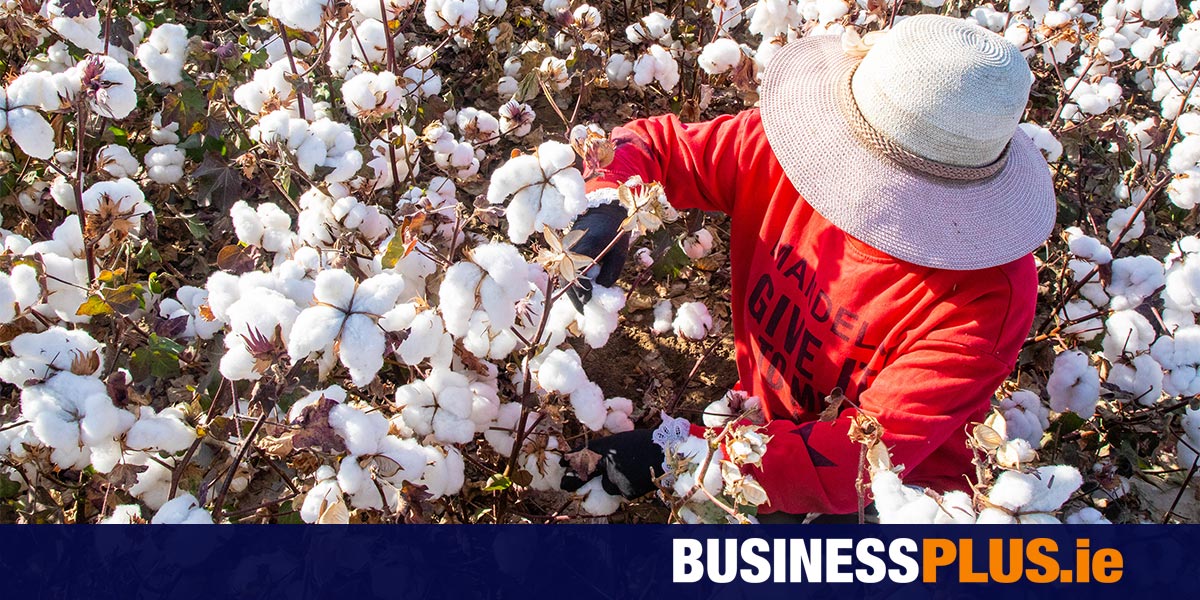
Many of these firms reportedly source cotton from Xinjiang, a region in northwest China where the largely Muslim Uyghur population is the biggest minority group.
A report in 2022 published by the United Nations said the Uyghurs have been subjected to extreme persecution by the Chinese state, including torture, rape and forced sterilisation.
Many international retailers have pledged to stop buying cotton sourced from the region. However, RTÉ revealed that suppliers to many Irish retailers still have links to these areas.
Rubens Carvalho, deputy director at environmental non-profit Earthsight, points out: “The average person who walks into a shop doesn’t wish to be complicit in forced labour and would probably be upset to find out they could be inadvertent accomplices.”
Take the example of Xinjiang. If brands have said they will not buy from the area, why does cotton linked to the region still end up in shops?
A key problem, according to multiple experts, is the certification systems used by retailers. Most of these schemes don’t give significant detail on where cotton is actually sourced from.
For example, a type of certification system used by many retailers is called “mass balance”.
Here, the certification body inspects cotton farms to ensure they operate ethically. However, it allows for the mixing of certified and non-certified cotton.
So a product can be sold with ‘60 per cent certified’ cotton. This means that while 60 per cent of the cotton is from certified farms, the source of the remaining 40 per cent is unknown.
“The problem is that once you attach a sustainability label to goods, it can provide a misleading image,” says Carvalho.
He adds that many consumers won’t pay attention to what percentage of a product is certified. The second major issue is that, even for the cotton which is certified, its traceability is limited.
Traceability refers to knowing where and how a component was sourced, processed and manufactured.
Full traceability would mean a company should know from exactly which farm their cotton was produced.
This means retailers would be able to easily avoid cotton from the Xinjiang region, for example. But traceability is often too broad for this.
Take Better Cotton, which describes itself as the largest cotton sustainability programme in the world. The body is funded by retailers and brands.
It clearly states that cotton which is certified under the Better Cotton Initiative “is not traceable to its country of origin”.
“This doesn’t allow consumers of goods to have visibility over where their goods come from,” says Carvalho.
Better Cotton did not respond to requests for comment from BusinessPlus.ie.
Carvalho says companies should be able to ensure better traceability showing the exact farm where cotton is produced. This would allow brands to know if the product was produced unethically.
“For large companies, it shouldn’t be hard or expensive to do,” he says. “You could use barcodes or QR codes in cotton bales, for example.”
But Dr Len Wassenaar, a leading expert in the type of testing used by cotton retailers, says this could also cause issues. “It is easy to change a label or a barcode,” he says.
“When there are pennies on the pound to be made, there will be fraud in so many areas, not just cotton. That’s why chemical tests are so compelling.”
Some companies have started offering tests which use chemicals as a way to verify the origin of cotton.
Naturally occurring elements in cotton, such as those from the soil, vary by region.
By testing which chemicals are present, companies can check the ‘biological fingerprint’ of the cotton.
This gives a high-accuracy estimate of exactly where it is sourced from. The big problem? These tests cost a lot of money.
“Say if you want to measure cotton in a T-shirt. That cotton will have dye in it,” says Dr Wassenaar.
“So first you need to clean it and isolate the cotton. Then you have to extract the cellulose from that. You’re looking at thousands [of euro] and that’s just to get a sample. You might want to run a trace analysis afterwards… it’s very expensive.”
There are other issues too.
Dr Wassenaar points out that the testing companies often don’t publicly share their work, meaning it can’t be verified by other scientists.
“[Chemical testing] is a powerful tool, but transparency is needed,” he says.
Patricia Carrier, a human rights lawyer with the Coalition to End Forced Labour in the Uyghur region, says attempts to certify cotton late in the supply process create too many issues.
She says it would be better if large retailers and brands insisted on traceability from the very start of the production process.
“No certification is going to be able to guarantee a retailer that their product isn’t tainted by cotton from the region… Only a full mapping of the supply can show if a brand or retailer is linked to a region.”
So why don’t companies do this? Again, most analysts say it is likely a financial issue.
Detailing exactly how cotton is produced and moves through the supply chain before being sold in shops would be fairly complicated and cost brands more money.
But Carrier says this is no excuse. She also points out that EU legislators are pushing for this reform to happen.
Last year, the EU introduced the Forced Labour Regulation.
This bans products made with forced labour from being sold in the bloc.
Regulators can force retailers which break the rules to withdraw their products from the market.
The rules will only come into force in December 2027 and Carrier says there are still question marks over how enforcement will work in practice.
“It is hard to say how impactful a piece of legislation will be,” she says. Nevertheless, she says it’s a significant step in the right direction.
“Voluntary measures will only go so far and won’t motivate the majority of companies to do what they’re supposed to do. The EU Forced Labour Regulation is a great starting point.”
Carrier says retailers should start looking now to “shift their supply chains out of the Uyghur region”, so they’re not caught out once the new rules take effect.
Rubens Carvalho, deputy
director, Earthsight
Nessa Cosgrove, a Labour senator, says the EU’s Forced Labour Regulation is an “important step” in tackling the issue.
However, she also calls on the Irish government to “go further” and pass Labour’s Exploitation and Trafficking Bill.
This would require companies to report annually on the measures they are taking to ensure that forced labour materials aren’t in their products.
“Irish people want to know that when we shop on our own high streets, we’re not contributing to misery and exploitation elsewhere,” she says.
This is also the key point raised by Carrier — that getting rid of forced labour products is something which almost everyone supports.
“Consumers don’t want to buy forced labour goods and brands don’t want to be linked to scandal,” she says.
“So there’s nothing to stop companies from doing the right thing.”