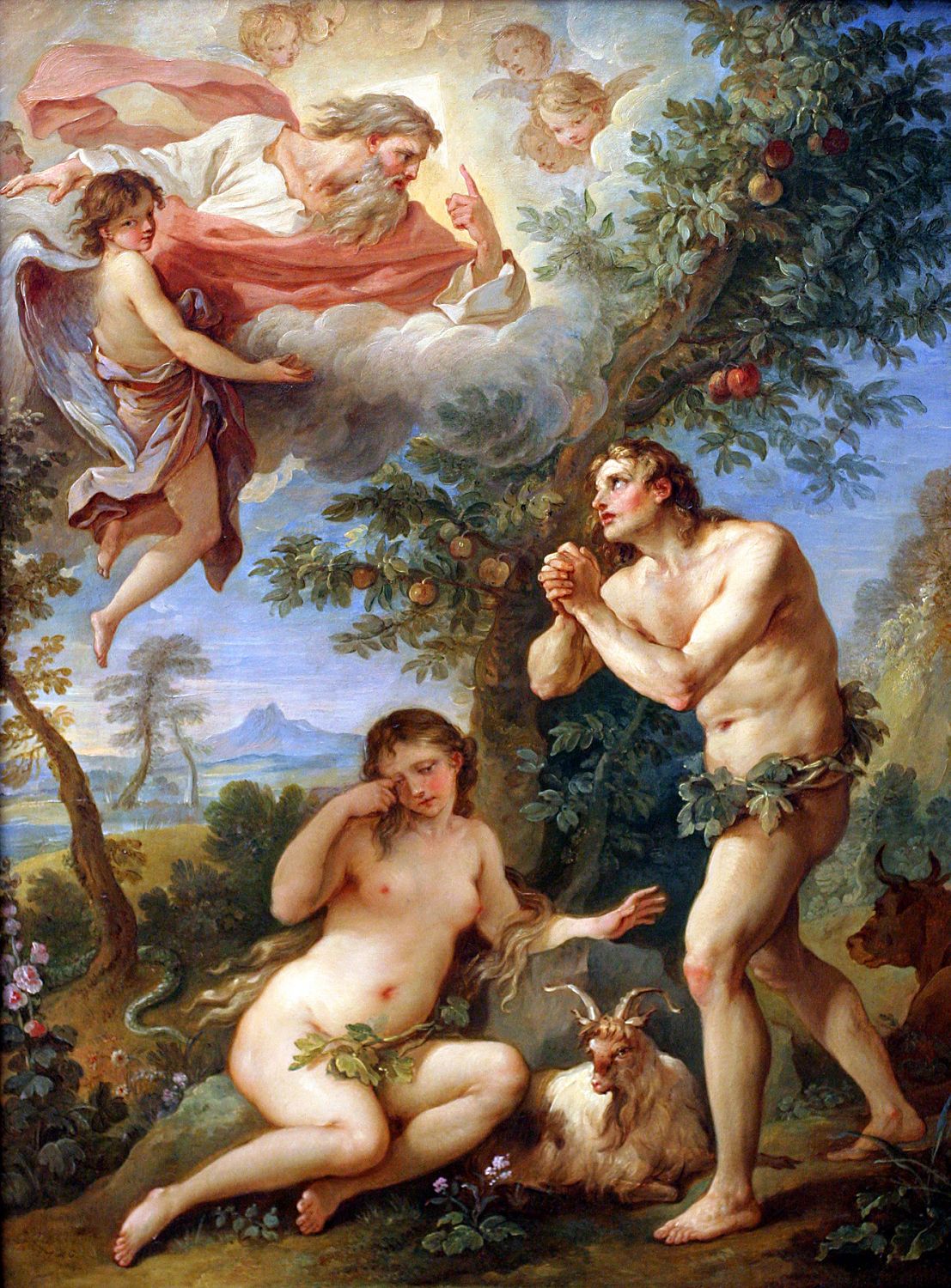
(Philosophy) My interpretation of the Garden of Eden story and Original Sin.
The statements, views and opinions expressed in this column are solely those of the author and do not necessarily represent those of this site. This site does not give financial, investment or medical advice.
I know it’s a geopolitical forum and not a philosophical one, and this subject doesn’t fit well here and I don’t even know if this will be published, but I hope it will. For me, understanding philosophy, the human mind, and higher concepts is very important; in my opinion, it’s not an accident we don’t teach our children philosophy, and I believe that’s a big mistake. We teach children religion, which are stories, without teaching them philosophy, which are the tools with which we can interpret and understand those stories. To quote Arthur Schopenhauer:
Religion is the metaphysics of the masses; by all means let them keep it: let it therefore command external respect, for to discredit it is to take it away. Just as they have popular poetry, and the popular wisdom of proverbs, so they must have popular metaphysics too: for mankind absolutely needs an interpretation of life, and this, again, must be suited to popular comprehension.
Whether you call Religion the “metaphysics of the masses” or the “opium of the people,” for some people with higher perception, there is something beyond dogma. In my view, the pursuit of that “something” constitutes real faith. So while I understand, just like Schopenhauer said, that some people will not understand it, I hope at least a few people will understand the perspective I am sharing here.
I used to write about this stuff and it was well-received and popular, but at some point I decided that through writing about God, meaning, love, morality, or other abstract subjects, I will not fix this world. It will not stop bombs falling on children’s heads, it will not stop suffering, oppression, and exploitation around the world, or the techno-feudal prison that is coming. That’s why I stopped writing such stuff and I started posting here on The Duran about geopolitics, economy, and what I think is really happening because, as Jesus said, “The Truth Will Set You Free.” The only way for me to do something about this horrible world is telling the truth and exposing lies. I know God and religion are controversial topics, but since it is Christmas, I thought I would give you my perspective on how I see it to give you glimpses into my thought process and logic. I could write about it for 100 pages or more, like on any other subject, so I will try to not make it too long.
Garden of Eden
First, to explain this Garden of Eden as I see it, I need to establish something: the difference between animals and humans. I have contemplated and researched this subject for some time. From my contemplation and research, I concluded that since some animals are able to use tools like humans, we can assume that they perceive the world through time and space as explained in the Transcendental Idealism of Kant, as well as understanding the concept of Platonic Ideas.
Because for animals to use sticks or rocks as tools, they need to understand the concept of a tool, since no stick or rock is the same; yet animals can ascribe to them a higher idea—the concept of a “tool” which can be used. Platonic ideas are concepts like, for example, the concept of a chair; while there are different types and shapes of chairs, we can ascribe to them the higher idea or concept of “chair” itself. In the same way, an animal can see many different-looking long sticks or rocks of similar shapes and ascribe to them the higher idea or concept of a tool. In my opinion, to understand the idea of concepts, time and space are also required; therefore, we can ascribe to animals’ perception of the world both the concepts of time and space and the concept of Platonic ideas.
Then the question is: what is the difference between us and animals since we both perceive the world through the same concepts of time, space, and Platonic ideas? The main difference I found through my research is the understanding of our inevitable mortality. I have had arguments about this with people who often bring up cases of elephants and elephant graveyards, or other animals grieving. But both of those examples only prove memory and a reaction to loss or empathy. Also, animals understand their mortality in the sense that they know they can die from hunger or by being attacked. By inevitable mortality, I mean the fact that no matter what happens, they will have to die—that their existence has an expiration date.
From all my research, there is no evidence animals know that, no matter what happens, they will have to die; that even if they eat well and avoid danger, in the end, they will have to die from old age. While animals see their parents die and all other things around them die, they do not take the logical conclusion that they will also have to die. Now, in my opinion, humans are the first animals that understood this fact: that our existence has an expiration date and that no matter what will happen, at some point we will have to die.
That knowledge of our inevitable death is what in my opinion the Garden of Eden is talking about, and that knowledge is the proverbial “fruit of knowledge” it speaks about. When the first humans understood their inevitable death, the question arrived: “Why?”, “Why do I have to die?”, “What is the meaning of all of this?”. This is the mother of all questions, a question we still try to answer and a question we so far were not able to fully answer.
Now, this question of “Why?”—this question of meaning—created something in us: an existential dread, an existential pain which in my opinion represents the proverbial “original sin.” Since animals don’t know about their inevitable mortality, they do not possess the same existential dread or pain; they live in the “now,” in a present where they are convinced they will live forever and that their existence is eternal instead of finite. In this sense, animals still live in the Garden of Eden created by God; they live in the present since they don’t know there is an end, unburdened by the “original sin” of knowing about their inevitable death and the finitude of their existence.
God
Now, when we left God’s Garden of Eden, we were burdened by this “original sin” of knowing about our inevitable death, which creates existential dread. We could only get rid of this existential dread by answering the mother of all questions: “Why?”, “Why do I have to die?”, “What is the meaning of all of this?”—questions which we are not able to fully answer even to this day.
To answer this unanswerable question, we created God the Creator. Since there is a God who created us, He must have had some purpose for creating us, which would represent the meaning of our existence. While we are not able to answer the question ourselves, if there is a Creator, He must have created us for some reason, and that purpose presents the meaning of our existence. In this way, God the Creator and His will became the answer for our unanswerable question. By investing in this idea, this cured us from our “original sin” of knowing about our inevitable death and the finitude of our existence. In this way, God is curing us from our original sin, which is in my opinion the meaning behind the allegory of the Garden of Eden.
So, in my opinion, the story of the Garden of Eden is a philosophical allegory of how we became humans and how we separated ourselves from all other animals, which are still living in the proverbial Garden of Eden representing the “now.” I hope some of you grasp the logic behind my analysis.
In our society, we are discouraged from thinking about our mortality and the meaning of life. Even if we end up thinking about it anyway, we are presented with Religion and the Bible, which are supposed to represent simple, ready answers. You are not supposed to contemplate those things deeply, but simply accept religion as: “metaphysics of the masses.” like Schopenhauer called it. Because questioning meaning can bring you to existential dread and pain, and only through deep contemplation of those subjects can we find our true answer and cure ourselves. It is easier to accept the religion and Bible as “opium of the people,” numbing our existential dread.
In our society, we are discouraged from contemplating such subjects deeply because people who do not do it are like children who are easily controllable. If you really end up thinking about this subject, you may end up understanding what Józef Piłsudski once said: “In life, there are things more important than life itself.” If you understand this truth, then “The Truth Will Set You Free.” Because as long as you think the meaning of life is merely enjoying life, if I control your ability to enjoy your life, I control you. Meanwhile, if you understand that life is about something more than enjoying life itself, you become uncontrollable; you become free. That’s something people holding power are afraid of. That’s why most of our population never thinks about life, death, and mortality; they are convinced that the meaning of life is the enjoyment of life itself.
I will end it here. I could write about the concept of slave morality which Nietzsche described and how the Roman Empire created Christianity against the teaching of Jesus to turn Jesus’ concept of the afterlife into a so-called “slave morality” used to pacify the population. BTW, I don’t fully agree with Nietzsche or Schopenhauer and I don’t want you to agree with my views. I am not a preacher. I will not guide you to God; I will not provide you with answers. You need to find your own God yourself! The only thing I want from you is to contemplate and think about it instead of choosing a false, easy way in the form of blindly accepting religion and scripture as the word of God instead think about the philosophical meaning of scripture.
To quote Nietzsche and Frankl:
No one can build you the bridge on which you, and only you, must cross the river of life. There may be countless trails and bridges and demigods who would gladly carry you across; but only at the price of pawning and forgoing yourself. There is one path in the world that none can walk but you. Where does it lead? Don’t ask, walk! ― Friedrich Nietzsche, Schopenhauer as Educator
Ultimately, man should not ask what the meaning of his life is, but rather must recognize that it is he who is asked. In a word, each man is questioned by life; and he can only answer to life by answering for his own life; to life he can only respond by being responsible. ― Viktor E. Frankl, Man’s Search for Meaning
Thanks to everyone who stuck with me until the end of my post. And, as always…
“Knowledge will make you be free.”/“The Truth Will Set You Free”
― Socrates/Jesus
+
“Knowledge/(The Truth) isn’t free. You have to pay attention.”
― Richard P. Feynman
=
“Freedom is not free, you need to pay attention.”
― Grzegorz Ochman
“Religion is the masterpiece of the art of animal training, for it trains people as to how they shall think. ”
― Arthur Schopenhauer
“The death of dogma is the birth of morality.”
― Immanuel Kant
“Dare to think!”
― Immanuel Kant, What is Enlightenment?
The statements, views and opinions expressed in this column are solely those of the author and do not necessarily represent those of this site. This site does not give financial, investment or medical advice.