The Analog Gödel: Geometry, Information, and the Stability of Life We tend to view stability as a physical battle—forces...
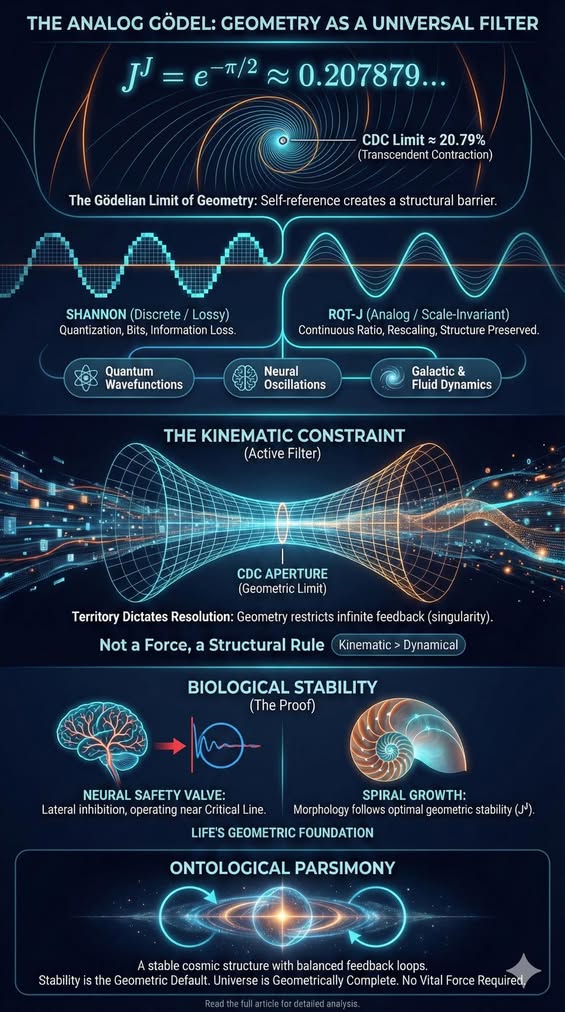
The Analog Gödel: Geometry, Information, and the Stability of Life We tend to view stability as a physical battle—forces fighting forces to keep a system in check. But there is a deeper, structural reason why the universe does not dissolve into chaos. I suspect Spacetime itself acts as a universal geometric informational filter This filter is not digital. It suffers no quantization or pixelation at small scales. It is purely analog, continuous, and rooted in the geometry of self-reference. The Gödelian Limit of Geometry In logic, Kurt Gödel showed that self-reference creates intrinsic limits. When a system attempts to fully describe itself, it encounters an unavoidable boundary. Within the RQT-J framework, the same principle applies to physical geometry. When an orthogonal operator J acts upon itself (J^J), it does not generate unbounded rotation or amplification. Instead, it produces a strict, transcendental contraction: J^J = e^(-π/2) ≈ 0.207879... This number is irrational and transcendental. It is the “Critical Damping Constant” (CDC). It plays a role analogous to a Gödel number—not as a code or numerological artifact, but as a structural limit imposed by geometric self-reference itself. Any system attempting perfect self-reference through feedback is geometrically required to contract to approximately 20.79% of its amplitude. Beyond Shannon: The Continuous Filter Standard information theory (Shannon) is fundamentally discrete. It relies on bits, symbols, and quantization. Compression in such systems inevitably introduces loss. The RQT-J framework is different. It is analog and scale-invariant. See… https://www.facebook.com/share/p/17kxdSuBrL/?mibextid=wwXIfr And… https://www.facebook.com/share/p/17tgaWPtdE/?mibextid=wwXIfr Because e^(-π/2) is a continuous geometric ratio, this damping governs self-referential feedback structurally across scales, including: 1. Quantum wavefunctions 2. Neural oscillations 3. Galactic and fluid spiral dynamics There is no underlying grid where the physics breaks down. Spacetime does not delete information like a lossy codec; it rescales it. The structure of the system is preserved, while energetic or informational excess is smoothly constrained. The Kinematic Constraint Spacetime is therefore not a passive void. It functions as an active geometric filter. The territory (geometric space) determines the resolution of the map (physical information). If a system attempts infinite feedback—such as runaway amplification or singular behavior—the geometry of space restricts it. The bandwidth of orthogonal self-reference is strictly limited by the CDC. This constraint is kinematic rather than dynamical: it arises from geometry itself, not from contingent forces, fields, or observers. Biological Stability: Why Life Doesn't Crash This geometric constraint explains why biological systems—the ultimate feedback loops—are remarkably robust. From the firing of a neuron to the beating of a heart, life relies on recursive cycles that should, by all accounts, be fragile. The answer lies in the Geometry of Stability. Biology does not need to "invent" a way to stop runaway feedback; it simply builds upon the intrinsic damping of orthogonal space. The CDC acts as a geometric bound on self-referential feedback, not a system-specific parameter. 1. The Neural Safety Valve In neural networks, lateral inhibition prevents over-excitation. The system naturally adheres to a damping ratio that prevents the "signal storm" of a seizure. The geometry of the network constrains feedback away from runaway amplification, consistent with the CDC limit. The brain operates near the "Critical Line" defined by J^J. 2. Spiral Growth and Morphology Natural spirals (nautilus shells, cochlea, phyllotaxis) are physical traces of orthogonal self-reference. As an organism grows by referencing its previous state, it follows the curve of optimal geometric stability—a logarithmic spiral defined by the contraction of J^J. This is not a claim of exact numerical identity, but of a shared geometric constraint arising from recursive growth in orthogonal space. Ontological Parsimony Historically, the stability of life was attributed to a "vital force" or mysterious complexity. Our framework offers a parsimonious alternative: Life is stable because it grows and functions within a stable geometry., ie., Stability follows directly from geometry’s inability to support undamped self-reference. The universe is stable because it is geometrically complete. ——— Copy only with attribution is requested