The power of swearing: Shouting expletives aloud makes you physically STRONGER by boosting your focus and disinhibition, study finds
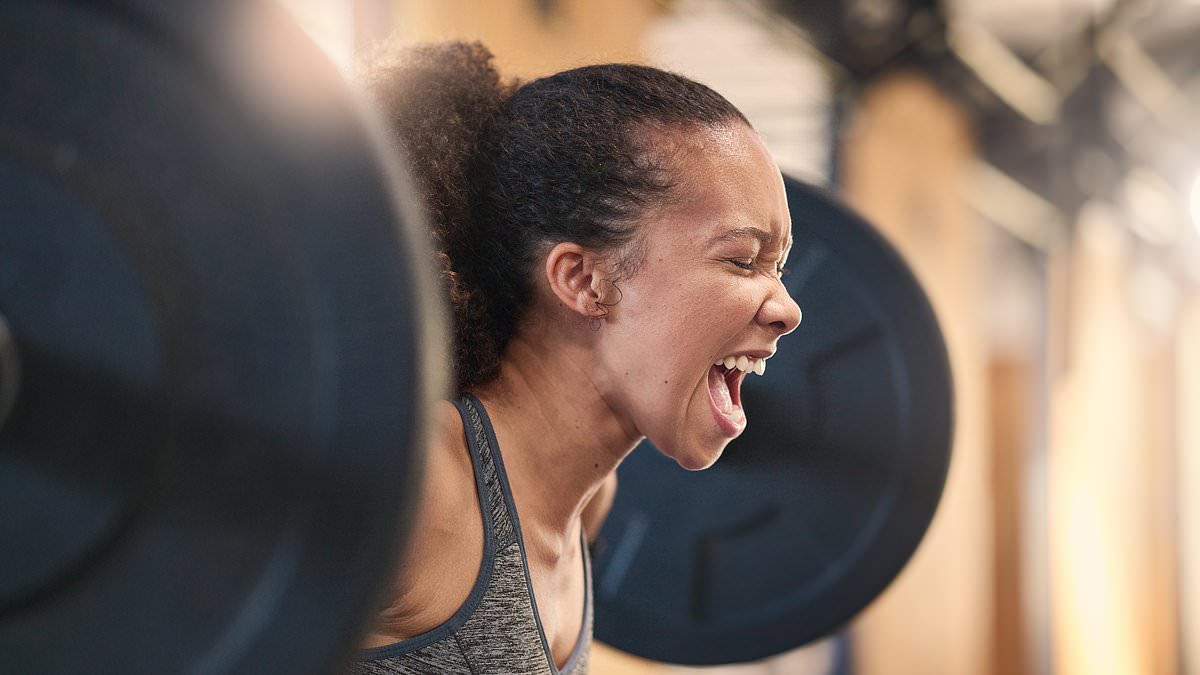
If you've ever felt like swearing during a workout, there's now a science–backed excuse for it.Researchers have discovered that shouting expletives boosts physical performance and makes people push themselves harder.This is because it helps people overcome their inhibitions by boosting their focus, they found.And it could explain why cursing aloud is so popular – especially in situations that involve endurance.'These findings help explain why swearing is so commonplace,' Dr Richard Stephens, from Keele University, said.'Swearing is literally a calorie neutral, drug free, low cost, readily available tool at our disposal for when we need a boost in performance.'Previous research has found that when people swear they perform better on physical challenges such as holding their hand in ice water.The new findings explain the mechanism behind it – and why it makes you 'go for it' a little bit more. Researchers have discovered that shouting expletives boosts physical performance and makes people push themselves harderFor the study, published in the journal American Psychologist, the team conducted two experiments involving 192 people.In each, they asked participants to repeat either a swear word of their choice, or a neutral word, every two seconds while doing a chair push–up.Following the challenge, they answered questions about their mental state during the task. These included references to how much positive emotion they felt, how distracted they were and how self–confident they felt.The questions also included a measure of psychological 'flow' – a state in which people become immersed in an activity in a pleasant, focused way.Analysis revealed that participants who swore during the chair push–up task were able to support their body weight significantly longer than those who repeated a neutral word.They found that this difference could be explained by increases in participants' reports of psychological flow, distraction and self–confidence.'In many situations, people hold themselves back – consciously or unconsciously – from using their full strength,' Dr Stephens said.'By swearing, we throw off social constraint and allow ourselves to push harder in different situations. Participants were asked to repeat either a swear word of their choice, or a neutral word, every two seconds while doing a chair push–up A previous study showed that out of 20 global countries, Brits are the second–most prolific swearers in the world, behind only the United States but ahead of Australia The origin of the f–word It may seem like a very modern expression, but the f–word was recorded in a dictionary in 1598 (John Florio's A Worlde of Wordes). It is remotely derived from the Latin futuere and Old German ficken/f***en meaning 'to strike or penetrate', which had the slang meaning to copulate.The word became rarer in print in the 18th century when it came to be regarded as vulgar. Source: Dictionary.com 'Swearing is an easily available way to help yourself feel focused, confident and less distracted, and "go for it" a little more.'He explained these effects could have valuable applications in sport, rehabilitation and any situation that calls for courage or assertiveness.'In this way, swearing could serve as an accessible way to unlock our full potential when peak performance is needed,' he added.Nick Washmuth, a PhD student at The University of Alabama in Huntsville, who contributed to the study, said: 'Our next step is testing whether this boost from swearing works in any context where success requires overcoming hesitancy.'Our labs are now studying how swearing influences public speaking and romantic approach behaviours, two situations where people tend to hesitate or second–guess themselves.'The research reads: 'This study shows that swearing can improve physical performance, and it works by helping people feel focused, confident and less distracted.'These data support the contention that swearing functions as a simple, cheap, widely accessible technique for rapidly counteracting tendencies to hold back.'Repeating a swear word at key moments, particularly when individuals feel challenged or outside their comfort zone, may serve as a strategic tool.'
A recent study found that while Brits may have a love for swearing, when it comes to our rivals we're far less prolific and creative.Researchers at the University of Eastern Finland analysed a whopping database of nearly eight billion words posted on social media.They found Americans use the f–word more frequently than Australians or Brits, but Australians are more creative in its use.Aussies tend to use more inventive variants such as f***ing, f****d, f****r, f***face', 'mother******', 'fark' and the Irish–derived 'feck'.In contrast, Brits and Americans are more likely to use the bog–standard classic – 'f***'. This is the ultimate curse word: Mathematician creates entirely new offensive term using computer algorithm A mathematician has created a curse word based on a list of 186 offensive terms – and she said it is 'the world's ultimate swear word'. Sophie Maclean, a student at Kings College London, fed a list of popular 'bad words' to a computer model to generate a new one.It found the supreme swear word begins with the letter 'b,' has four letters and ends in '–er.' And although the word is already used in English in another context, it could offer a satisfying new alternative to 'f***' and 's***'. According to Maclean, swearing does have some good uses; it can help to reduce pain if you stub your toe.