You won’t see a weirder rocket launch than this Falcon 9 flying in fog
SpaceX livestreams every single one of its rocket launches, most of them involving its workhorse Falcon 9 vehicle.
The vast majority of the Falcon 9 launches take place from Florida’s Space Coast, but the company also uses Vandenberg Space Force Base in California for occasional missions.
Its latest launch from the West Coast took place on Saturday, with a Falcon 9 deploying 27 Starlink internet satellites to low-Earth orbit.
It was the ninth flight for this particular first-stage booster, which previously launched SDA T1TL-B, SDA T1TL-C, and now seven Starlink missions.
Following stage separation, the rocket’s first stage landed on the Of Course I Still Love You droneship stationed in the Pacific Ocean, paving the way for more flights using the same booster.
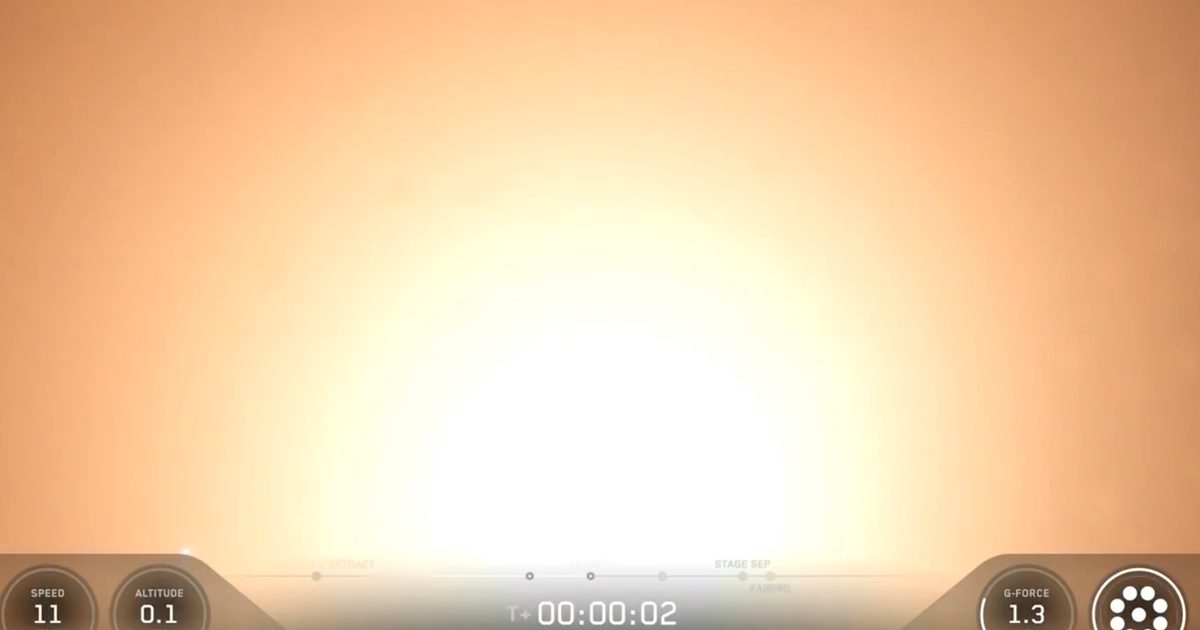
What made Saturday’s launch unusual was that it took place in thick fog. It meant that you couldn’t even see the rocket as its engines ignited and it left the launchpad. Instead, the low cloud surrounding the launch site glowed orange as the rocket headed skyward. The camera view on SpaceX’s livestream then cut to a booster’s-eye view and showed the rocket rapidly clearing the low cloud as it roared its way to orbit.
SpaceX has launched the Starlink Group 15-12 mission, aboard the Falcon 9 B1093-9 from a foggy SLC-4E at the Vandenberg Space Force Base (VSFB), in California, sending 28 Starlink v2 Mini satellites, into Low Earth Orbit.@NASASpaceflight Overview: https://t.co/LaCHUiyioW pic.twitter.com/gD9hmY9oQf— Elisar Priel (@ENNEPS) December 14, 2025
Some types of cloud, such as thick cumulus or anvil formations, can force mission controllers to postpone a launch due to the risk of natural lightning strikes as the rocket leaves the launchpad. Carefully designed launch rules also prevent rockets from passing through clouds reaching freezing temperatures, or those producing precipitation, as friction from the rocket could trigger an electrical discharge or damage onboard electronics.
Fog, on the other hand, presents fewer challenges, enabling mission controllers to proceed with a launch. Fog consists of low-lying, shallow stratus clouds that are usually warm and well below freezing altitudes, so it lacks the electrical buildup that you get with higher clouds.
It means that rockets can safely proceed through surface fog, though mission controllers will have to rely more on radar and instrumentation than visual observation for the initial part of the flight.