These U.S. States Still Require A Front License Plate
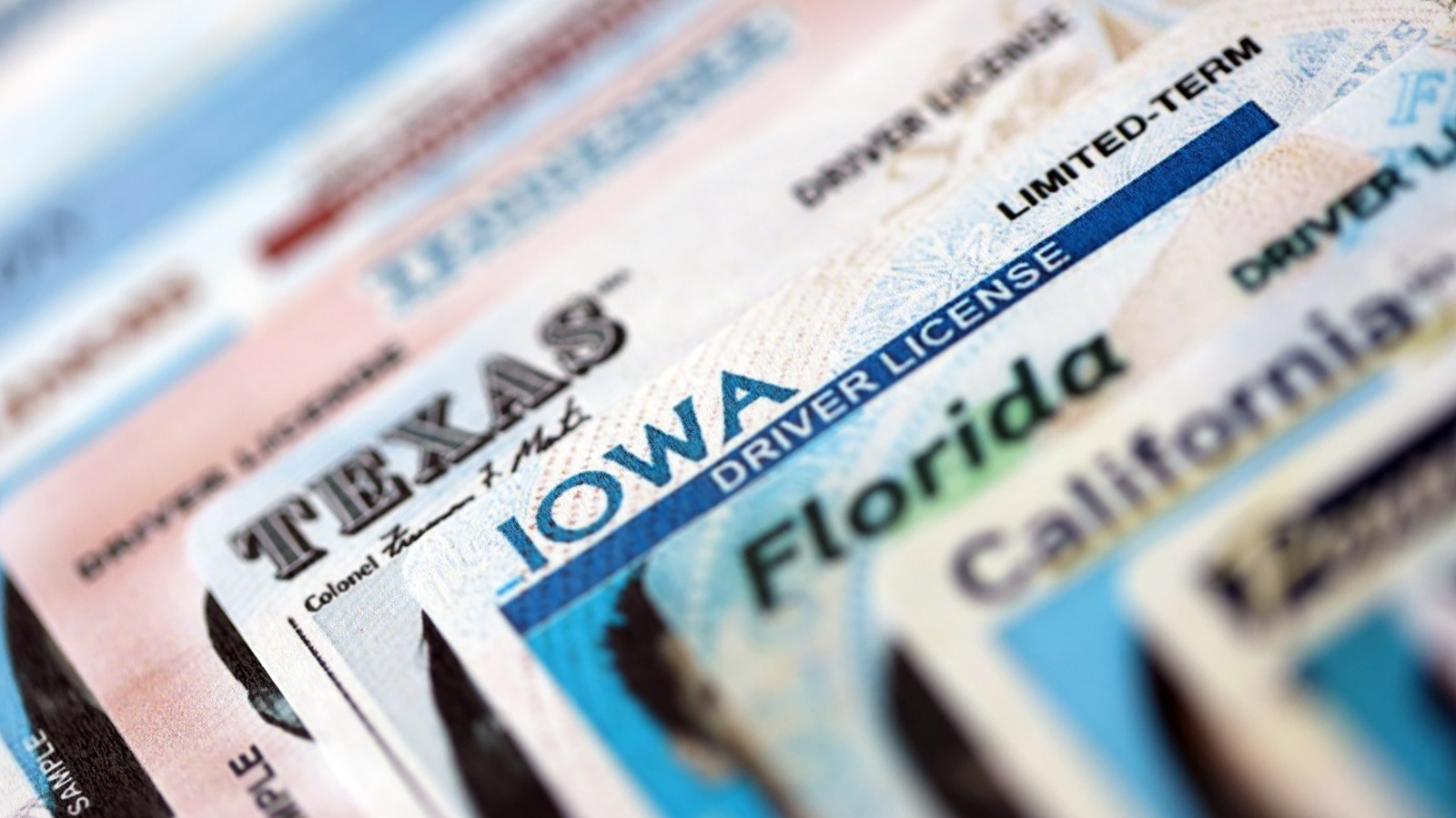
If you pay close attention to cars on U.S. roads, you'll see that some sport license plates on both the front and the rear, while others only wear them at the back. The reasons some states don't require front license plates are cost, metal conservation, aesthetics, environmental impact, and even Advanced Driver Assistance Systems. However, most states still mandate that vehicles display plates on both front and back.
According to a 2025 report by LegalClarity — a legal‑analysis website that tracks U.S. state vehicle laws — 28 states still mandate that most passenger vehicles display both front and rear license plates, including large states such as California, Washington, Virginia, Massachusetts, Texas, New York, and Illinois. The main reasons for having a front license plate come down to identification and law enforcement. Front license plates are also used by automated toll booths and traffic cameras to generate revenue.
There are exceptions to these rules, though. Certain historic cars and cars that weren't manufactured to wear front plates may be exempt. Regardless, if you want to drive your car without the front plate, make sure to check your state's laws, as the police might be lurking around the corner.
The logic behind two-plate states
Besides the states mentioned above, others that also require front and rear plates include Colorado, Connecticut, Hawaii, Iowa, Idaho, Maine, Maryland, Minnesota, Missouri, Montana, Nebraska, Nevada, New Hampshire, New Jersey, North Dakota, Oregon, Rhode Island, South Dakota, Vermont, Wisconsin, and Wyoming. Granted, some states have their own rules on top of these. For example, Idaho no longer requires a front plate if you don't have a bracket. Therefore, it's always best to check exemptions and special rules for your own state.
Having both the front and rear plates improves public safety by letting the authorities identify hit-and-run perpetrators more easily. It's also much easier to record a traffic violation and tie it with a specific driver. Having front plates also makes traffic control systems and automated toll booths more efficient, since these systems primarily capture a vehicle's front. Front plates also let law enforcement identify wanted or stolen vehicles and repeat offenders more easily. Lastly, if one were to lose a rear plate on a vehicle that does not need a front plate, the vehicle becomes practically unidentifiable, which can complicate all of the above.
Driving with no front plate in a two-plate state
If you live in a state where both plates are required, but you decide to go front-plate free, there are a few things you should keep in mind. Not every state is going to treat this the same. For example, in California, not having the front plate mounted is treated as an infraction. In practical terms, this means that it usually leads to a fix-it warning, sometimes followed by a fine, but no criminal record.
In other states, such as Texas, not having a front license plate is treated as a Class C misdemeanor that can technically result in a criminal record. However, the court can dismiss the charge if the defendant fixes the issue before appearing in court and pays a $10 reimbursement fee. After all, not having a license plate can have serious consequences, so much so that a lost license plate once even ended a huge car theft ring.
If your state doesn't require front plates, you can legally drive through a two-plate state, because plate rules depend on where the car is registered. But that doesn't mean you definitely won't get pulled over. In Heien v. North Carolina, the Supreme Court ruled in 2014 that police can stop drivers if the officers "reasonably misunderstand" the law.
If you relocate permanently, though, you must transfer your registration. Deadlines for this differ across states. For instance, in Utah, you have 60 days to do so, while in New York, it's 30 days after moving in.