Six Months Later, the Switch 2 Proves It Has Staying Power
It’s been six months since the Nintendo Switch 2 finally stepped out into the light of day. The inevitable tragedy of any new product is that the novelty quickly dissipates. Despite having it in hand for half a year, fans, detractors, and even Nintendo itself seem to be underestimating just how this iterative handheld/console hybrid device may hold the secret to even better handhelds of tomorrow.
Nintendo would rather you focus on its first-party games. At the same time, the PC crowd is still too obsessed with getting their hands on the latest and greatest chips to recognize the benefit of handheld-specific game optimization. The result is only ever a small bump in frame rate that won’t truly impact the overall quality of titles. Even when the Switch 2’s on-paper specs don’t seem to hit the mark as handhelds that cost $200, $550, or $900 more, its console-based hardware has managed to keep pace in 2025. Time will tell whether it will stay that way into 2026 and beyond.
The Switch 2 is a model for how the old ways of making consoles may still win in the long run. The 5-year-old Xbox Series S and Series X, as well as the PlayStation 5, are PCs in everything but name. They’re both working on AMD APUs, or accelerated processing units, that make porting games between consoles and PCs relatively easy. The Switch 2 is the outlier. It’s using an Nvidia-made chip that is based on an entirely distinct ARM-based microarchitecture. Public statements from numerous developers show porting games to Switch 2 isn’t straightforward. Still, because of Nvidia’s hardware-specific DLSS (deep learning super sampling) upscaling, games on Nintendo’s handheld are just as playable.
The Switch 2 isn’t a replacement for a PC. It’s a device that also hides its share of hidden costs. I had to buy an extra 256GB microSD Express card for the sake of downloading all these games I’ve played throughout the year. And to that end, Nintendo seems to be emphasizing digital media with the proliferation of game key cards—rather than the collectible physical media you can actually claim to own. Nintendo also brought us the first $80 game, and it’s still trying to force consumers to accept a new pricing standard for a hobby that’s getting ever more expensive.
The Switch 2 may not stay $450 for long, either. Because of the RAM shortage, consoles and PCs alike will probably cost more in 2026. The best advice I can offer is that you should get the console you want now and enjoy it while it lasts.
Switch 2 manages to hold its own
‘Cyberpunk 2077’ runs smoothly on Switch 2. © Raymond Wong / Gizmodo
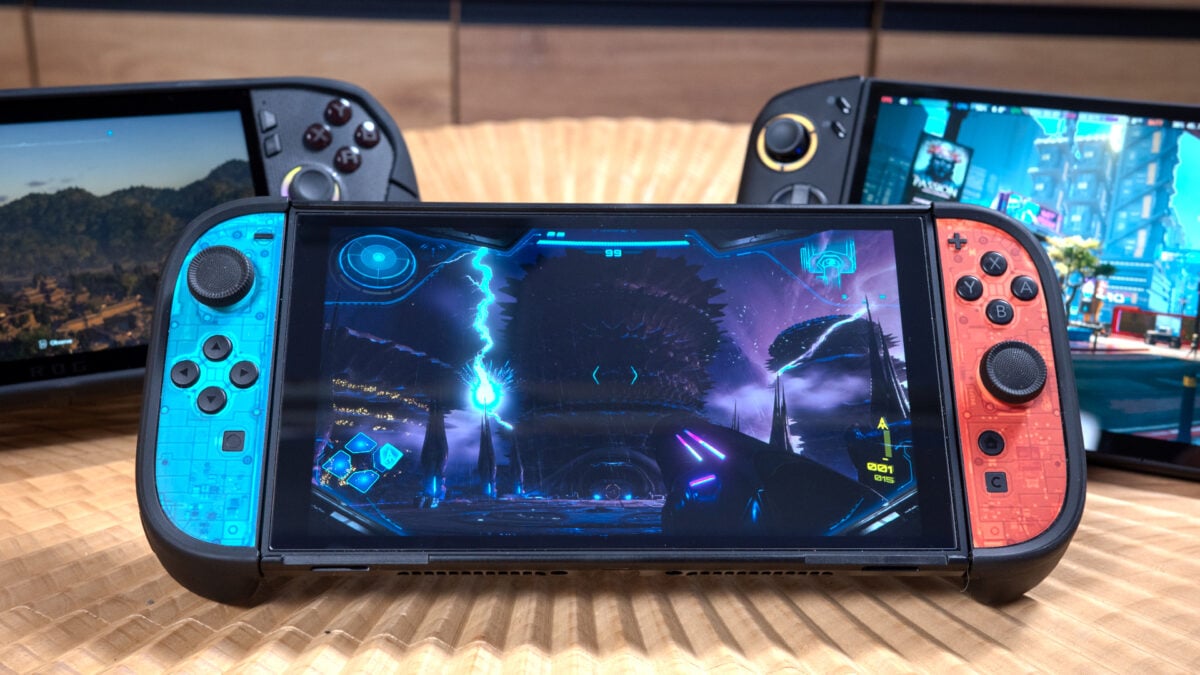
The original Switch was a secondary console for many players; only there to play Nintendo’s first-party titles not available elsewhere. The Switch 2 has the potential to be a primary device, especially for those who live a mobile gaming lifestyle. With its lower power draw, limited memory, slim design, and minimal battery, it can’t offer the same fidelity as more expensive machines. The thing is, you need to compare it to other available handhelds. In that regard, the Switch 2 makes games look just as good for a fraction of the cost.
With all the 2025 handhelds at hand, I made an effort to compare performance between all available systems, in official and non-official configurations. This year, I tested the $650 Legion Go S with SteamOS, the $1,350 Legion Go 2, and—finally—the $1,000 Asus ROG Xbox Ally X. These are all handheld PCs. They are all running various operating systems, though they’re all powered by AMD chips built for this form factor. Some sport better screens, like the Legion Go 2’s beautiful OLED display, and they feature more console-like controls than the Switch 2. I tested each handheld at its maximum resolution, but PC gamers have the choice to reduce graphical quality for the sake of performance; the Switch has far fewer options.
Legion Go S Steam Deck settings gameplay © CD Projekt Red / Screenshot by Gizmodo
Switch 2 gameplay © CD Projekt Red / Screenshot by Gizmodo
I dual-booted the Legion Go 2 with Bazzite as well as Windows 11. Bazzite is a Linux-based operating system similar to SteamOS. The Asus ROG Xbox Ally X is running Windows, but with the full screen experience, a version of the OS that lets you navigate to your games with a controller. The new UI is still buggy. However, Microsoft has made strides with preset game profiles so that you don’t have to finagle graphics or mess with TDP (thermal design power). Both Linux-based handhelds offer better performance on the same specs compared to Windows 11, even to this day.
Compared to those handheld PCs, the Switch 2 runs on much more limited hardware. It uses an Nvidia Tegra T239, which is an octa-core ARM-based CPU alongside an Ampere GPU. Ampere microarchitecture goes back all the way to 2020. All these other handhelds are running on AMD’s more recent RDNA 3.5 microarchitecture. They all feature more RAM (the Switch 2 has 12GB, but only 9GB is used for games) and higher TDP (the Switch 2 is limited to 13W compared to 30W, 35W, or even 40W on these other systems).
Despite all that, the situation with games is a whole different story. I tested three titles that have come to Switch 2 since launch: Cyberpunk 2077, Star Wars Outlaws, and Assassin’s Creed: Shadows. Nintendo worked with the developers of all three games to make their titles work well on Switch 2, and it shows when you actually play each title.
Legion Go S Steam Deck settings gameplay. © CD Projekt Red / Screenshot by Gizmodo
Switch 2 gameplay. © CD Projekt Red / Screenshot by Gizmodo
In Cyberpunk 2077, a Legion Go S with SteamOS (which notably offers better performance than the version with Windows 11) clocks in at about 35 to 40 fps in regular gameplay running at the max 33W TDP. An Asus ROG Xbox Ally X manages between 39 and 45 fps, with frame rates only dipping to around 37 fps. That’s all with Steam Deck settings at each handheld’s max wattage and not plugged in. The handheld PCs all had AMD’s FidelityFX Super Resolution for upscaling, enhancing performance at the cost of some instances of visual fidelity.
A Switch 2, at less than half the total TDP of a Legion Go S, runs at just below 30 fps in the “Quality” graphics mode. In “performance” settings, Cyberpunk 2077 targets 40 fps. Comparing the Switch 2 in handheld mode to the other devices, Nintendo’s device is able to hold its own. Geometry remains detailed, though it comes at the cost of density with NPCs or street traffic. I did an entire playthrough on Nintendo’s system, and the only time I found there to be consistent frame rate problems or any bugs was during sections found in the Phantom Liberty DLC.
Cyberpunk 2077 developer CD Projekt Red removed minor or insignificant environmental details to improve overall performance. Nintendo’s handheld relies on Nvidia’s DLSS. That means, in both handheld and docked modes, the Switch 2 is hitting 1080p from an original much lower resolution. Performance mode targets 720p in handheld mode, and even that is upscaled. The only time in my tests where I found a true difference in performance was with a Legion Go 2. With that handheld (32GB of RAM and Ryzen Z2 Extreme chip version) running at 33W TDP, it could equal 50 fps at Steam Deck settings at 1200p. That creates a much smoother experience than these other handhelds could hope to achieve. Yes, 40 versus 30 fps is a better experience, but when you consider the amount of money you need to spend to hit those extra frame rates, the Xbox Ally X’s performance seems paltry. The only other handheld that can almost match the Switch 2’s price, the Steam Deck (non-OLED), can maintain 30 fps relatively consistently.
Ubisoft’s games were rebuilt with Switch 2 in mind
Star Wars Outlaws runs so surprisingly well on Switch 2, it makes you wonder what other ports are possible. © Raymond Wong / Gizmodo
The performance situation gets more interesting with two Ubisoft titles. The publisher tapped its developers and even brought on extra help—specifically Ubisoft Red Lynx on Star Wars Outlaws—to design Switch 2-specific ports for each game. Outlaws, which makes use of the Snowdrop engine, is an especially great port on Switch 2. It runs at a tight clip the entire way through and still supports great environmental lighting effects.
Legion Go 2 low settings gameplay. © Ubisoft; screenshot by Gizmodo
Switch 2 gameplay. © Ubisoft; screenshot by Gizmodo
Assassin’s Creed: Shadows, the more recent title, runs on the Anvil engine. On higher-end PCs, it will feature some epic environmental quirks and ray-traced lighting that won’t be present on any handheld you choose. Not if you want playable framerates. On the Xbox Ally at 1080p resolution, it will squeak a frame rate above 30 fps on low settings and sometimes dip below that. On the Bazzite-installed Legion Go 2, you won’t see much difference at 1200p. On a Switch 2, you’ll normally experience frame rates at or just below 30 fps, sometimes dipping lower.
Ubisoft’s developers wrote that bringing Shadows to Switch 2 was an “ambitious technical undertaking”—and it shows. The game lacks certain environmental effects, like splashes when running through water. The Switch 2 version still uses the same cloud and cloth physics as it does when on more powerful systems, but they’re scaled back. Assassin’s Creed: Shadows features Steam Deck-specific settings for handhelds. This comes up even when running Bazzite, and it offers a stable 30 fps, though it also limits your ability to change graphics settings unless you change the game’s .ini file. Overall, you can get a slightly better experience on the more expensive handhelds, but it’s not so different that I’d argue it’s worth spending $200 or more to get the PC version.
Switch 2 gampelay. © Ubisoft / Screenshot by Gizmodo
ROG Xbox Ally X low settings gameplay. © Ubisoft / Screenshot by Gizmodo
Developers don’t have a choice. Games need to be fine-tuned for the Switch 2. Back in September, Gearbox delayed Borderlands 4 for Switch 2 for “additional development and polish.” FromSoftware similarly pushed back its port of Elden Ring Tarnished Edition on Nintendo’s system after numerous hands-on reports cited performance issues.
Games without proper optimization won’t work well on any handheld, period. The next task is then to incentivize developers to make their games for this form factor. This is where Nintendo needed its first-party games to showcase the best of what the Switch 2 has to offer. The company mostly succeeded in 2025, but it still needs to take things further.
The first party game situation
Donkey Kong Bananza was the first must-play game of the Switch 2’s life cycle. © Adriano Contreras / Gizmodo
Nintendo has to ensure its first-party titles show developers and gamers alike what the handheld is capable of. Mario Kart World may be a great party game to pack in with the Switch 2, but it’s not the kind of game to emphasize what makes the system unique. The following months post-launch have been a mixed bag of meh, solid, good, and absolutely fantastic titles. Donkey Kong Bananza is like a Christmas tree, festooned with breakable joy. Bananza looks fantastic and plays well, save for occasional slowdowns when there’s too much destruction on-screen.
Pokémon Legends: Z-A tried to completely reinvent the franchise’s formula with real-time battles. At the same time, the game’s flat environments and streets devoid of any sense of activity, from humans and pocket monsters alike, make it feel like it was built for an older device. On the flip side, Kirby Air Riders is a manic blast of energy that has the capability to exhaust or enthrall a player, depending on their temperament.
Metroid Prime 4: Beyond runs at 60 fps at 4K, but it’s the art direction that sells the environments more than textures or pixel count. © Nintendo; screenshot by Gizmodo
Nintendo spent much of 2025 trying to emphasize Switch 2 upgrades for original Switch titles like Kirby and the Forgotten Land + Star Crossed World and The Legend of Zelda: Breath of the Wild/Tears of the Kingdom. While these games may have emphasized the Switch 2’s performance over the original Switch, we had to wait for Metroid Prime 4: Beyond to display what’s truly unique about Switch 2.
The game is far from perfect. It’s brought down by NPCs who are too keen to chirp in and ruin exploration and immersion. It’s not the best flavor of Metroid Prime on offer (that designation still belongs to Metroid Prime: Remastered). However, it’s the only game in the 2025 lineup that makes use of the Joy-Con 2 and the comforts of both gyro and mouse controls rolled into one. Metroid Prime 4 lets you seamlessly go from stick-based aiming to precise mouse aiming just by putting the controller on your lap or couch.
Of all the games I tested this year, only Metroid Prime 4 can claim to have made use of the Switch 2’s best features. It can hit a true 4K resolution and run at 60 fps when docked and connected to a TV. Its performance mode outputs at 1080p and can hit the fabled 120 fps.
Only Nintendo does Nintendo
© Adriano Contreras / Gizmodo
More than eight years after Nintendo first launched the original Switch, nobody has copied its design. No other company has a handheld as easily dockable, easily sharable, and easy to plug in and play as the Switch 2. That ease has its hefty drawbacks. There’s every reason to want a handheld PC simply for the customizability of using SteamOS or Windows 11. Plus, these handhelds have access to a wider variety of games thanks to their large PC libraries.
Nintendo’s Switch 2 proves how good handhelds could be if they had the proper support of both the maker and third-party developers. It’s also a showcase of how hardware-specific upscaling can make a massive difference in how well games perform. There are multiple leaks to suggest Sony is working on a PlayStation 6. This console could make use of Sony’s own upscaling tech as well as a version of AMD’s “Redstone” upscaler. Until some other company comes along with the kind of hardware and software support, the Switch 2 is this year’s most impressive handheld, hands down.