Drones over Dublin Bay: What happened during Zelenskiy’s visit to Ireland?
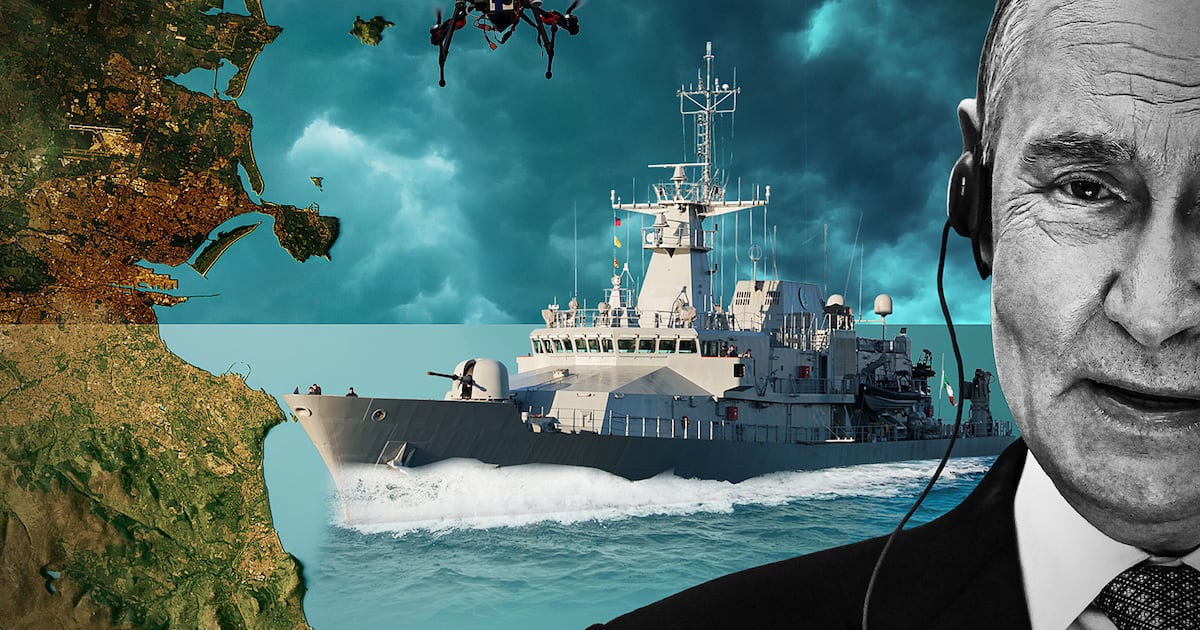
The Rheinmetall Mark 20 anti-aircraft gun is mounted on the decks of most ships in the Irish Naval Service and is capable of firing a round measuring the length of a human hand well over a kilometre into the air.This was the weapon that the crew of LÉ William Butler Yeats, the Naval Service vessel, considered using when they spotted five large drones hovering about 500m above their ship in the Irish Sea on the night of Monday, December 1st.The drones appeared shortly after Ukrainian president Ukrainian president Volodymyr Zelenskiy’s aircraft touched down in Dublin Airport.It would have been a daunting though not impossible task to shoot down the drones. The guns are not equipped with night-time optics and are not guided by radar, meaning success would depend entirely on the marksmanship of the crew.READ MOREGardaí identify suspected prime mover in death of toddler found buried near Donabate, Co Dublin‘Sometimes people feel Dublin Bus is letting them down, but they don’t realise the real reason’Jennifer O’Connell: It’s time to ban the toxic teen popularity counterSanta arriving by helicopter and suites for €19,000: Christmas in Ireland’s five-star hotelsTen years ago, the possibility of hitting the drones might have been much greater. LÉ Eithne, the Naval Service’s former flagship, was equipped with radar-guided anti-aircraft guns and an air-search radar before it was decommissioned in 2022. The Yeats was positioned in Dublin Bay, about 13 nautical miles out to sea. It was located there to act as an outer security cordon during Zelenskiy’s arrival. Another smaller ship, LÉ Aoibhinn, operated closer to shore, acting as the inner cordon.As the crew stood on deck watching and filming the drones, the ship’s officers discussed other options. They could use the ship’s main gun, the 76mm deck mounted cannon, which did have radar guidance.However, it was only capable of firing solid projectiles. Anti-aircraft shells, which can be set to detonate in the air near their target, were not available. Any solid shell could potentially travel kilometres into the sky, endangering the four or five civilian aircraft that were in a holding pattern over the Irish Sea, waiting for the airport to reopen after Zelenskiy’s landing.Consideration was also given to using the ship’s heavy machine guns or even the sailors’ standard-issue Steyr rifles. Ultimately, it was decided the drones did not pose an immediate threat to the ship, meaning the use of weapons could not be justified. The risk of endangering civilian air traffic was also judged to be too great.Most western European naval vessels would not have such concerns. Almost invariably, large vessels are equipped with air-search radar and electronic jamming technology, meaning the drones can be tracked and disabled with a few presses of buttons. The Irish Naval Service does not have this technology. Instead, the crew had to rely on what one naval source called the “Mark 1 Eyeball” – a tongue-in-cheek term for a sailor’s naked eye.The bridge of the LÉ William Butler Yeats. Photograph: Nick Bradshaw From a psychological warfare viewpoint, it is hard to imagine a more effective demonstration of Ireland’s inability to defend itself. For a relatively low cost, and at minimal risk, a hostile actor has managed to embarrass the Irish Government on the world stage shortly before it is due to host the EU presidency. [ ‘Considerable’ concern Ireland lacks means to defend itself ahead of EU presidency roleOpens in new window ]It was a classic case of hybrid warfare of the type regularly used by the Russian security services.If stopping the drones was difficult, definitively pinning the blame on Moscow will be even more so.On Tuesday, European Council president António Costa said the incident was “another example of the hybrid attacks from Russia” on European territory. It is not clear if he was basing this view on intelligence yet to be made public or sharing the widely held suspicions of European security services.Taoiseach Micheál Martin, who was standing beside Costa when he made the remarks, was initially more circumspect, saying the incident fit in with a pattern of similar incidents across Europe.Speaking in the Dáil later in the week, he too specifically namechecked Russia: “The circumstances are suggestive of this being part of an ongoing Russian-inspired hybrid campaign against European Union and Ukrainian interests.”The Coalition’s approach mirrors that of the Danish and Norwegian governments, who attributed multiple recent drone incursions on their capitals to hybrid warfare, possibly but not definitely carried out by Russia.The investigation into the Irish incident is being led by the Garda Special Detective Unit (SDU) with the support of the Irish Military Intelligence Service and foreign security services. It is in its early stages but so far no hard evidence has emerged to conclusively point to Russia as the culprit.The Russian embassy in Dublin has also denied any involvement, dismissing the allegations as “rumours and innuendo”.Despite the denial, the Government is – based on the modus operandi involved and the timing of the incident – firmly of the view that this was a Moscow operation, even if it is reluctant to say so explicitly in public. It is entirely possible it will never be known who was behind the operation. “Such is the beauty of this kind of thing. You inflict damage while maintaining plausible deniability,” said a Government official.The investigation is focusing on the drones’ path to determine their origin. Investigators believe the most likely scenario is they were launched from a ship. This would match suspicions of investigators in Denmark who believe some of the drones that shut down their national airport came from a vessel. French authorities also suspect five drones spotted over a nuclear submarine base on the Atlantic coast were launched at sea.There was no known Russian naval ship in the Irish Sea at the time of last week’s incident but, five hours before Zelenskiy’s arrival, an EU satellite picked up the presence of a “dark ship”, a vessel that had its transponder switched off, 36km from the Dublin coast.The mysterious 64m vessel is at the top of the list of suspects.It remains possible the drones were launched from land, though this would probably have required the secret landing of a medium-sized team of skilled drone operators in the country, along with five large drones. It would be a challenging task even for the Russian security services.Russia regularly hires local criminals to carry out acts of sabotage in western countries. However, the skill required to pilot the drones means this would probably not have been an option.The mystery over the drones’ origin is not helped by initial confusion over who was responsible for investigating the sighting. When first queried last Thursday, Garda headquarters insisted it had no ongoing investigation and referred questions to the Defence Forces.The following day, it backtracked, announcing the SDU were investigating. It is understood the confusion stemmed from the fact the incident happened in international waters, leading senior gardaí to assume it was a military matter.This caused some consternation in military circles. “For weeks, the guards were insisting they and they alone were taking care of security for Zelenskiy. Then when the s**t hit the fan, they passed the buck,” said one military officer.Tensions grew after senior gardaí privately criticised the Defence Forces for not opening fire on the drones.As the investigation progresses, the focus is turning to how the security services can prevent a repeat occurrence during Ireland’s hosting of the EU presidency for six months from next July.A similar drone incursion during the main EU leaders’ summit in Dublin, which will see the attendance of about 50 heads of Government, would be orders of magnitude more embarrassing.The Government is scrambling to act. Last month Minister of State for European Affairs and Defence Thomas Byrne requested and received an additional €19 million to fast track anti-drone defences for the Air Corps headquarters in Baldonnel, Co Dublin in advance of the presidency.[ Stephen Collins: What would happen if Russians landed at Shannon and took over the airport?Opens in new window ]This will “provide aerial protection around Baldonnel and to ensure that the facility can remain open in the event of any potential drone disruption around the time of VIP flights”, he said.It is understood the most likely option is a suite of electronic jamming technology that will make it impossible to operate drones near Baldonnel, where heads of state will arrive. Acquiring a missile-based air defence system and training its crew at such short notice is not viewed as feasible, sources said. Gardaí are also being provided with short-range anti-drone weapons. At an event at The Curragh Camp on Thursday setting out Government plans to spend €1.7 billion on defence to 2030, Minister for Defence Helen McEntee said anti-drone technology that can “identify and neutralise” drones that “may be a threat” will be in place before senior EU figures meet in Dublin next summer.All of the spending will not prevent a repeat of last week’s incident. A primary air defence radar, complete with ship-borne missile batteries and electronic jammers, would be required to respond adequately to a drone threat over the Irish Sea.A primary radar system is being pursued by Irish authorities at an estimated cost of €500 million but is unlikely to be in place until 2028. An effective anti-air missile defence system is a similarly remote prospect.There is also an urgent need to clarify command and control procedures, including the delineation of Garda and Defence Forces responsibilities, sources said. In addition, chains of command in the military “need an urgent overhaul”, said one officer.As it stands, during operations, naval ships report back up to Naval Service HQ while Air Corps aircraft report to their own headquarters. These reports are then relayed to J3/5, the Defence Forces’ planning and operations branch in McKee Barracks in Dublin.“There needs to be a smarter, more direct system that can respond instantly to emergencies,” said one officer. “That would be an easy fix they could do tomorrow if the desire was there but no one seems to recognise the urgency.”