Belarus Frees Protest Leader, Nobel Laureate in Deal With U.S.
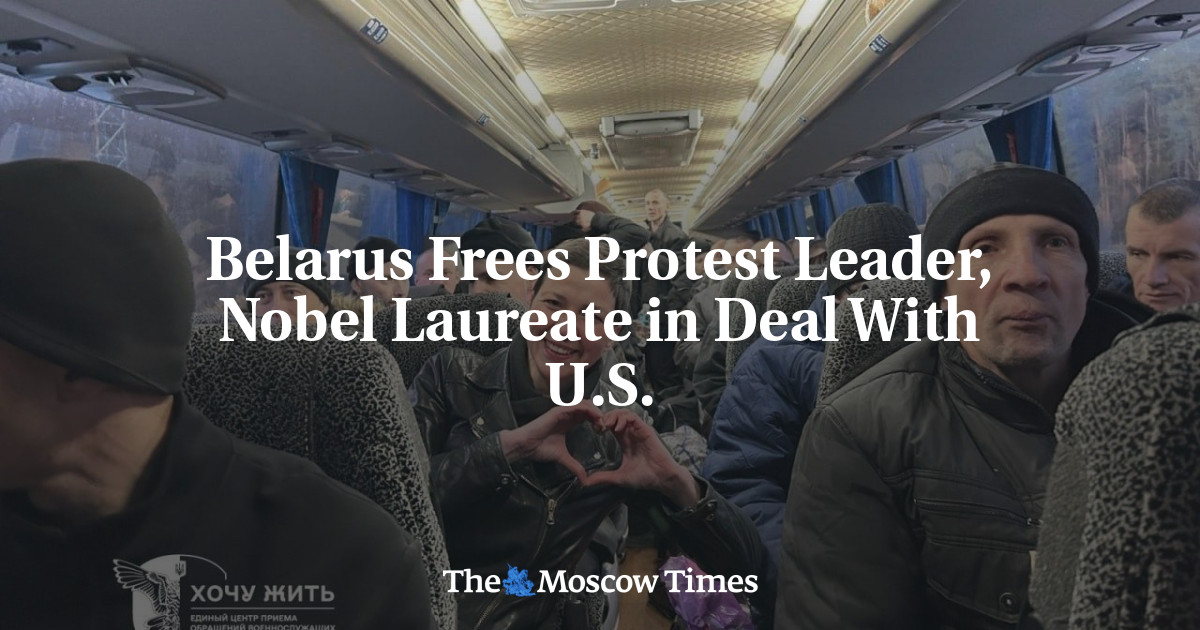
Belarus has released 123 prisoners, including protest leader Maria Kalesnikava, Nobel Peace Prize-winning rights activist Ales Bialiatski and ex-presidential candidate Viktar Babaryka, in exchange for the United States lifting some of its sanctions on Minsk.
The prisoners were freed in connection with the lifting of "illegal" U.S. sanctions on the Belarusian potash industry earlier Saturday as well as Washington's work to lift other sanctions on Belarus, President Alexander Lukashenko's press service said in a statement.
Kalesnikava, 43, was sentenced to 11 years in prison in 2021 after helping lead historic protests against Lukashenko's re-election that nearly toppled him from power in 2020.
She refused to go into exile and tore up her passport at the Belarus-Ukraine border but was ultimately jailed for violating national security and conspiring to seize power. She was kept largely in isolation cells and held virtually incommunicado since 2023.
"I'm thinking of those who are not yet free, and I'm very much looking forward to the moment when we can all embrace, when we can all see one another, and when we will all be free," she said in a video interview with a Ukrainian government agency after being sent to Ukraine after being released.
Bialiatski, 63, was sentenced to 10 years in prison in 2023 on charges widely seen as retribution for his criticism of Lukashenko.
"Our fight continues, and the Nobel Prize was, I think, a certain acknowledgement of our activity, our aspirations that have not yet come to fruition, therefore the fight continues," he told opposition media outlet Belsat in a televised interview from Vilnius.
Minsk also freed Babaryka, an ex-banker who tried to run against Lukashenko in the 2020 presidential election but was jailed instead.
The prisoners released on Saturday had been convicted on charges including espionage, terrorism and extremism and included citizens of other countries including the United States and Latvia.
Belarus has carried out a sweeping and violent crackdown on opposition activists and ordinary people who criticize Lukashenko since the 2020 protests, which saw hundreds of thousands of Belarusians take to the streets to call for free and fair elections.
It has typically charged critics with “extremism,” handing out years-long prison sentences.
Minsk has sought to improve ties with the U.S. since President Donald Trump returned to office this year, freeing dozens of political prisoners including opposition leader Siarhei Tsikhanouski in recent months.
Belarus had at least 1,200 political prisoners as of November 2025, according to the rights group Viasna.
AFP contributed reporting.