This 5 Minute Homemade Bird Feeder Is a Total Bird Magnet
Photo credit: Shutterstock
Winter, frost, food shortages: here’s what you absolutely must give birds to help them survive
Suet! It’s an excellent energy source that helps birds survive freezing winter conditions. Species like chickadees, woodpeckers, and nuthatches particularly love it. Suet is a fatty substance obtained by rendering animal fat, primarily used as winter bird food. It can be made from beef, pork, or lamb fat and is rich in energy, helping birds maintain their body temperature during cold months. Beyond bird feeding, suet is also used in making soaps, candles, and cosmetic products.
Birds are especially fond of sunflower seeds, millet, and flaxseed. You can offer these in feeders or scatter them on the ground. Birds also enjoy fruits like grapes, apples, and berries. What many people forget: birds need water too. The League for Bird Protection recommends providing water in small dishes, regularly refreshing it. Birds need to drink and bathe to remove parasites from their plumage.
Finally, continue these helpful practices through the end of winter—birds will get accustomed to visiting you and would find themselves in serious trouble if you suddenly stopped.
Winter Puts Birds at Risk: This Simple, Eco-Friendly DIY Can Really Make a Difference
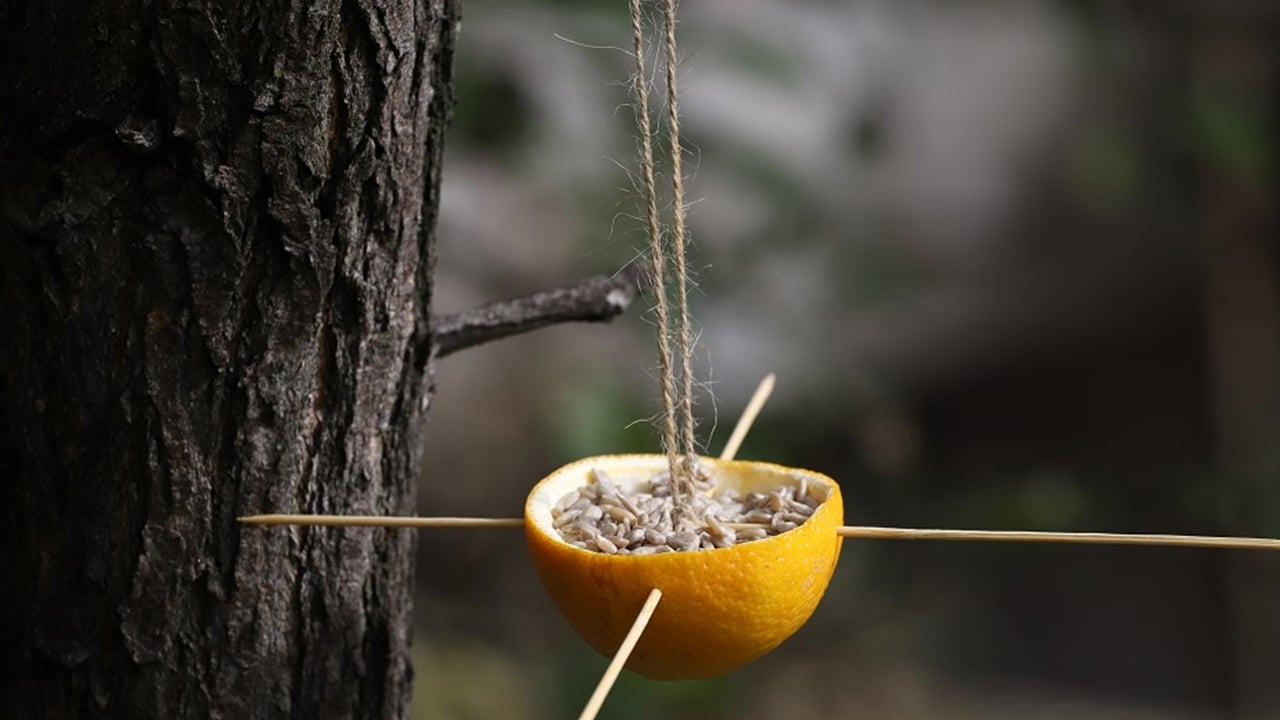
Using biodegradable materials like orange peel, wood, and twine gives you the opportunity to create objects without harming the planet. In this project, you’ll give birds a helping hand by making their food quest easier as winter approaches.
This homemade bird feeder is not only sustainable but incredibly effective—and you probably have everything you need already.
You’ll Need:
½ orange
Twine
1 suet ball with seeds for birds
Toothpicks
The Construction:
Cut the orange in half and cleanly hollow out one of the halves.
Pierce it with 3 evenly spaced holes, located 1 cm from the edge.
Cut 3 pieces of twine, each 45 cm long. Fold them in half and pass both ends of each strand through a hole to create a loop, then pass the two ends through the loop to tie a knot.
Tie all these strands together to another piece of twine, which will allow you to hang the feeder from a tree branch.
Fill the orange cavity with a suet ball with seeds, sold at pet stores.
Insert toothpicks horizontally—they’ll hold the ball in place and serve as perches.
How to Make Your Own Suet at Home to Feed Birds in Winter
It’s entirely possible to make your own suet at home for winter bird feeding. Here are the steps:
Grate or cut 500 g of suet into small pieces (you can find it at butcher shops or animal feed stores).
Put the suet pieces in a saucepan over medium heat and melt them, stirring regularly.
Add 1 tablespoon of sunflower or millet seeds, or pieces of dried fruit or raisins, or even pieces of stale bread.
Mix everything well and let it cool slightly before pouring the mixture into ice cube molds or silicone molds to form suet balls.
Let it cool and harden completely before removing the suet balls from the molds.
You can now place the suet balls in bird feeders or hang them from tree branches.
Important note: suet can melt and drip in high temperatures, so don’t put too much in feeders. Also regularly check feeders to prevent suet balls from being invaded by insects or bacteria.
Feeding Birds in Winter: How to Make Fat Balls?
Making fat balls provides precious help and guarantees quality food for our little friends. Here’s what to do!
The mixture: In a bowl, mix whole sunflower seeds, pieces of peanuts and almonds (unroasted and unsalted), walnuts, hazelnuts or corn, but also millet or oat seeds, or even apple seeds.
The fat: Melt a block of vegetable fat (250 g or 500 g of vegetable shortening, depending on your needs) in a saucepan, then pour over the seed mixture—it should just reach the surface of the seeds. Mix with a wooden spoon to get a homogeneous blend.
The molds: Pour the mixture into small bowls of equal diameter. Once their contents solidify, you’ll get two half-balls that you’ll assemble to form the complete ball, allowing birds to peck all around. Alternatively, you can use yogurt containers or silicone molds that are easy to unmold.
For best results: Place the bowls in the refrigerator overnight so the fat solidifies. Unmold the half-balls by pressing with a finger on the surface or run air along the side of the bowl with a knife tip.
The net: Bring two half-balls together into one and enclose it in a net. You can reuse those from potatoes or oranges (shallot nets have too-tight mesh) and cut them to size. You can also use anti-bird netting (the mesh is a bit wide, just double it). Tie everything with a rubber band.
Hanging: Below the rubber band, tie a string and make a large loop. Hang each ball out of reach of cats, not too close to a walkway to avoid disturbing the birds during their feast, and sheltered from wind, ideally in a sunny location.
Tips: Avoid adding stale bread crumbs or cookie crumbs to your seed mixture—they spoil quickly. And above all, never give them anything salty: salt is poison for them. Just 7.4 mg of salt is enough to kill a sparrow weighing about 28 g. In case of snow, it’s better to use sand rather than salt, because birds peck at snow to drink and consume it once melted.
Where to Place Your Homemade Bird Feeder?
Install your homemade bird feeder at a height between 1.50 meters and 1.80 meters, on a post or hanging, to protect it from cat attacks. For the same reason, don’t place it on a window ledge or inside a thicket. Choose a quiet spot, sheltered from wind, with some sun to limit humidity development. Place the feeder facing east, as there are no prevailing winds or driving rain. The ideal is to combine a platform feeder, appreciated by finches and goldfinches, with suspended food, which will please more acrobatic species like tree creepers and certain chickadees. If you can’t ensure daily seed distribution due to schedule constraints, opt for an automatic model that delivers food for two or three days. And clean each feeder once a week. Use a scraper to remove stuck seed husks, then wash the platform with a brush, water, and a little Marseille soap. Rinse and let dry before adding more seeds.
How Do Birds Stay Warm in Winter?
By puffing up their feathers! This strategy used by certain birds allows them to maintain their body heat in winter. Birds have layers of feathers that form natural insulation, but when exposed to cold temperatures, they can puff up their feathers to create pockets of warm air between the feather layers. This process allows birds to conserve their body heat and reduce heat loss through their skin. It’s often used by birds living in cold climates or exposed to extremely low temperatures. Feather puffing is an automatic process—the bird doesn’t do it consciously, but it’s a physical reflex triggered by cold.
Creating a simple, eco-friendly homemade bird feeder is one of the most rewarding winter projects you can tackle—and watching your backyard transform into a wildlife haven makes those five minutes totally worth it.
**”Je l’ai posée hier, ils sont venus dès ce matin” : cette mangeoire maison à faire en 5 minutes est un aimant à oiseaux**
This article first appeared on modesettravaux.fr – Author: Clémentine Gros
Christmas Cactus: This Kitchen Staple Triggers Gorgeous Blooms
Amazon’s $12K Tiny Cabin Is the Internet’s New Winter Obsession — & It Might Be the Coziest Thing You Can *Add to Cart* This Year
This Coating Turns Tiles into Modern Floors Without Renovations
Experts Say 68°F Isn’t Really the Best Temperature for Your Home
GRAZIA Gift Guide: Luxe Lifestyle Gifts for the Homebody, the Hostess, & the Aesthete
Villa Ardore: A Tuscan Passion Project