


Cyber security is a fast-growing field where organizations constantly look for skilled professionals who can protect systems, detect threats, and respond to attacks effectively. If you have a cyber security interview coming up in just 30 days, the right preparation strategy can help you build strong fundamentals and Cyber Security Course in Hyderabad improve your confidence quickly. With focused learning and daily practice, it is absolutely possible to become interview-ready within a month.

Understand the Job Role Before You Start
Every cyber security role has different expectations. Some focus on SOC operations, others on penetration testing, risk management, or incident response. Before you begin studying, carefully analyze the job description to understand the required skills. This will help you prioritize topics that matter most and avoid wasting time on irrelevant areas.
Build a Strong Foundation in Security Basics
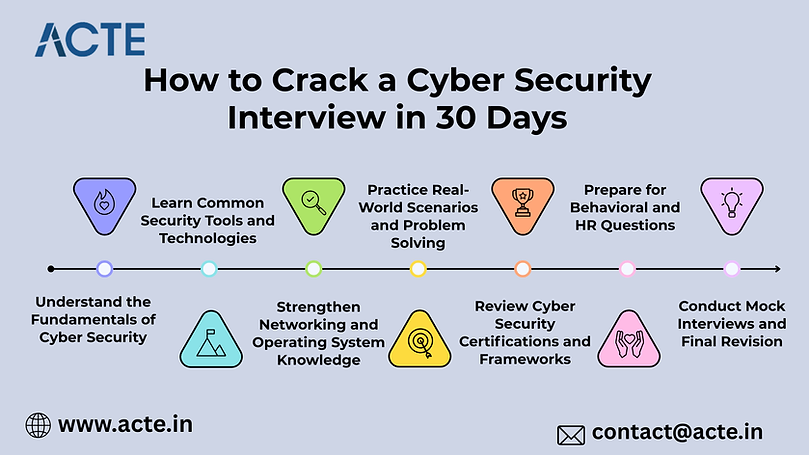
Start your preparation with core cyber security concepts. Focus on confidentiality, integrity, availability, authentication, authorization, encryption, and risk management. These fundamentals are frequently tested in interviews because they define how secure systems are designed and maintained. A clear understanding of these principles will make it easier to answer both basic and advanced questions.
Strengthen Networking Knowledge
Networking is one of the most important areas in cyber security interviews. You should understand how data moves across systems and how attackers exploit network weaknesses. Study TCP/IP, DNS, HTTP/HTTPS, VPNs, ports, routing, switching, and firewalls. These topics often appear in technical discussions because they are essential for understanding security architecture.
Learn Operating System Security
Cyber security professionals regularly work with Linux and Windows systems. Review key concepts such as user management, file permissions, authentication processes, Cyber Security Course in Chennai system logs, and security configurations. Understanding operating system security helps you identify vulnerabilities and explain how systems can be protected from unauthorized access.
Gain Practical Experience with Tools
Hands-on experience is a major advantage in interviews. Use virtual labs or online platforms to practice security tools and techniques. Work on tasks like scanning networks , Cyber Security Online Course analyzing logs, and identifying vulnerabilities. Practical exposure helps you connect theory with real-world applications and gives you stronger examples to share during interviews.
Study Common Cyber Threats and Attacks
Modern cyber security interviews often include questions about real-world threats. Learn about phishing, ransomware, malware, brute-force attacks, social engineering, and insider threats. Understand how these attacks work and how organizations defend against them. This shows that you are aware of current security challenges and industry practices.
Practice Real-World Scenarios
Scenario-based questions are very common in cyber security interviews. You may be asked how you would handle a security breach, investigate suspicious activity, or secure a compromised system. Practice answering in a structured way—identify the issue, analyze the risk, and explain your solution step by step. This demonstrates strong problem-solving ability.
Improve Communication and Presentation Skills
Technical knowledge alone is not enough. You must also communicate clearly and confidently during interviews. Practice explaining your projects, skills, and experiences in simple language. Employers value candidates who can communicate technical issues effectively to both technical and non-technical teams.
Conclusion
Cracking a cyber security interview in 30 days is completely achievable with focused preparation and consistent effort. By mastering core concepts, strengthening networking and operating system knowledge, gaining hands-on experience, and practicing interview scenarios, you can build strong confidence. Combine technical skills with clear communication, and you will be well-prepared to succeed in your cyber security interview and move forward in your career.
Comments (0)