
Remember me







 Credit: Thijs de Buck/Mollie/Strava/ZME Science
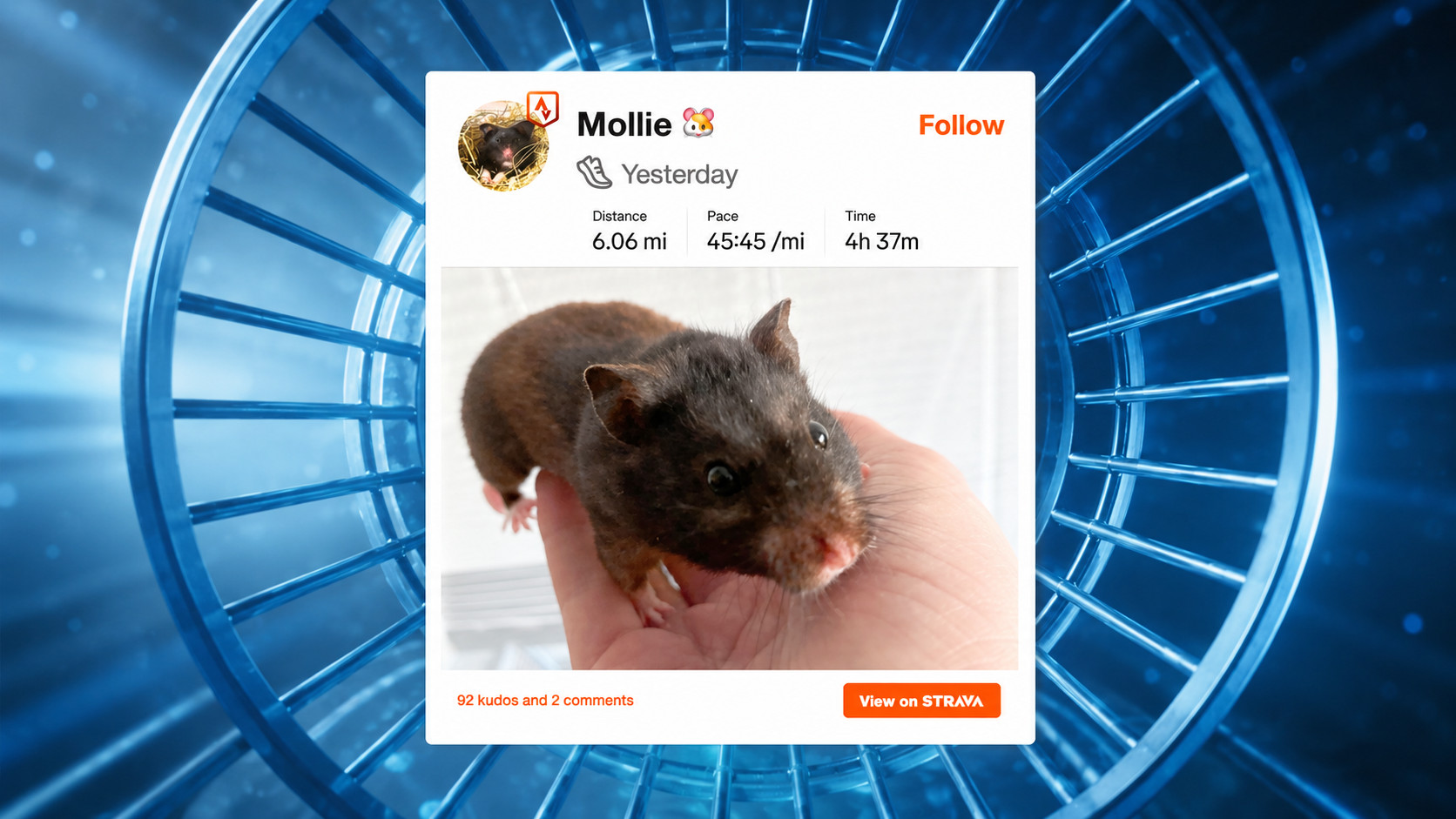
Every night, sometime around 10 p.m., Mollie clocks in.
He does not lace up shoes or check the weather. He climbs into a running wheel in an apartment in Utrecht, the Netherlands, and starts moving. By morning, he may have covered about 10 kilometers — more than six miles — in a series of furious little sprints.
Then his workout appears on Strava.
Mollie is a 10-month-old hamster whose owner, Thijs de Buck, an MRI physicist and marathon runner, built a system that counts every revolution of his wheel and converts the result into the same sort of fitness data recorded by human runners. Mollie now averages close to 70 kilometers a week and has logged a personal best of 11.15 kilometers in a single day.
The project began as an elaborate bit of curiosity and became an internet phenomenon. But Mollie’s mileage also raises a more interesting question: Why does a creature that can fit in two hands want to run so far?
As it turns out, scientists have been asking versions of that question for decades.
Building a Strava Account for a HamsterDe Buck initially bought a cheap bicycle computer to measure Mollie’s wheel. The system used a magnet and sensor to count rotations, but it would fail to restart counting whenever Mollie stopped for more than five minutes.
“So if Mollie would take a lunch break at 1 a.m., we’d have no idea how far he’d have run after that,” de Buck told Runner’s World.
×
Thank you! One more thing...Please check your inbox and confirm your subscription.
So, he built something better.
 Credit: Thijs de Buck
A magnet attached to the wheel passes a Hall-effect sensor each time Mollie completes one rotation. The wheel travels roughly 65 centimeters per revolution. A small ESP32 computer records the time of each pass, allowing the system to calculate not only distance but speed and running intervals.
Each morning, a script on de Buck’s computer retrieves the data, creates a .fit activity file and sends it to Strava. A tiny screen even displays Mollie’s live speed, which can reach roughly four to five kilometers per hour.
De Buck added automatic personal records and more than 100 possible activity titles, including “No Rest for the Whiskered” and “The Fast and the Furriest.”
 Mollie is a cutie! Credit: Thijs de Buck
There was one unexpected expense though. Auto-uploading the files this way required a paid account.
“There was really only one reasonable solution: my hamster now has Strava Premium,” de Buck told Runner’s World.
The account promptly took off. By the time ZME Science profiled Mollie today, he had accumulated more than 10,000 Strava followers.
De Buck, meanwhile, has discovered the peculiar indignity of being athletically overshadowed by his own pet.
“I trained for a marathon for like half a year and gave a good effort, I thought. I got, like, maybe 40 ‘kudos,’ which is like the ‘likes’ on Strava. But Mollie’s getting about a thousand for each run each night,” he told CBC. “It’s not fair.”
Ten Kilometers Is Less Strange Than It Sounds Mollie’s stats are uploaded to Strava every morning. Credit: Mollie/Strava
Mollie’s distances sound absurd mainly because humans are comparing them with human exercise.
To a hamster, several kilometers of nightly wheel running is not unheard of.
In a 1990 experiment with golden hamsters, researchers reported that animals given running wheels voluntarily covered six to seven kilometers each night. In another hamster experiment, healthy control animals averaged 11.5 kilometers per day on their wheels — remarkably close to Mollie’s personal record.
Rodents tend not to run continuously. They sprint, stop, eat, drink and start again. Mollie follows much the same pattern.
His clockwork schedule is also characteristic of captive hamsters. During one seven-day period, he began running between 9:54 and 10:04 p.m. on five nights.
But captivity can also complicate the picture of hamster athleticism.
Hamsters have been favorites of scientists studying circadian rhythms — the roughly 24-hour internal clocks that help animals decide when to sleep, eat and become active. In lab hamsters, this rhythm is especially easy to measure because the animals typically sleep through the day and become intensely active after dark. Researchers can simply record when a hamster starts running on its wheel each evening and watch how that schedule shifts when they change light, temperature or other cues.
But when researchers tracked wild female Syrian hamsters in Turkey in a 2008 field study, the animals often emerged from their burrows during daylight, particularly in the morning and late afternoon.
This showed that an internal clock does not rigidly dictate that an animal must be active at night. Light, temperature, predators, food and the constraints of captivity can all influence when that clock translates into visible activity.
That makes Mollie’s wonderfully precise Strava record a little harder to interpret. It tells us exactly when and how much one captive hamster runs. It does not necessarily tell us what a hamster would choose to do under very different conditions in the wild.
Is Wheel Running Exercise or Frustration?Mollie’s viral fame has also revived a long-running debate about the welfare of small pets.
Animals kept in cramped or barren environments can develop stereotypies — repetitive behaviors associated with frustration or stress. In hamsters, persistent bar chewing is one example. Some researchers have wondered whether intense wheel running might actually be a sign of distress.
In a 2005 study of golden hamsters, researchers found that access to a large, properly constructed running wheel in an enriched enclosure did not harm the animals and actually reduced stereotypic bar-mouthing.
And rodents will sometimes choose wheels even when nobody cages them. In a striking 2014 field experiment, researchers placed running wheels outdoors and discovered that wild mice voluntarily climbed aboard and ran, despite receiving no food reward. The experiment involved mice, not hamsters, so it cannot settle the question for Mollie. But it undermined the idea that wheel running must inherently be an abnormal product of captivity.
The rest of the enclosure also matters. Experiments with golden hamsters have found that deep bedding encourages burrowing and reduces some abnormal behaviors, while restricted environments can increase behaviors such as wire gnawing.
De Buck told Vox that Mollie was adopted from someone who kept him in a smaller enclosure, where he climbed and bit the fence. De Buck upgraded him to a larger cage and wheel and added toys and deep bedding. He also hides food so Mollie can forage.
“I think some behavioural aspects (more running, digging tunnels in the bedding, ‘foraging’ if we hide food in the bedding) make his behaviour closer to natural, but it’s, of course, never like in the wild,” he told Vox.
A Fitness Tracker Becomes a Behavior Tracker Thijs de Buck showing off Mollie’s wheel and cage. Credit: Thijs de Buck
That may ultimately be the most interesting part of de Buck’s gadget.
A single night’s mileage cannot tell him whether Mollie is content. Months of data might reveal something more useful: whether his activity changes after bedding is replaced, food is hidden differently, the room stays lit later or something about his health changes.
“People often talk about pets being ‘happy,’ but, especially with small animals, that’s difficult to assess objectively,” de Buck told Vox. “I’m curious whether long-term activity data might give us useful clues about changes in his behaviour or wellbeing!”
For now, Mollie remains an experiment with a sample size of one — and an unusually good Strava account.
De Buck hopes eventually to match his hamster’s weekly mileage once he recovers from an injury. That means running roughly 70 kilometers a week.
Mollie, meanwhile, has no training plan at all.
He just wakes up and runs.

