
Remember me

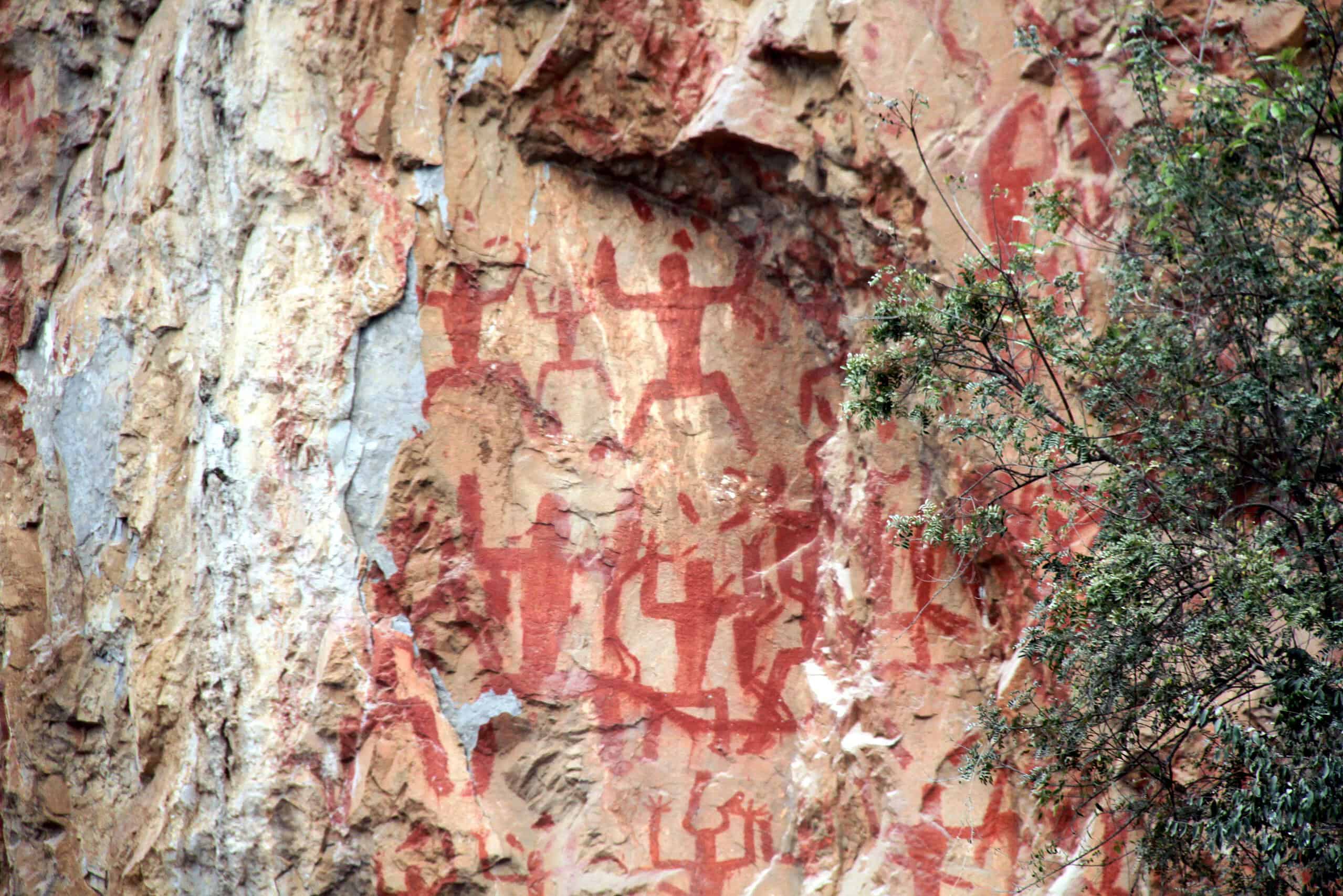


 Examples of images related to reproduction in the Huashan rock art. Image from the study.
The artists behind China’s iconic cliff paintings may have paid a steep price to ensure their art lasts.
For more than 2,000 years, red figures have clung to limestone cliffs above the rivers of southern China, surviving monsoon rains, heat and typhoons. Now, researchers say they have found an unexpected reason for that durability: ancient artists mixed human and animal blood into the mixture. The proteins in the blood appear triggered the growth of crystals around the pigment, effectively welding the artwork to the rock.
A 2,000-Year-Old Painting RecipeThe paintings were dated between the 5th century BC and the 2nd century CE by the Luoyue people. The Lạc Việt or Luoyue were an ancient conglomeration of peoples inhabiting northern Vietnam and southern China. There are 38 rock-art paintings covering steep limestone cliffs along the Zuojiang and Mingjiang rivers. They depict people, animals, boats, weapons and bronze drums, often in what archaeologists interpret as ceremonial scenes.
The region has a subtropical monsoon climate, which makes it even more surprising that the art survived so well. Paint exposed on a cliff for two millennia faces water and humidity, heat, and plants growing over it. Yet many of the reddish images remain clearly visible.
 Image via Wiki Commons.
So, researchers led by Meng Wu and Pengcheng Hu went to investigate. They analyzed naturally detached painted fragments from three sites, examining their microscopic architecture.
The team used electron microscopy, chemical analysis, infrared and Raman spectroscopy, and proteomics — a technique that identifies proteins preserved in a sample.
The first thing the analysis highlighted was that the paintings weren’t just one red pigment brushed onto bare stone. They had layers.
Blood, Clay, and MortarDirectly on the natural limestone, the painters put an artificial mortar containing lime, bone ash, and blood. Then, on top of it, they added red pigment, made from clay rich in extremely small particles of hematite, an iron oxide that produces a red color.
×
Thank you! One more thing...Please check your inbox and confirm your subscription.
But this mortar appears to be the key to the paintings’ survival.
According to the researchers’ reconstruction, the artists first heated limestone together with bone, producing quicklime mixed with bone ash. They then added water and a small quantity of blood, creating a mortar that could be spread across the cliff.
Separately, they processed iron-rich red clay to obtain the fine hematite pigment. They painted with that pigment while the mortar underneath was still partly wet. This led to some powerful chemical reactions.
Art and ChemistryWhen lime is mixed with water, it forms calcium hydroxide. Exposed to carbon dioxide in the air, calcium hydroxide gradually converts back into calcium carbonate — essentially the same mineral that makes up limestone.
But the Huashan paintings add another twist. The blood helped organize the growth of dense mineral crystals around the pigment particles. Basically, the new rock crystals organized around the red pigment, protecting it.
In other words, the pigment was no longer simply sitting on the rock. It had become embedded in a mineral structure chemically similar to the cliff itself.
Proteomic analysis detected proteins associated with blood and indicated contributions from both humans and animals. The proportions varied among the sites, suggesting that different groups or painting episodes may not have followed the same rigid recipe.
Because it was human blood, this strongly suggests the paintings weren’t just made randomly. Their creators did not necessarily grab a piece of red ochre, mix it with a convenient glue and smear it onto a wall. The proposed process involved burning limestone and bones, preparing lime mortar, incorporating biological material, processing clay and timing the application of pigment to the curing of the underlying layer. When you add the use of human blood, obviously this was something important.
Where Did They Get the Blood?The natural question is, of course, what kind of blood was it? Was it the blood of the artist, voluntarily putting a part of themselves into their art? Was it from their enemies? Or something else?
Researchers detected two human proteins that drew particular attention: prolactin-inducible protein and lactotransferrin. The authors associated them with female reproductive biology, pregnancy, and breastfeeding.
Essentially, this could be childbirth blood. This is far from proven yet, but it appears to be the most likely option. Researchers couldn’t recover ancient DNA that could reveal the biological sex or identity of the people who supplied the blood, though other sites may contain such evidence.
This also fits with the archaeological interpretation. Some imagery at Huashan has been interpreted in connection with fertility and reproduction. But without stronger archaeological evidence, scientists cannot tell whether artists chose blood primarily because they understood its practical properties, because it carried ritual meaning, or for both reasons.
The study was published in the Journal of Archaeological Science.

