GameSquare Holdings stockholders approved a proposal authorizing a reverse stock split on Aug. 13, the same day the company disclosed in a quarterly filing that it has pledged roughly three-quarters of its Ethereum against $12.1 million in short-term borrowings.
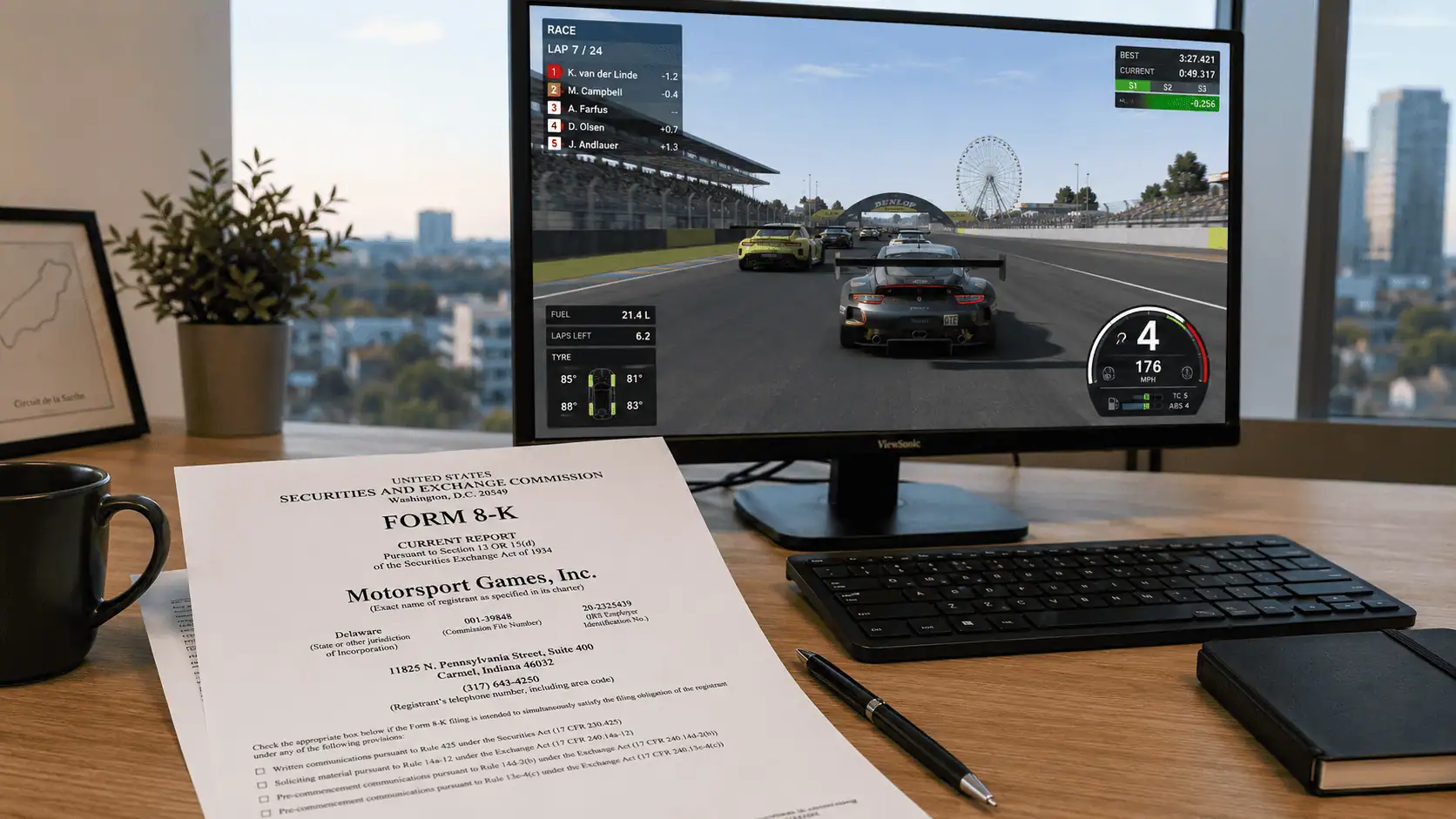
The vote authorizes the board to consolidate the company’s shares at any ratio between 1-for-2 and 1-for-8, at its discretion, in order to regain compliance with Nasdaq’s minimum bid price requirement. The result was reported in the subsequent-events note of the company’s Form 10-Q filed Aug. 13. The board has not named a ratio.
Its window is narrow. GameSquare must demonstrate compliance by Sept. 7, and any reverse split must be completed no later than 10 business days before that date, placing the practical deadline in the final week of August, as previously reported by The Esports Advocate.
The same filing describes a treasury strategy that has changed character since GameSquare announced it.
The company has entered into short-term promissory notes with unnamed third-party lenders, secured against its ETH. The notes carry 60-day terms at 8.5% to 9.5% annual interest, mature Aug. 16 and Sept. 30, and renew automatically unless either party gives notice. Promissory notes payable due within a year stood at $12.1 million at June 30, against $2.0 million at the end of 2025. Proceeds from the ETH-backed notes totaled $10.1 million during the first half, and interest expense on them was $0.4 million.
The collateral terms carry the risk. GameSquare must pledge ETH worth at least 150% of the principal at inception. If coverage falls below 130%, the lender issues a margin call. If it falls below 120% and the company does not cure the deficiency within 24 hours, the lender may liquidate the pledged ETH. Above 170%, the company may request the return of excess collateral, subject to the lender’s approval. Declines in the token’s price, the filing states, “could result in margin calls requiring the Company to post additional collateral or repay a portion of the outstanding borrowings.”
The filing quantifies how much is committed. At June 30, the $12.1 million outstanding was secured by 11,319.65 ETH with a fair value of $17.8 million, a collateral coverage ratio of approximately 147%. That is roughly three-quarters of the ETH GameSquare holds directly, pledged at a valuation of about $1,570 a token. Holding the pledge and the principal constant, a decline of about 12% from that level would have brought the position to the margin-call threshold. The token has instead risen, trading at $1,875.30 early Friday.
GameSquare does not intend to repay the notes in the near term. It “intends to further extend the maturity dates of both notes until ETH price recovers to values closer to its original cost basis on purchases made in the third quarter of 2025,” according to the filing. Those purchases were 15,630 ETH contributed at a fair value of $55.3 million, or roughly $3,538 per token, leaving the token about 47% below the price the company paid.
The structure of the holding has changed as well. GameSquare adopted the treasury in July 2025 under a board authorization of up to $100 million, pairing it with crypto capital manager Dialectic and its Medici yield platform, as previously reported by The Esports Advocate. It contributed 15,630 ETH to a Dialectic feeder fund in the third quarter of 2025. That position is now almost entirely unwound, falling from $41.4 million on Jan. 1 to $377,438 at June 30, with $29.2 million redeemed and $19.2 million recognized as a realized loss.
The filing is explicit that the realized loss “does not represent a cash loss,” because the company redeemed its fund units for ETH rather than for cash. The effect was to move the position out of a managed fund and into direct custody. GameSquare sold only $584,172 of ETH outright during the half. Meaningful selling began afterward, with 1,209 ETH liquidated in July, according to a capital allocation update issued July 15.
What remains is 14,840.04 ETH held directly, carried at $23.3 million against a cost basis of $33.6 million, an unrealized loss of $10.3 million. A further 240.47 ETH sits in the Dialectic fund.
The filing confirms that the treasury is funding the buyback. GameSquare “intends to continue using funds generated by its treasury strategy to opportunistically repurchase its common stock,” it states. The company had repurchased 7,844,590 shares for $3.8 million through June 30, and a further 1,042,665 shares for $0.4 million after quarter end, leaving $10.8 million authorized.
GameSquare’s quarterly statements continue to carry a material uncertainty that raises substantial doubt about its ability to continue as a going concern, language also present in its first-quarter filing and absent from its Aug. 10 earnings release. The condition is easing rather than worsening: the working capital deficiency narrowed to $4.5 million at June 30 from $18.7 million at the end of 2025, while the accumulated deficit grew to $190.6 million.
The filing also puts an exact figure on a share count that market data services have been carrying wrong. GameSquare reported 103,809,536 shares outstanding as of Aug. 13. Several services still list 93.7 million, the figure from the cover of its first-quarter report in May, understating the company’s market capitalization by roughly 10%, as previously reported by The Esports Advocate. The count rose even as the company was buying stock back, in part because GameSquare issued 3,433,000 and 5,000,000 common shares in June on the conversion of its Series A-1 and Series A-2 preferred stock. Shares closed at $0.3782 on Thursday, down 7.73%.
Separately, the filing discloses that option awards to Chief Executive Officer Justin Kenna and Chief Financial Officer Michael Munoz covering 1,045,712 and 301,249 shares, previously reported on Forms 4 in July 2025 and amended that November, “were not validly issued.” They were re-granted on July 10 as new awards, with 62.5% vesting the same day and the balance in July 2027. Kenna received a further option over 150,000 shares on July 10, and Chief Operating Officer Amaree Tanawong a discretionary award of 50,000 restricted stock units described as separate from and in addition to her employment agreement, both vesting in full on grant.
Still unknown are the ratio the board will select and when it will act, the tally of the Aug. 13 vote, which had not been filed at publication time, how much ETH is pledged today, and whether the board still stands behind the treasury strategy of up to $250 million described in its first-quarter filing and not repeated in this one.
The operating business continues to improve, and the second quarter was the strongest GameSquare has reported. The balance sheet built alongside it is now the harder problem: three-quarters of the treasury pledged against borrowings the company is waiting out, an asset trading well below the price it paid, and a share count it is asking permission to consolidate. The strategic question is no longer whether GameSquare can grow into its valuation, but whether it can unwind that position on its own timetable rather than a lender’s.