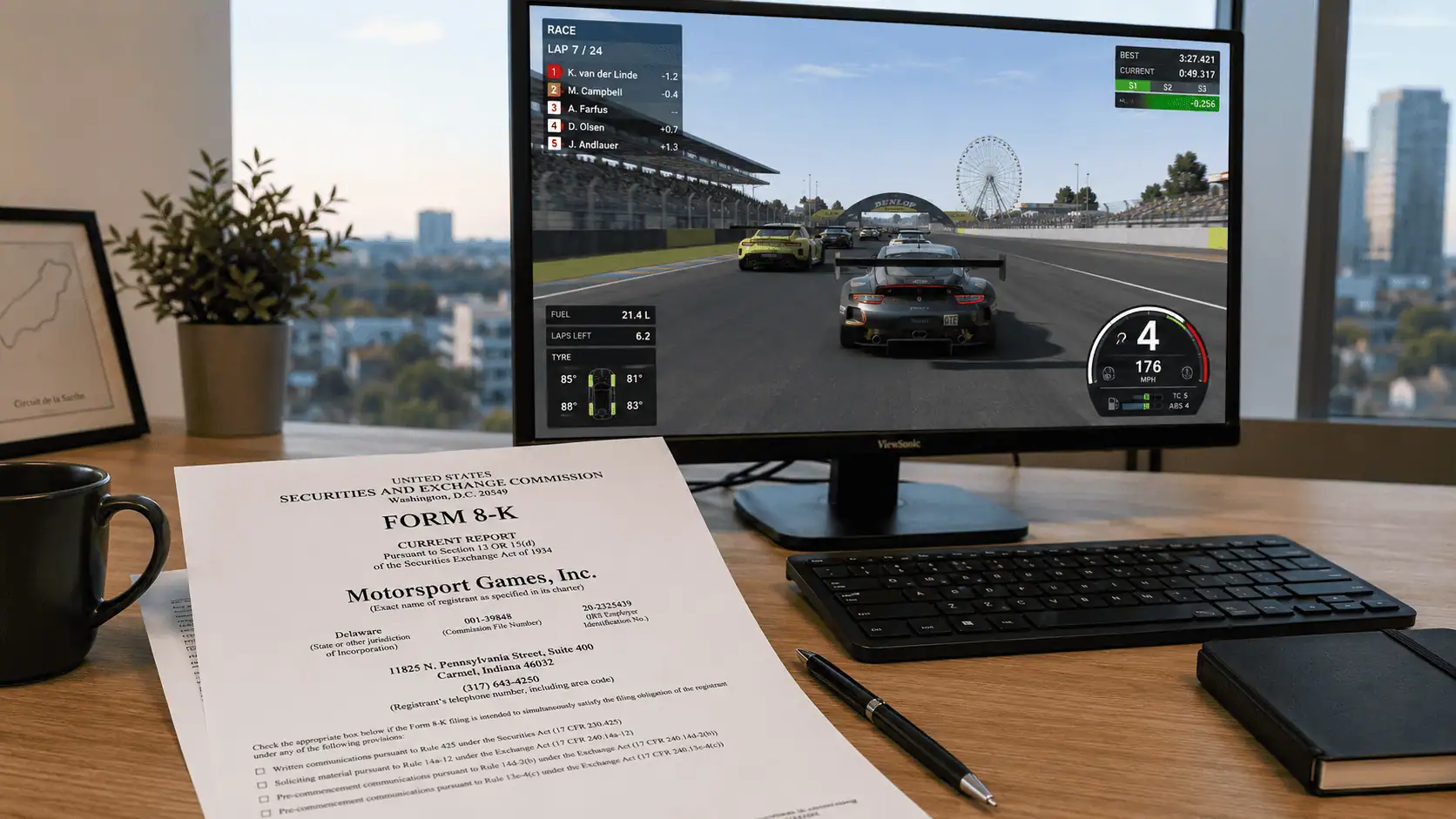
Motorsport Games generated $36,277 in esports revenue in the second quarter of 2026, the first income the segment has produced since 2023, according to a quarterly report the company filed with the U.S. Securities and Exchange Commission on Friday.
The money came from “facilitating Esports events for partners using our Le Mans Ultimate title,” the filing states, without naming the partners or the events. It cost more than it brought in. The segment recorded $42,139 in cost of revenues for a gross loss of $5,862, and carried $101,172 in development expense — its first since 2023, a year in which the segment’s full-year development spend was $9,614. The quarterly operating loss was $115,694, against $21,302 a year earlier. Motorsport Games said it “will continue to pursue Esports partnerships in the second half of 2026.”
The company has disclosed one esports arrangement running on the title during the quarter, though it has not connected that arrangement to the revenue. Motorsport Games President and Chief Executive Officer Stephen Hood told the company’s first-quarter earnings call in May that Logitech had chosen RaceControl, the multiplayer and subscription platform inside Le Mans Ultimate, to power the Logitech G Challenge esports series, according to a transcript of the call. The 2026 edition of that competition moved to Le Mans Ultimate from Forza Motorsport, Traxion reported in May, carrying a prize pool of more than $35,000 and six daily qualifying windows running from May 5 to July 27 — four of them inside the second quarter. Motorsport Games has not said whether that competition produced the quarter’s esports revenue.
The restart does not involve the property the segment was built around.
The same filing repeats a promise the company has now made in three consecutive August reports, with only the season label changing: “Although we did not organize the Le Mans Virtual Series for the 2023/24, 2024/25 or 2025/26 seasons, we currently plan on organizing the 2026/27 Le Mans Virtual Series to commence this year.”
The version filed in August 2025 is almost identical, listing two dormant seasons instead of three and naming the 2025/26 series as the one that would “commence this year.” The report filed in August 2024 used the same construction for the 2024/25 season, which it said would “commence later this year.” Every season named in those filings has since joined the list of the ones the company did not organize.
The season label advances with each annual cycle. The deadline does not.
Hood attached specific timing to the revival a year ago. Traxion reported on Aug. 13, 2025 that Hood told an earnings presentation, “Now that team events have been incorporated into the product experience, we can accelerate our plan to bring the world’s biggest racing esports event back into focus,” adding that “Le Mans Virtual will be returning, with the final expected to be held next year and early qualifying rounds appearing in Q4 of this year.” No qualifying rounds ran in the fourth quarter of 2025, and Friday’s filing confirms no 2025/26 season took place.
The Le Mans Virtual Series began in 2020 as a one-off 24-hour race staged after the pandemic postponed the real event, then ran as a multi-round championship for the 2021/22 and 2022/23 seasons, pairing professional racing drivers with sim racing teams. Motorsport Games’ filings credit the 2022/23 finale with approximately 8.8 million video views, about 27 million minutes watched and a global audience of 5 million across television and over-the-top channels. The rights sit inside Le Mans Esports Series Ltd., a joint venture in which Motorsport Games holds 51% alongside the Automobile Club de l’Ouest, organizer of the 24 Hours of Le Mans.
That 2023 finale was also the last one. Traxion, reporting the planned revival in 2025, wrote that the event “was also beset by technical issues and a rather public rant from four-time world champion Max Verstappen – the combination of which made the organisers shy about a return.”
The technical problem has not been solved in the intervening three years.
On Feb. 18, Motorsport Games cancelled a scheduled 24-hour driver-swap test race in Le Mans Ultimate, replacing it with a 12-hour test on a single time slot. “We’ve identified some unacceptable service issues when running events with 130+ clients connected to servers – which is expected for longer races and 62 car grids like Le Mans,” an official statement said. “These issues don’t show up in smaller races but become critical at this scale.” The statement added that the company had “found some anomalies with the network traffic within containers on these high-load servers.”
Three days before the quarterly report was filed, Traxion reported that the 8 Hours of Daytona special event had been pushed back two weeks, apparently for technical reasons, and that Motorsport Games would lay the groundwork for 62-car grids and around-the-clock racing in a coming update. The game’s first in-game 24 Hours of Le Mans special event is scheduled for the week of Oct. 20 — the technical proof point any televised 24-hour esports final would have to clear, with roughly ten weeks of the year remaining after it.
The financial gap between the series’ peak and the present is wide. Esports revenue reached $1,179,920 in 2022, or 11.4% of company revenue, and fell to $290,172 in 2023, according to Motorsport Games’ annual report for that year. The segment earned nothing in 2024 or 2025. The $36,277 booked in the second quarter is about 3% of the 2022 figure and 1% of the company’s $3.5 million in quarterly revenue.
The filing also hedges the plan against the company’s finances, listing the 2026/27 series among forward-looking statements subject to “the possibility of further adjustments to our product roadmap due to the continuing impact of our liquidity position.” Motorsport Games held $3.9 million in cash at June 30 and has $1.8 million undrawn on a $3 million Citibank revolving facility.
Neither Friday’s earnings release nor the accompanying 15-slide investor presentation mentions esports or the Le Mans Virtual Series in its discussion of the quarter. The deck’s eight-point highlights slide credits RaceControl subscriptions, the Le Mans Ultimate version 1.4 release, a record concurrent-player peak and a share repurchase; the segment’s first revenue in three years does not appear. The presentation’s forward-looking statements slide lists the growth drivers management expects to pursue — RaceControl subscription revenue, new Le Mans Ultimate content, a console version of the game — and names neither esports nor the series, though the quarterly report filed the same day lists the 2026/27 series among its own forward-looking statements.
The company’s standing corporate description, carried at the foot of the same release, still identifies Motorsport Games as an “award-winning esports partner of choice for the 24 Hours of Le Mans, creating the renowned Le Mans Virtual Series.”
The disclosure lands while the company is defending itself from its own shareholders. Motorsport Games adopted a poison pill in July, with a 12.5% trigger and an expiry of July 20, 2027, and tightened its shareholder-meeting rules after Red Oak Partners accumulated roughly 11% of the stock, as previously reported by The Esports Advocate. Friday’s filing adds a risk factor, absent from both the company’s most recent annual report and its first-quarter filing, warning that an activist campaign seeking to change “our board composition, leadership, strategic direction, or business mix” could disrupt operations and divert management attention.
Still unknown are whether the quarter’s esports revenue came from the Logitech competition or from other partners, the format, calendar, prize pool and broadcast arrangements for the 2026/27 Le Mans Virtual Series, whether the Automobile Club de l’Ouest has committed to the revival as joint-venture partner, and whether qualification will run through Le Mans Ultimate‘s paid RaceControl subscription tiers rather than the open format used in 2022/23.
The immediate result is that Motorsport Games has established that third parties will pay it to run competitions on Le Mans Ultimate, at a scale of tens of thousands of dollars a quarter. The larger question is whether a company whose own endurance test events have been cancelled or delayed twice this year — the February race explicitly over server capacity — can stage a 24-hour, multi-class, broadcast-grade final before the calendar it has already missed three times runs out again.