
Remember me


Old news I stumbled across by accident: University of Saskatchewan researchers discovered back in 2019 that a new strain of feral pigs—super pigs—have among their many interesting behaviors the habit of building above-ground structures out of cattails1.
(They’ve been dubbed “pigloos,” and you can see one here. It’s worth taking a look.)
I don’t know why this surprised me. Lots of animals build homes. Birds build nests, beavers build dams, squirrels build dreys. Moreover, it should be no surprise that some animals are very bright. Having grown up next to a pig farm, I have enough appreciation for porcine intelligence that I am a bit uncomfortable eating pork… although it helps that pigs would definitely return the favor if they could.
The moral of the story is probably “it is good for us that pigs don’t have thumbs.”
Intelligent animals appear in millennia-old fables. It’s no surprise that this tradition lives on in speculative fiction. How and why the animals are intelligent varies widely, as do the consequences for humans. Perhaps some examples are in order.
Brain Wave by Poul Anderson (1954)
As the novel opens, Earth emerges from a region of space whose curious properties inhibit certain electromagnetic and electrochemical processes. Every thinking being on Earth evolved in the context of that field suppression effect. Without it, everyone and everything becomes five times more intelligent.
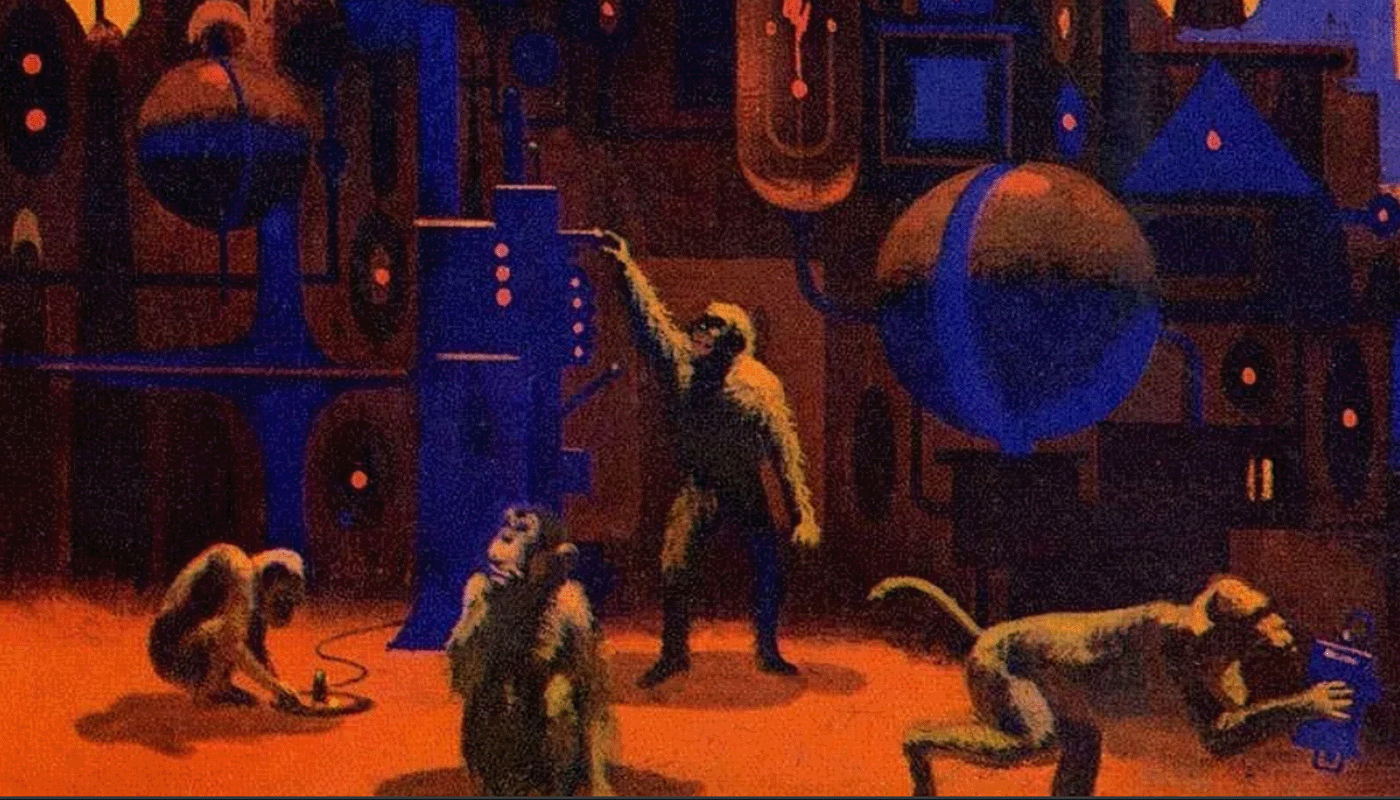
Intelligence amplification is, of course, extremely disruptive. Not merely for humans. Prey animals like rabbits can suddenly reason. Farm animals easily escape their pens and fields. The entire ecosystem is upended.
This is, of course, the novel that inspired Joan2 and Vernor Vinge’s Zones of Thought setting.
Being constrained by the limited page count available to authors of this era, Anderson could not explore his setting deeply before wrapping up the plot. A question that only belatedly occurred to me: what happened to non-animal species that have some ability to sense and react to their environment? Did mycorrhizal networks suddenly have a glimmering of consciousness?
“Chain of Command” by Stephen Arr (1954)
(First published in Galaxy Science Fiction, May 1954 and available at Project Gutenberg) At the behest of his wife Clara, George voices a simple request to his building’s janitor. Might the janitor cease placing mousetraps outside every mouse house? Thanks to poorly shielded atomic radiation, George, Clara, and their children are too bright to fall prey to traps, but even mutant mice are mice and mice do not care for traps.
George’s request filters up America’s chain of command. When it becomes clear that the janitor’s tale of talking mice isn’t a joke but fact, the military-industrial complex’s top brass reacts badly. And unwisely. And without the proper respect for the havoc that intelligent, telepathic mice could cause if they were sufficiently motivated.
Dogsbody by Diana Wynne Jones (1975)
Framed for, charged with, and convicted of committing murder, the great star Sirius is stripped of his stellar status and decanted into the body of a terrestrial puppy. There he will live and die unless Sirius can find the Zoi, the arcane murder weapon. The quest does not begin well. Hardly has he been incarnated than a human, deeming the litter of puppies surplus to need, tosses the bag containing Sirius and his littermates into a river.
Kind-hearted Kathleen rescues Sirius. However, this hardly gets Sirius closer to his goal. Not only does Kathleen have problems of her own, having earned the ire of her English aunt and uncle by being flagrantly Irish, but the Zoi could be anywhere on Earth. The search could take time Sirius may not have. The true killer is on Earth, and Sirius is very much in their crosshairs.
Readers should be grateful at the lack of a flurry of Sirius-and-Canis-Major puns.
Readers unfamiliar with Jones’ work should be aware that she was entirely comfortable depicting nice people suffering for reasons that are in no way their fault, and that for Jones, appallingly abusive relationships were the very stuff of plot. Not that protagonists could not prevail, but they always earned it.
Kiki’s Delivery Service by Eiko Kadono (1985)
Like all young witches, Kiki must venture out in the world to find a place for herself. Kiki is accompanied by a little black cat named Jiji. Black cats are traditional companions for witches and Jiji is Kiki’s.
Kiki has no problem understanding Jiji and vice versa. This is not thanks to magic. Kiki is the victim of centuries of cultural loss. If there is a spell for talking to animals, she does not know it. Instead, she and Jiji learned each other’s languages the hard way; exposure to the other’s speech, paying attention, and hard work.
Kiki’s Delivery Service is one of those heartening novels with a wealth of disturbing implications. For example, it’s clear that magic has been very nearly expunged thanks to inefficient intergenerational transmission. As well, it seems animals (or at least cats) are as intelligent as humans, a fact most humans prefer to ignore.
Green City Wars by Adrian Tchaikovsky (2026)
Down these mean streets an intelligence-enhanced raccoon must go who is not himself mean, who is neither tarnished nor afraid. Although if pressed, Skotch would admit that like every intelligent animal in Neuwien-Grunstadt, the realities of getting along have left Skotch at least a little tarnished. As well, it is a foolish Gehirner—uplifted animal—who isn’t at least a little afraid.
At least Skotch’s latest assignment seems harmless enough. All he has to do is find one intelligent mouse in a large city full of intelligent, competitive animals, a city whose quiet below-the-stairs wars are kept secret from the humans. How hard could finding one mouse be?
Many of Tchaikovsky’s works involve dissimilar beings gaining a better grasp of their common elements to arrive at some reasonably acceptable compromise by which all can live somewhat harmoniously. This is not one of those. Humans have taken steps to ensure their creations faithfully serve humans, but the main inhibitor of animal-on-animal conflict is the need to avoid catching human attention.
Obviously, there are far more than five works that feature intelligent animals (and of course, we’ve discussed books about talking animals in a previous article). I dare say there could be as many as six or even seven! Wow me with overlooked classics in comments below… icon-paragraph-end