The sharpest pictures ever taken of the Sun show it swirling
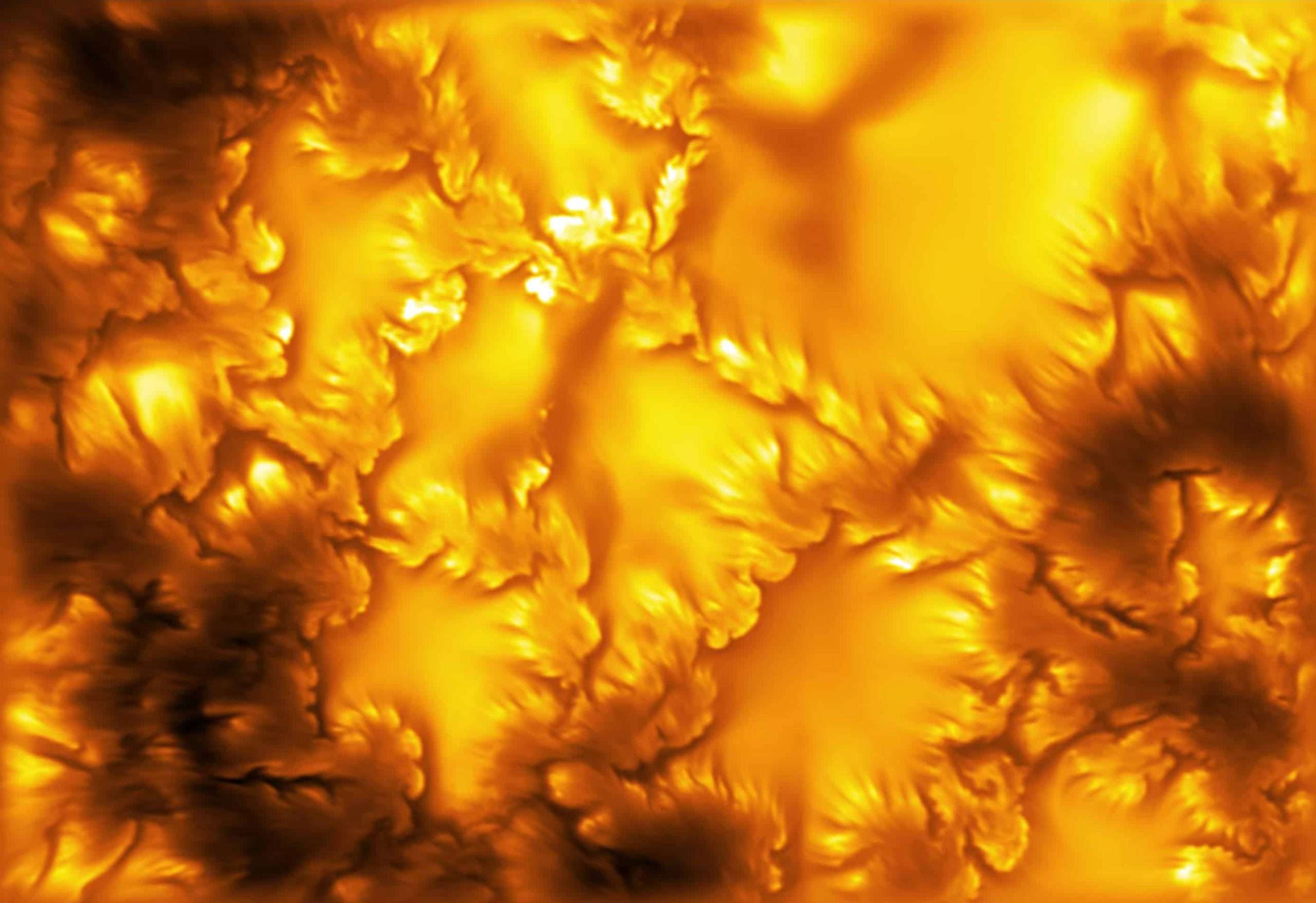
The surface of the Sun has been photographed in more detail than ever before, and it turns out to be covered in whirlpools. Victoria Gill reports for BBC News on the most detailed images of the Sun yet, taken by the Inouye Solar Telescope on a high peak in Hawaii and published in the journal Nature.
The swirls are the Sun's magnetic field being twisted and shoved around by the motion of hot gas. Physicists call the effect Kelvin-Helmholtz instability, and it turns up whenever two fluids slide past each other and small disturbances grow into spiraling vortices. In the ocean, it is what builds ripples into big waves. The National Solar Observatory says the vortices on the Sun sit 50 to 65 kilometers apart.
This churning is what produces the Sun's biggest outbursts. "These twisting motions are creating magnetic energy, which can build up to produce those large-scale explosions," NSO astronomer Dr David Kuridze told BBC News. His colleague Dr Friedrich Woeger said the energy gets released "as a flare or what's known as a coronal mass ejection."
Those releases are space weather, which can knock out power grids and satellites and injure astronauts. "To figure out and eventually predict space weather, we want to understand the physics of the Sun, all the way down to the smallest scales," said Dr David Boboltz of the NSO, who called the Sun a "unique laboratory." He added that "the first experimental proof of Einstein's general relativity came from solar eclipse observations. So simply for human knowledge, we need to have experiments like this."
Previously:
• The most detailed image of the sun
• Up-close footage of a solar eruption