
Remember me
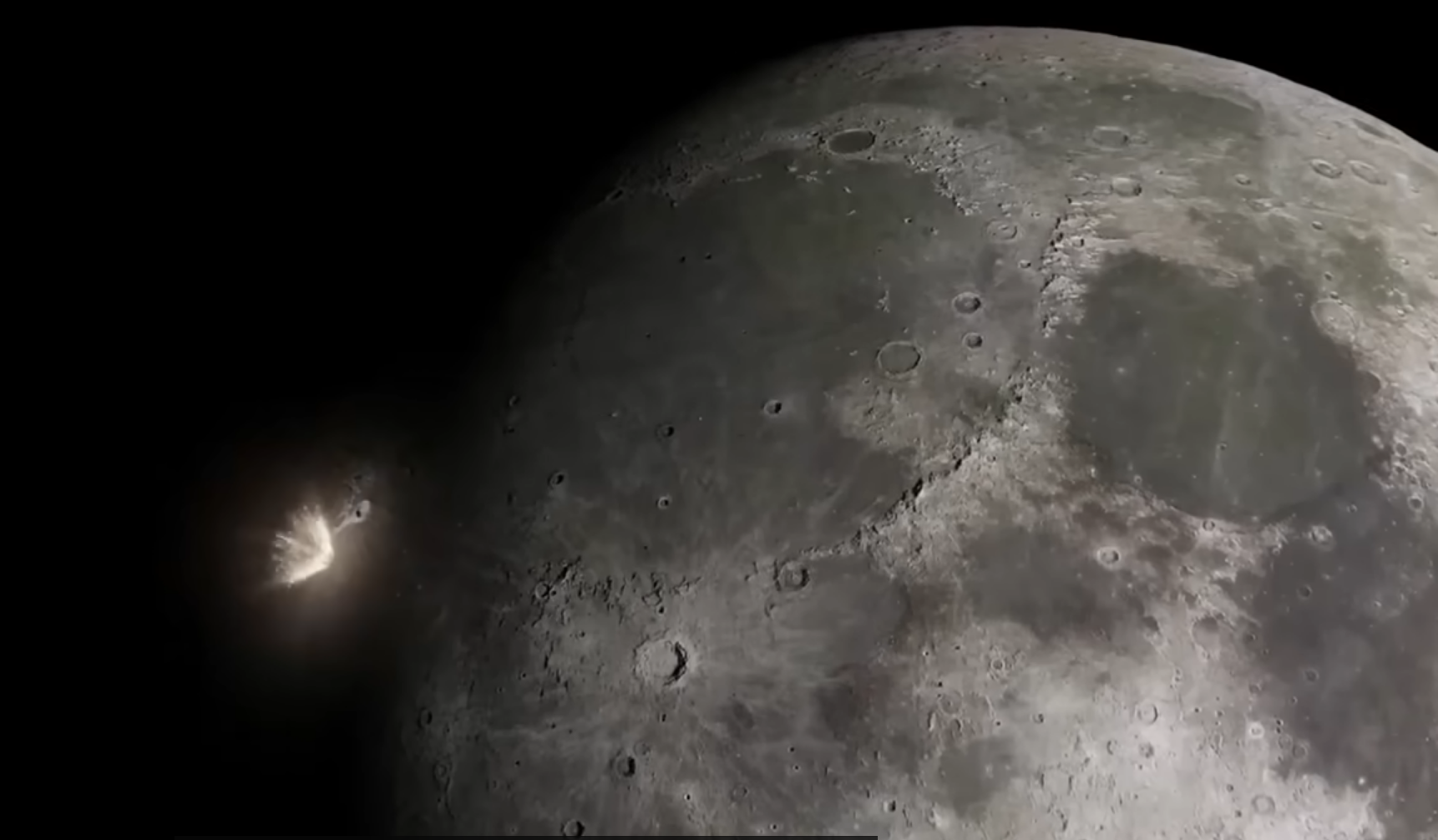

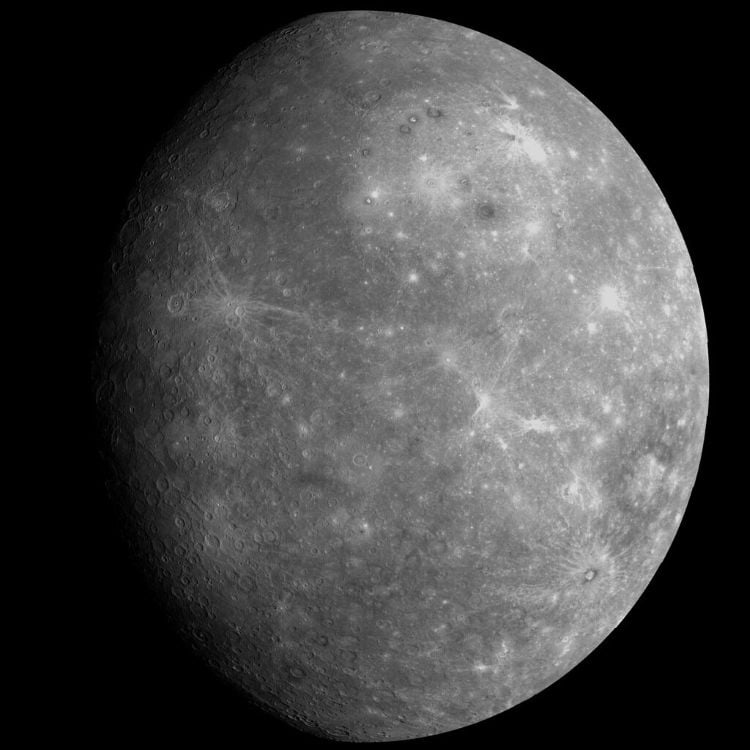
On Wednesday, August 5th, at 06:35 UTC (11:35 p.m. PDT; 2:35 a.m. EDT), a 13.8-meter (45-ft) long, 4,000 kg (9,000 lbs) spent upper stage once belonging to a SpaceX Falcon 9 rocket struck the Moon. The upper stage (designated object ) is a leftover piece of the rocket that launched Firefly's Blue Ghost Mission 1 and ispace's HAKUTO-R M2 “Resilience,”, two lunar landers that launched in January 2025. The spent stage struck the western "lunar limb," close to the Einstein Crater on the moon's dayside while traveling at roughly 8,700 km/h (5,400 mph).
Before the impact, scientists estimated that the upper stage would create a crater measuring 20 to 27 meters (65 to 89 feet) in diameter and 4 meters (12 to 13 feet) in depth. While no images of the collision were captured, the plume created by the impact was observable to viewers with the right equipment. In addition, astronomers at the ESO's Very Large Telescope (VLT) in Chile also provided spectroscopic data of the region, which noted the presence of lithium and sodium kicked up from the impact.
This dust dissipated within minutes of the impact, and images of the impact crater were captured afterward by the Korean Pathfinder Lunar Orbiter (KPLO) mission (also known as Danuri). "Danuri began observations about 30 minutes before the collision and, through orbit control, passed over the impact site multiple times, conducting a total of 8 imaging sessions," said officials with the Korea Aerospace Research Institute (KARI) on the morning of August 6th. "Through this observation, changes in the terrain around the impact site and traces of ejecta spread were confirmed."
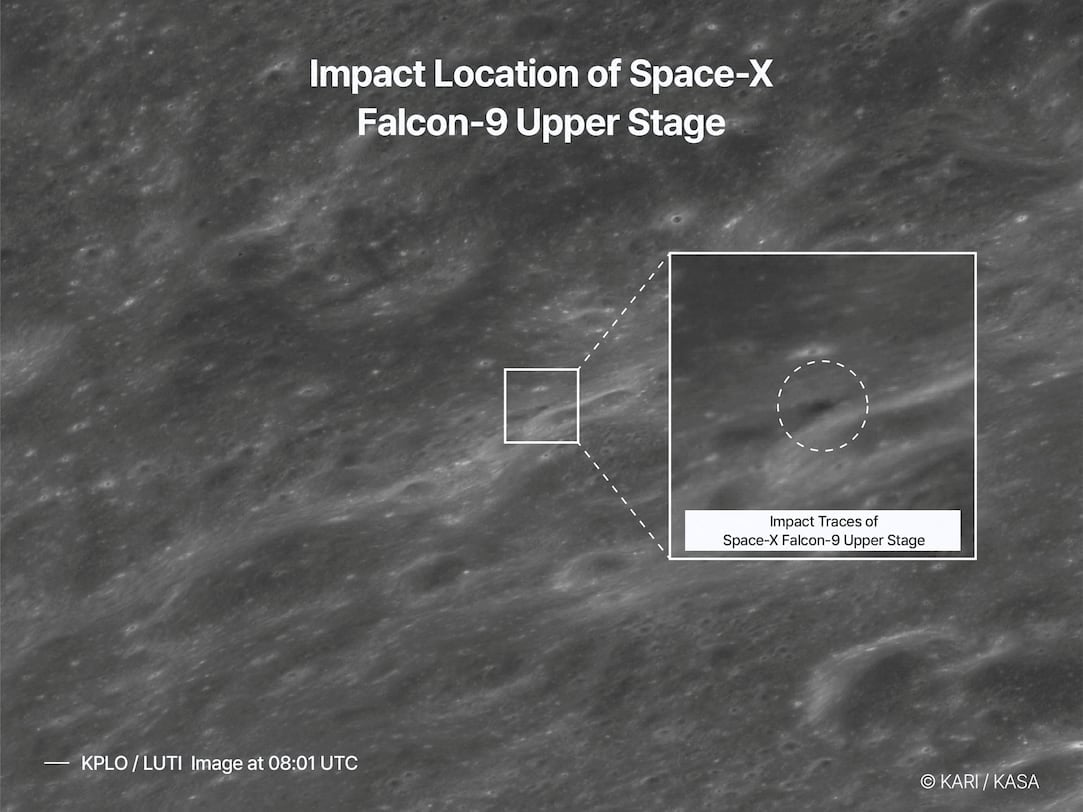 A satellite image shows the impact site of the second stage of a SpaceX Falcon 9 rocket after it smashed into the moon on Aug. 5. Credit: KARI/KASA/Reuters
The South Korean space agency also noted that the Danuri orbiter secured footage from before and after the collision, allowing for an analysis of the changes it caused. NASA also plans to conduct follow-up observations with the Lunar Reconnaissance Orbiter (LRO), in collaboration with KARI. The Meteoroid Environments Office at the agency’s Marshall Space Flight Center also used ground‑based telescopes to image the impact.
Astronomers at the ESO's Very Large Telescope (VLT) in Chile also provided spectroscopic data of the region, which noted the presence of lithium and sodium kicked up from the impact. While the impact and debris pose no harm to any missions currently in orbit or on the surface, the incident is something of a bellwether. As more rockets are sent to space and human activity increases in cislunar space, spent stages and debris will become a growing concern.
This was illustrated in a recent study by researchers from the Chinese Academy of Sciences (CAS), where simulations on debris propagation showed that space junk posed a collision risk to future missions. And now, a little over a month after the paper's release, a piece of debris from a rocket (belonging to the world's most famous launch provider) has illustrated this problem.
While this is not the first time that space debris has impacted the Moon, as NASA Administrator Jared Isaacman indicated in a post on X, this risk of impacts will increase as more launches are made. Already, NASA planners are concerned about safeguarding against meteoroid impacts, which are very common (as Isaacman also pointed out). However, the increasing risk of debris striking the surface must also be taken into account before crewed missions become a regular occurrence.