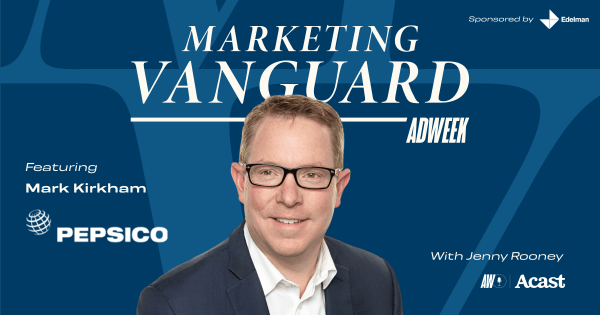
Our Marketing Vanguard series live from Cannes Lions continues as host Jenny Rooney sits down with Mark Kirkham, CMO at PepsiCo Beverages U.S., to break down why Cannes only works when CMOs show up with clear intention.
Mark explains how AI has moved from tech hype to operational reality, why disruption cycles collapsed from five years to five months, and why honest peer debate is the only way marketing leaders stay ahead.
What you’ll learn:
Why AI is shifting from hype cycle to everyday marketing work How CMOs should evaluate AI through growth, efficiency, insight, and discoverability Why disruption now happens in months, not years How peer learning and open debate help the entire industry move forward Why Cannes works best when CMOs prioritize quality over quantity How teams can learn from challenger brands and organic social-first thinking Why the industry has a role to play in making Cannes more curated and creatively valuable
This episode is part of a special vidcast series recorded live during Cannes Lions 2026 and presented in partnership with Edelman.
About our guest:
Mark Kirkham is Chief Marketing Officer of PepsiCo Beverages US, where he leads brand, category, and marketing programs across Pepsi, Mountain Dew, Starry, Bubly, and Mug. A 15-year PepsiCo veteran, Mark has held global and regional marketing leadership roles including Chief Marketing Officer, International Beverages, VP of Global Sports, Juice and Energy, and Head of Marketing & Innovation for Western Europe.
His work has included Pepsi’s UEFA Champions League partnership, the global Pepsi Taste Challenge, expansion of Gatorade and Mountain Dew across international markets, and award-winning brand and innovation programs. Before PepsiCo, Mark held roles at P&G, Nielsen, and Forrester Research.
Episode Highlights:
[01:58] Why Quality Over Quantity Is Better for the Industry — Mark sees the compression at Cannes as a good thing if it leads to better curation. Fewer people, fewer submissions and more intentional participation can improve the quality of work, conversation and networking. For CMOs, the takeaway is clear: showing up everywhere and submitting everything is not the strategy. The stronger move is knowing what deserves attention and making those moments count.
[05:21] The Five-to-Ten-Month Disruption Cycle — Mark makes a sharp point about the speed of change. Marketing used to move through five-to-ten-year disruption cycles. Now it feels more like five-to-ten months. That changes what leaders need from the industry. Annual check-ins are not enough. CMOs need constant conversation with peers, partners, and agencies so they can stay close to what is evolving across both brands and the broader ecosystem.
[07:36] Why Learning Alone Is Not Enough — For Mark, the job is not only to keep learning individually. It is also to share collectively. Cannes and communities like Marketing Vanguard matter because they create rare spaces for honest conversation, disagreement, and healthy tension. His line cuts through: the day he stops learning is the day he stops being a marketer, but the day marketers stop sharing with each other is the day the industry stops learning.
[08:47] Why Different Business Models Make Teams Smarter — Mark points to Poppi as an example of why traditional marketing teams need different perspectives in the room. Bringing in talent from a brand built through organic social forces a large organization to see brand building differently. It is not about one model being better than another. It is about exposing teams to different instincts, different speeds and different ways of earning attention.