'To Be Forgotten Is to Die Twice': The Fight to Protect the Graves at Ireland’s Bessborough Mother and Baby Home
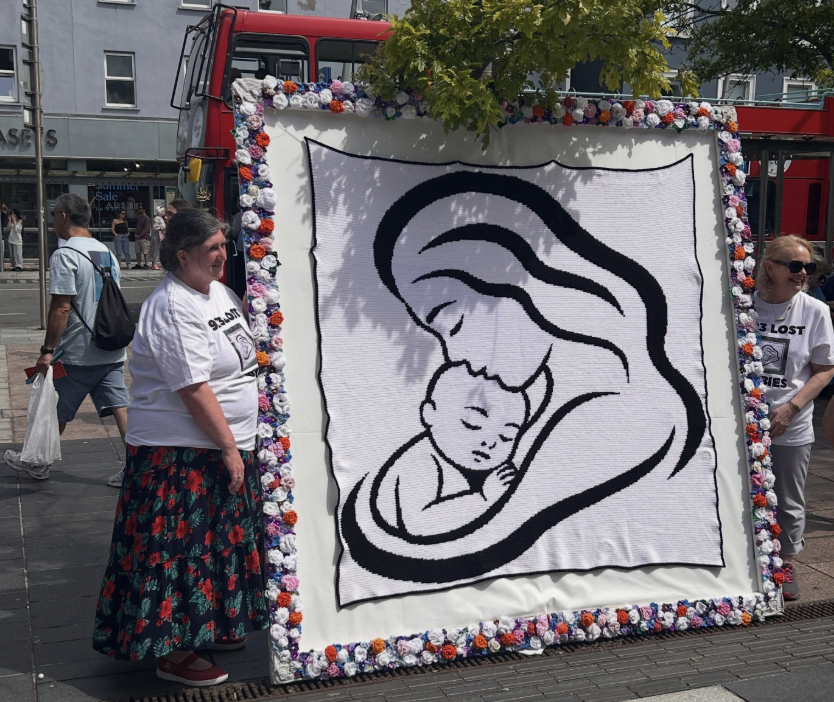
Institutions called the Magdalene laundries, or mother and baby homes, effectively became prisons for “fallen” or “immoral” women who deviated from strict social norms. (Courtesy of the Irish Council of Civil Liberties) Survivors and advocates in Ireland are fighting to stop the construction of luxury apartments on the grounds of the former Bessborough Mother and Baby Institute, where hundreds of infants who died in state- and church-run custody are believed to remain buried in unmarked graves. At a national rally on July 18 outside the Cork City Library—the site of the former Bessborough Mother and Baby Institute—survivors and their families warned building over the site would erase one of Ireland’s darkest chapters. There, survivors and their families spoke about their experiences. Advocates held a banner with the names of infants who died at Bessborough and others marched with signs reading, “To be forgotten is to die twice.” Bessborough is part of a system of containment institutes first founded back in the 1760s as places to help sex workers pursue more “moral” forms of employment. By the 1800s, these institutions—called the Magdalene laundries, or mother and baby homes—effectively became prisons for “fallen” or “immoral” women who deviated from strict social norms. Run by Christian religious orders and institutions, mother and baby institutes kept unmarried pregnant women hidden from public view in a Catholic country where unmarried pregnant women and girls were and are deeply stigmatized. Inside mother and baby institutes—which received public funding and were run by religious orders—unmarried pregnant women and girls were hidden away and faced intense violence. According to the Irish Mother and Baby Homes Commission of Investigation, 11.4 percent of the people incarcerated in these institutions were minors. After their children were born and babies at least partially weaned, these women were forcibly separated from their children who would be taken for adoption. But many children died in these institutes because of systemic neglect and abuse. … If these apartments are built, the floodgates will be opened. Elliot Gallogly, descendant of a survivor of the Good Shepherd Magdalene Laundry Institute in Limerick According to the data that is available, almost 9,000 babies were born at the church-run institute that imprisoned unmarried pregnant girls and women until they gave birth between 1922 and 1998. In 2021, the Commission of Investigation into Mother and Babies Homes released their final report detailing emotional abuse, “appalling physical conditions” and traumatic childbirth experiences. At Bessborough, which was run by the Congregation of the Sacred Hearts of Jesus and Mary, 953 babies and 19 women died and were buried in unmarked graves on the property; 859 of those babies’ burial locations are currently unknown. According to the Mother and Baby Homes Commission, many are “highly likely” to be buried at the very place where the Estuary View Enterprises is planning to build 106 apartments. Although preliminary searching has not uncovered any remains, this does not mean children are not buried on the property. To date, no survey or ground penetrating radar have been used to assess the site. Three children who lived at Bessborough, circa April 1961. (Courtesy of survivor Mari Steed, far right, via CNN) Despite Estuary View Enterprises’ plan to build expensive, largely inaccessible housing during an ongoing housing crisis in Ireland, an Coimisiún Pleanála, or independent quasi-judicial body that decides appeals, ratified a decision a week before the July 18 rally that would allow the fund to build apartments on the former site of Bessborough, effectively stifling any effort to uncover the final resting place of these infants who died while in the care of state-and-church sanctioned institutions. At the rally last month, dozens of survivors and advocates called on the state to purchase the land. This call is not new—survivors have long been demanding the protection of these lands to memorialize their lost loved ones and further investigate their final resting places for decades, but this past week’s developments highlight the urgency of this issue. The council’s decision also sparks a broader discussion about what states owe the survivors of violence and murder and the stewardship of land which still holds immense trauma and unidentified remains. As Ann Marie Ahern, councillor for the East Cork Municipal District, shared on social media, “Bessborough is sacred ground.” The issue of recognizing the history of Magdalene laundries and mother and baby institutes is more important than ever, as existing businesses and homes already stand on the lands—some even in the exact buildings—where this violence occurred. … The Irish state has not compelled any of the religious orders to pay any amount of compensation to survivors or even release all records, so we don’t have accurate numbers. Gallogly Elliot Gallogly, a PhD candidate at the University of Galway’s Department of History and descendant of a survivor of the Good Shepherd Magdalene Laundry Institute in Limerick, organized a sister protest in Galway last month “sparked out of solidarity, empathy, and also the knowledge that if these apartments are built, the floodgates will be opened.” “We already have ex-Magdalene and Mother and Baby Institute buildings that are currently active and thriving schools or businesses that barely acknowledge their past with a plaque or line of text in the building’s history,” he said. The hope is that this step would not only help Irish citizens understand the histories of violence that took place where they live, work and learn, but implore them not to repeat them again in the future. Last month’s protest was a call to action for people across the party line about the importance of not only preserving sites of violence for survivors to grieve but also to allow the state and independent researchers to uncover other information that can help families still looking for their loved ones. As Carmel Cantwell, an advocate whose mother and brother were inside the Bessborough Mother and Baby Institution in 1960, wrote via email, the July 18 protest “was a great show of solidarity from survivors, supporters and cross party public representatives who came together to show this was political but that it was the right thing to do.” While on the surface this fight feels contained to Ireland, there is a long history of exploitative homes for unmarried mothers. In the late 19th century, homes housing unmarried pregnant women opened across the country, growing to a peak in the mid-20th century when unmarried women lived in hidden institutions where they were pressured to give up their children for adoption, just like in Ireland. Many of these homes in America closed after Roe v. Wade in 1973. But over 400 of these homes remain open to this day—such as Liberty University’s Godparent Home where unmarried women bear and give birth to a child whom they are coerced to adopt out to wealthy Christian parents. These mothers are then incentivized with a full-ride scholarship to the university. While mother and baby homes exist in the United States, they do not in Ireland but there is still work to be done. Liberty’s Godparent Home began under the direction of Jerry Falwell Sr., the fundamentalist Baptist preacher and televangelist. (The Liberty Godparent Ministry / Instagram) Gallogly urges people to sign the petition to stop the buildings and to learn more about the history of “Ireland’s architecture of containment.” The identification and protection of the final resting place of these babies is just the beginning. “To this date,” Gallogly explained, “the Irish state has not compelled any of the religious orders to pay any amount of compensation to survivors or even release all records so we don’t have accurate numbers.” Currently, nearly all of the information on mother and baby institutes is survivor testimony, and as a result, many women and children who lived in the institutions or family of these people do not have any information about what happened to their loved ones or where those who died or were killed rest. While the commission’s final report affirms that “women and children should not have been in the institutions,” it fails to acknowledge the gross abuse that survivors have detailed largely from lack of evidence. This failure to officially recognize the abuse people faced perpetuates the same trauma of erasure that survivors are facing with this real estate development. “People can also help by pressing the Irish government in all capacities to work faster on the Archive relating to Irish Institutional and Family Separation History,” Gallogly wrote to me, “to compel the religious orders to release all relevant information, and to Compulsory Purchase Order all land that may be contested grave sites for excavation survey.” The goal is not just to protect Bessborough lands but all former institutes in Ireland and to pressure the people and organizations who ran them to divulge their records. Bessborough is just the start, hopefully the spark to create official state systems not only to hold these people and organizations accountable but also to secure financial reparations for survivors and their families and create and fund spaces and programs to grieve and memorialize the dead. If Bessborough is the start, survivors and advocates on site point to a larger goal to protect sites of violence and stop them from witnessing this abuse and murder in the first place, including one sign that read: “From Bessborough to Palestine Building on Babies Bones is a Crime.” Bessborough opens a much wider discussion about what we and the state, as witnesses to violence, owe the dead and how trauma lingers not only in the land but in the people whose relatives’ bodies are built on top of. As Cork Sen. Laura Harmon said at the rally on July 18, “They say that the arc of history bends towards justice, but that arc only bends because we make it bend. We’re telling the Taoiseach, we’re telling the people of Ireland, the government, and the world that we are going to bend that arc at all costs towards justice because our history is part of our present, and it’s part of our future, and we will do everything in our power to ensure we save Bessborough.” * A note from Ms. editors: We want to hear from you for The Majority, a new campaign collecting stories about how reproductive freedom has enabled readers to build the lives they want and need. Poll after poll shows a majority of Americans support reproductive healthcare access. Yet public debate overlooks the lives shaped by abortion access, contraception, IVF, miscarriage care, maternal healthcare or comprehensive sex education—countless women who chose to pursue an education, have children, not have children, protect their health and chart their own future. Add your voice and complete the sentence: “Access to reproductive choices gave me the freedom to….” Together, these stories will help show not only why reproductive freedom remains a majority value, but also what it makes possible. Look to these trusted groups if you or a loved one needs to know more about reliable abortion care: Ensure work like this article continues At Ms., we believe the stories that shape women’s lives deserve serious, sustained coverage. That’s why, since 1972, we’ve reported on gender, politics, democracy, reproductive freedom, economic justice and culture long before the mainstream press caught up. Our journalism remains independent because it is funded by readers—not advertisers, corporations or billionaires. If this story mattered to you, please consider supporting Ms. by making a tax-deductible donation, becoming a member to receive a magazine subscription, or gifting a membership to a friend. Your support helps ensure that feminist journalism not only survives, but thrives.