
Remember me







Going vegan could help you lose excess weight far quicker than Ozempic, scientists have suggested.
Researchers discovered that people who ditched foods like meat and fish for a low-fat plant-based diet shifted 5.9kg – or 13lb – of their body weight after just four months.
In comparison, trials show that those injecting semaglutide, the active ingredient in the blockbuster jabs Ozempic and Wegovy, lose an average of 6.9kg, just over a stone, in nine months.
Some studies on the weight loss injections, which are now used by some three million Britons, show an even more gradual slimming effect, with patients losing an average of just 10lb over seven months.
The new research, by US scientists, found that eating plant-based foods cuts daily calories by around a quarter – roughly 500 – resulting in significant weight loss.
The study followed 224 overweight adults, most of whom were women, with an average age of 54.
They were split into two groups; half the patients adopted the plant-based diets while others maintained their original eating habits.
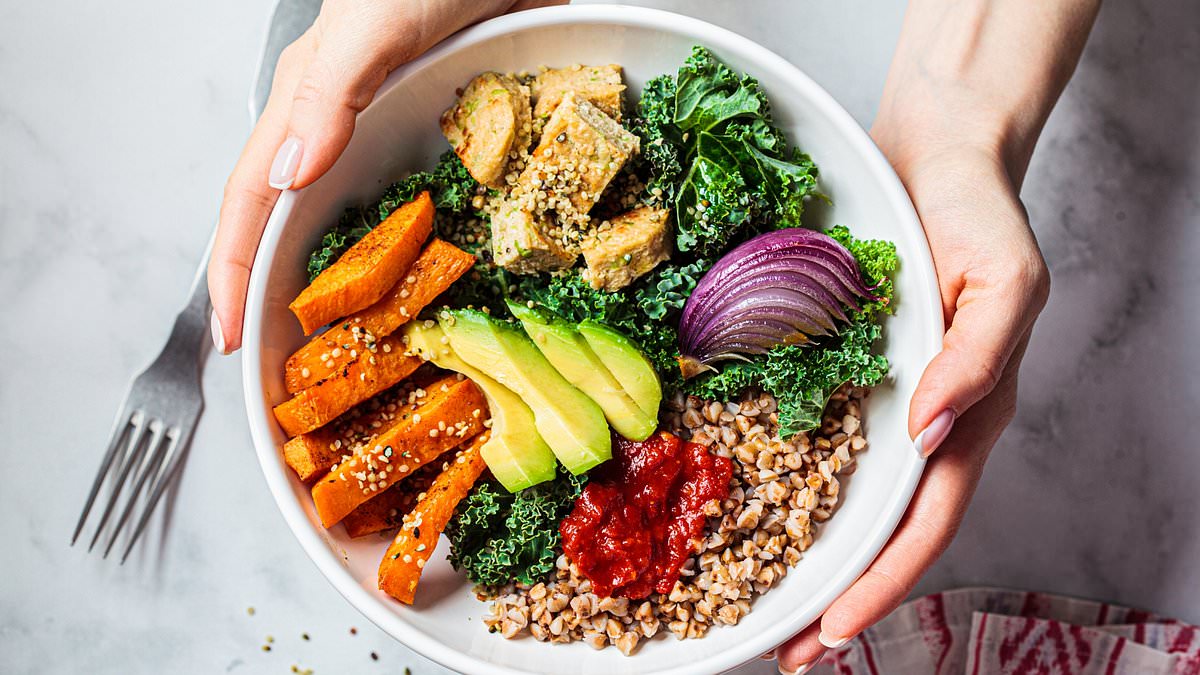
Those following the vegan diet could eat as much fruit, vegetables, grains and legumes like chickpeas and beans as they liked, but were told to avoid meat, fish, dairy products and eggs.

Researchers found that people who ditched foods like meat and fish for a low-fat plant-based diet shifted 5.9kg – or 13lb – of their body weight after just 16 weeks
After 16 weeks their average vegetable intake rose by around 150g – roughly half a head of broccoli- and fruit intake increased by around 80g, the equivalent of a medium apple.
The consumption of legumes, such as beans, almost tripled, while their intake of plant-based meat alternatives more than doubled.
After finding that the routine brought weight loss of almost a stone, the researchers wrote in the journal JAMA Network Open that the intervention 'may be an effective treatment for overweight adults'.
In a secondary analysis, the team found that the reason meat-heavy diets are fattening is because they are much more energy-dense. In other words, they contain more calories.
They discovered that the vegan participants had been eating roughly the same weight of food as they had before, when their diets included meats.
However, they were consuming close to 500 fewer daily calories than those continuing to eat meats, dairy, fish and eggs.
In real terms, they had gone from eating 1,834 calories per day to 1,343 calories per day – a decrease of more than a quarter.
The team - from a group of universities including the University of Utah - added: 'Plant-based foods are high in water and fibre and low in fat, increasing food volume without a proportional increase in energy content.
'This promotes satiety (feeling of fullness) and reduces energy intake without deliberate caloric restriction.'
As well as losing weight, the study found that those on the vegan diet had more stable blood sugar, less fat in the liver and muscles, and burned more calories digesting food.
The researchers wrote: 'These findings suggest that dietary composition – specifically, an emphasis on plant foods – can meaningfully influence energy intake regulation.
'This mechanism helps explain the significant weight loss and metabolic improvements observed in response to a low-fat vegan diet...'
The scientists did acknowledge the study's limitations, including that the study relied on patients self-reporting the foods that they were consuming.
They also said the participants volunteered for the study and may not represent the wider population.
Around 3.5 million people in the UK are believed to follow a plant-based diet.
Experts have said that the eating plan has a number of health benefits, and separate studies have shown that vegans are less likely to suffer from heart disease, diabetes and cancer than meat eaters.
However, some say that veganism can also trigger a number of harmful vitamin deficiencies.
Chief amongst these is a lack of vitamin B12 – a nutrient crucial for healthy blood vessels and brain function that is not found in plant-based foods like fruits, vegetables and grains.
Instead, vitamin B12 is primarily found in meat, fish, milk and eggs. The NHS advises that vegans take a daily vitamin B12 supplement.
'This is a vitamin that is fundamental to the function of the human body, and it is almost entirely absent from a vegan diet,' Dr Julian Owen, consultant trauma and orthopaedic surgeon at Addenbrooke's Hospital, previously told the Daily Mail.
'If supplements are not taken, after six months of going vegan, people can start to experience neurological symptoms such as anxiety, depression and even psychosis – symptoms of Vitamin B12 deficiency.'