“Putin has done a lot of good”: Norwegian activists head to Russia once again
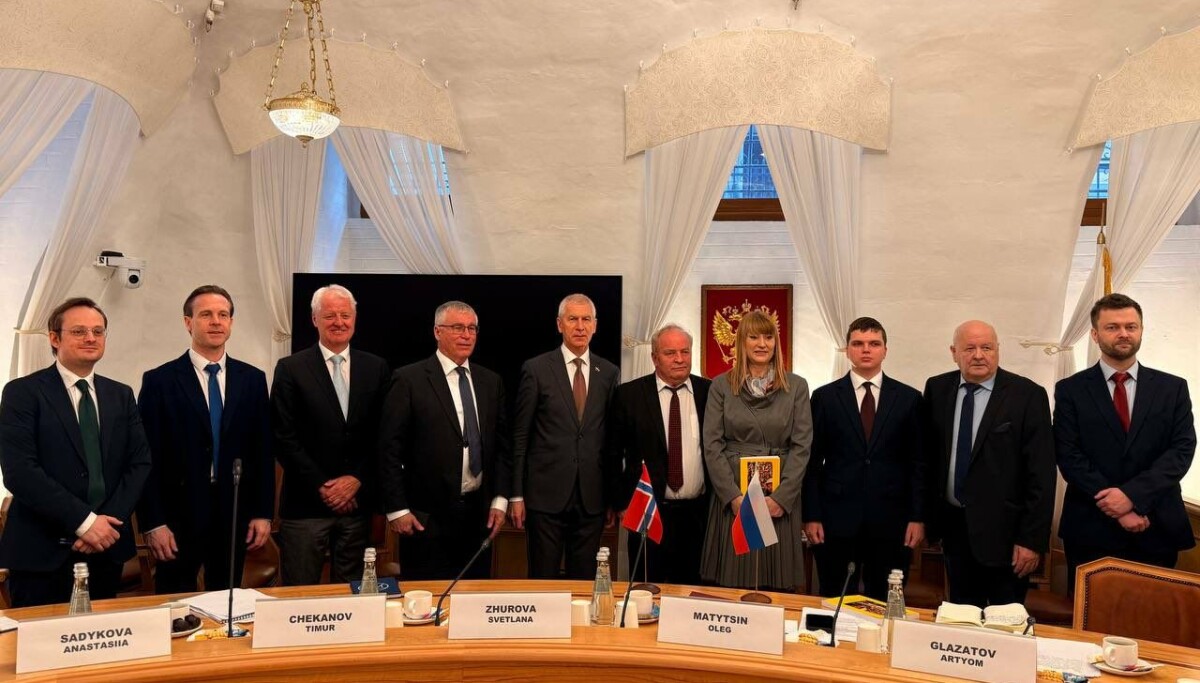
In 2026, activists met in Moscow with Svetlana Zhurova, a State Duma deputy who performed at a concert commemorating the annexation of Crimea titled "For a World Without Nazism! For Russia! For the President!" Zhurova is subject to sanctions by the European Union, Canada, the United States, the United Kingdom, Switzerland, New Zealand, Australia, and Japan.
Photo: Russian Embassy in Norway
Members of the organisation Bike for Peace regularly travel to Russia, where they meet politicians and state officials, earning favourable coverage from Russian state media. Ahead of their current visit, we spoke to the activists about dialogue with the Kremlin, the war in Ukraine, and why their leader believes “Putin has done a lot of good.”
While Norway remains one of Ukraine’s staunchest supporters and has joined its European allies in condemning Russia’s aggression, a small group of Norwegian activists continues to cultivate ties with Moscow.Their trips have received enthusiastic coverage from the Russian state-aligned media, including Tsargrad, TASS, Komsomolskaya Pravda, RIA Novosti, and the Murmansk-based TV-21.We met members of Bike for Peace on the eve of their latest visit, shortly after they had collected their Russian visas from the Russian Consulate General in Kirkenes.On the morning of 30 July, the lobby of the Scandic Hotel is bustling. A group of around ten Norwegians, led by Bike for Peace chairman Tore Nærland, are outlining the plans for their forthcoming trip to Russia to journalists from Norwegian broadcasting NRK.The organisation first began organising cycling tours to the neighbouring country in the early 1980s with the aim of promoting Soviet–Norwegian friendship. Since then, Nærland and his colleagues have visited Russia more than twenty times. Following Russia’s full-scale invasion of Ukraine, they swapped bicycles for buses and began making the journey to Moscow in stages.Having finished speaking with the Norwegian reporters, Nærland turns to us and immediately sets out his pacifist position.“You know, when Ukraine drops bombs on Russia, or when Russia does the same to Ukraine, it’s wrong. It’s simply wrong. We’re against all wars.”When we point out that Ukraine is acting in response to Russian aggression, Nærland agrees—but with a qualification.“Yes, of course. But, you see, we have to look at the historical context.”In his view, it is the West that bears responsibility for prolonging the war in Ukraine and for the events that led to it.“Of course, we oppose what happened on 24 February 2022. But we also don’t like what happened in 2014. You know there was a coup in Kyiv, backed by the United States and the CIA.”
Tore Nærland (left) and Erik Berge in the lobby of the Scandic hotel in Kirkenes.
Photo: Olesia Krivtsova
Nærland and his companions also take a markedly different view of Russian politicians. According to him, many of them genuinely want peace.As he speaks, Nærland taps the cover of a book he published after his previous trip to Russia in March 2026. The cover features him posing with a large group of State Duma deputies.“This is MP Svetlana Zhurova, the Olympic speed-skating champion. She’s now in parliament. After meeting us, she travelled to the United States and spoke with a member of Congress. We want to build a bridge between East and West. We are not participants in this war. It’s not in our interests.”At that moment, our conversation is interrupted by a woman working at the hotel reception. She politely asks us to move elsewhere because she can hear the discussion.“I’m from Ukraine. I’ve lost everything—I no longer have a home. This is too painful a subject for me. Could you please continue your conversation somewhere else?”“We’re more interested in what can be done today to find a peaceful solution,” Nærland continues after moving away from the visibly distressed Ukrainian receptionist.“But the State Duma has no real decision-making power,” we point out. “It is entirely subordinate to Putin, and he has shown no willingness to end the war.”“We’ve never spoken to Putin directly, of course, but we have met one of his advisers and members of parliament,” Nærland replies. “They say they want to find a solution, and that people around Putin are also interested in peace. So far, those are only words, without action. But now they’ve invited us back to Russia to discuss it. I believe that creates an opportunity for dialogue. Do you see what I mean?”Nærland then shows us another photograph in his book—this one featuring Russian Senator Sergey Kislyak, whom the group met during their previous visit to Moscow. The Federation Council’s media outlet Vmeste RF later produced a video report on the meeting, in which Nærland argued that, unlike Western countries, “Russia does not pursue a policy of boycotts” and that relations between Norway and Russia should become even closer.
Senator Sergei Kislyak at a meeting with Norwegian activists in Moscow in March 2026.
Photo from the Federation Council website
Joining the discussion, Erik Berge, one of Nærland’s long-time associates, describes Kislyak as “one of the most experienced and senior representatives of the Russian authorities with whom this [anti-war] issue can be discussed”.“At the beginning of February, the treaty [on measures for the further reduction and limitation of strategic offensive arms] expired. We went to the Federation Council and met Sergey Kislyak. We publicly asked him about New START. This is a serious existential issue that people still need to discuss, regardless of everything else.”“We don’t ride bicycles for fun,” Nærland adds. “We ride for peace. Peace means ending war. In your opinion, what is the best solution? To come together, to talk, to sit down at the negotiating table…”“But Kyiv and Moscow have already tried that several times,” we remind him. “The problem is that Putin wants to seize Ukrainian territory, which is unacceptable to Ukraine. What do you think about that?”“It’s not for us to find the solution. They have to sit down and negotiate. That’s why we condemn all wars: the war in Ukraine, the war in Iran, the war in Iraq.”To reinforce his point, he asks Berge to fetch another of his books, Survivors of Hiroshima and Nagasaki, inspired by the many cycling expeditions he has undertaken around the world. Judging by the photographs, Nærland and his fellow activists have travelled through Japan, Kazakhstan, the United States, the United Kingdom and China.
Norwegian activists at a meeting with Murmansk students in March 2026.
Screenshot from the video: TV-21 Murmansk
We ask whether they are aware of the Russian political prisoners jailed for opposing the war.It turns out they are.“But we also know the other side,” Nærland and Berge suddenly reply. “We know what is happening to opposition figures in Ukraine today.”“But we’re not talking about Ukraine,” we respond. “We’re talking about Russia, because that’s where you’re travelling, and you’ll be meeting people who voted for repressive legislation.”The two activists fall silent for a moment.“I can’t answer for everyone,” Nærland finally says after a pause, “but I can answer for the people we met on our previous trip. We had a very good dialogue, and we condemned things that are wrong.”Berge, meanwhile, turns his criticism towards the Norwegian media.“I contacted journalists I know personally who have experience covering events in Russia and Ukraine. They had no interest whatsoever in hearing what we wanted to say about our previous trip. I can’t understand or explain that lack of curiosity. And the questions they asked were rather provocative—as though they wanted to push me into talking about things I had no reason to discuss.”“Do you like Putin’s policies?” we ask.“That’s a good question—a very good question!” Nærland exclaims. “I like you very much. It’s a difficult question, but, you know, I don’t live in Russia. Of course, Putin has done a lot of good by making sure people have jobs in Russia. But I shouldn’t… answer that. Do you understand?”Asked whether he considers Russia to be a dictatorship, Nærland replies simply:“I wouldn’t put it that way.”Before leaving, we ask why there appear to be no women among the Norwegian activists.“There are, there are,” Nærland and Berge laugh. “Two women are travelling with us—they’re just in the swimming pool at the moment. We have no problems with gender equality.”Among those listening quietly throughout the interview is one of the movement’s youngest participants, 26-year-old Daniil Doroshenko. He obtained Norwegian citizenship in 2023, having previously lived in Norway as a resident.According to publicly available information, Doroshenko served in the Russian military between 2020 and 2021. It has not been possible to establish whether this was compulsory military service or service under contract.
Both images were taken from Daniil Doroshenko’s Instagram profile. Following his interview with the Barents Observer, the photograph on the right was removed.
Photographs posted on Daniil’s Instagram account and on his father’s profile on the Russian social network Odnoklassniki showed a young man in military uniform strongly resembling Doroshenko. He insists, however, that the person in the photographs is his brother.Doroshenko declined to answer questions about the forthcoming trip to Russia.Shortly after our meeting with the Bike for Peace activists at the Scandic Hotel, the photograph of a man in military uniform disappeared from his Instagram account.