LAST UPDATE
|
1 hr ago
The Housing Essay is a new weekly deep dive from a rotating variety of voices into issues impacting the property crisis in Ireland. Are there potential solutions that may be currently overlooked or traditionally ignored by policymakers?
NOTHING BEATS THE joy of sitting on your balcony watching the world go by underneath and all around you. Children playing on the swings, older longtime friends chatting on benches, people on bikes meandering by, or simply watching the trees sway gently in the light wind.
We’ve reached that time of year when a large number of us leave our island and venture out across European cities, with many of us struck by the amazing public spaces other Europeans take for granted. This year we decided to do our holidays differently. Instead of staying in a hotel room or using potentially unethical short-term lets, we’ve committed to two weeks dog-sitting in Rotterdam.
What we love the most about pet sitting is the opportunity to spend time with a new doggy friend, while also immersing ourselves in the local environment, observing the community, the built environment and the public realm. Letting us experience a real home away from home.
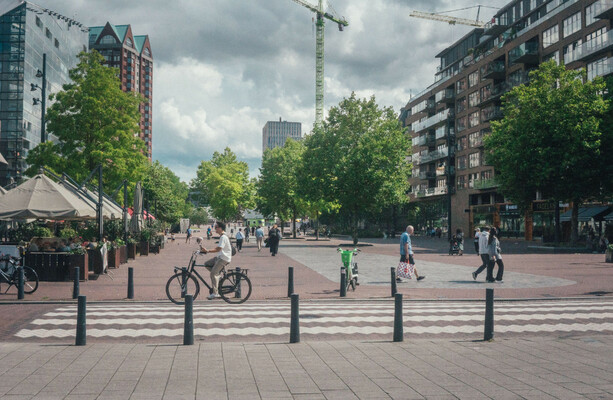
Having lived in the Netherlands before, we knew what to expect, but every time we return to the country it’s a culture shock. Seeing the normality of great public spaces accessible for all. Spaces that many in Ireland would assume were only accessible through exclusive gated communities; in other words, an overarching mindset of public luxury but only for those who can afford it.
Looking out from our 5th floor apartment in Rotterdam, you can see and hear this public luxury everywhere. The trees, trams, parks, playgrounds, waterways, bins, cycle paths, footpaths, seating and so much more. You can’t miss it, unless you’re in a car (which there aren’t too many moving around in the four days we’ve been here).
But most of all, we get the feeling of a lived space, a place where people rest, play and work, a place where people can build an urban community, with a thriving local economy. The new apartment block we look out onto has helped build this sense of community by ensuring its shared green spaces, benches and playgrounds are open and free for all to use, rather than being locked away from the public behind gates. This type of development approach is normal here.
Why can’t we do the same?
This is a stark contrast to the new apartment blocks close to our home in Cork City. We’ve seen so many blocks go up, creating 100s of new homes, yet providing little in the way of public services. No playgrounds for children, no bins and very little in the way of green spaces and benches.
There is one thing Cork City and Ireland do have in bucket loads, but that is missing in the Netherlands. Dereliction. So if you walk around most streets in Ireland, your overriding experience will be one of public squalor. If you’re lucky, you might get a sprinkle of public luxury in the form of an odd bench, tree or bin.
So how do you explain that in a country frequently ranked as one of the richest in the world, public squalor dominates our public realm, infrastructure and services? Maybe the answer lies in a 1958 book by economist J. K. Galbraith’s called ‘The Affluent Society’.
Galbraith’s theory was that ‘public squalor’ occurs when countries prioritise ‘private affluence’. This, it seems, is exactly like how Ireland is currently being governed. We are watching private companies and individuals become extremely wealthy while our public services are dangerously mismanaged.
There are so many examples linked to the Irish housing crisis. For example, instead of directly building public housing on state land, we are spending millions each month renting homes from private landlords. We are paying €180K a year to keep a family in for-profit emergency accommodation, while it would cost a fraction of that to bring thousands of empty council homes back into use.
The crowning achievement of Ireland’s ‘prioritisation of private affluence resulting in public squalor’ couldn’t be visualised better than through the decay and dereliction.
We have long argued that using derelict buildings is the most sustainable way to create more homes, cheaper and quicker than new build. We also strongly advocate for new apartments to be built in our cities and towns, densifying our urban environments before expanding into greenfields or allowing landlords to rent out sheds.
But we need to ensure we densify in a way that makes our urban environments great places to live, rather than their current squalid state. This requires a different mindset to our traditional suburban semi-detached cul-de-sac housing developments, that expects everyone to have a car for accessing anything outside their home environment.
For instance, if you end up living in one of the smaller and darker apartments the government wants built in urban Ireland, where do you go to socialise with friends for free? Where can you sit outside to breathe in fresh air and feel the sun on your face?
Where can your children play?
The reality of living in a town or a city is that your home goes beyond the walls that surround you. An urban home includes all the public spaces, nature parks, playgrounds, sports fields, transport links, libraries, swimming pools, exercise fields and much more.
With increasingly less space in urban homes, there is a much greater need to compensate with aptly designed public spaces.
Some might consider all of this to be a waste of taxpayers’ money. Others may believe that public luxury should only be accessible for those who can afford it. Thankfully, we and others like us view it differently, considering it essential public services. Services we need to normalise in Ireland to improve everyone’s quality of life, so society as a whole can prosper. Services that are also essential for creating more sustainable, climate-resilient and equitable environments.
Sadly, we are currently a long way from this in Ireland. However, there is Dóchas, with an increase in conversations in recent years.
Most notably in the recent RIAI Cities in Crisis podcast series where we used our contribution as an opportunity to draw specific attention to the ever more urgent need for public luxury.
Jude Sherry and Dr Frank O’Connor are founders of anois.org, ffud.art and #DerelictIreland. They are part of a series of writers, academics and economists penning a weekly essay delving into the housing crisis and potential solutions.