
Remember me



 Kyle Ross-Imagn Images
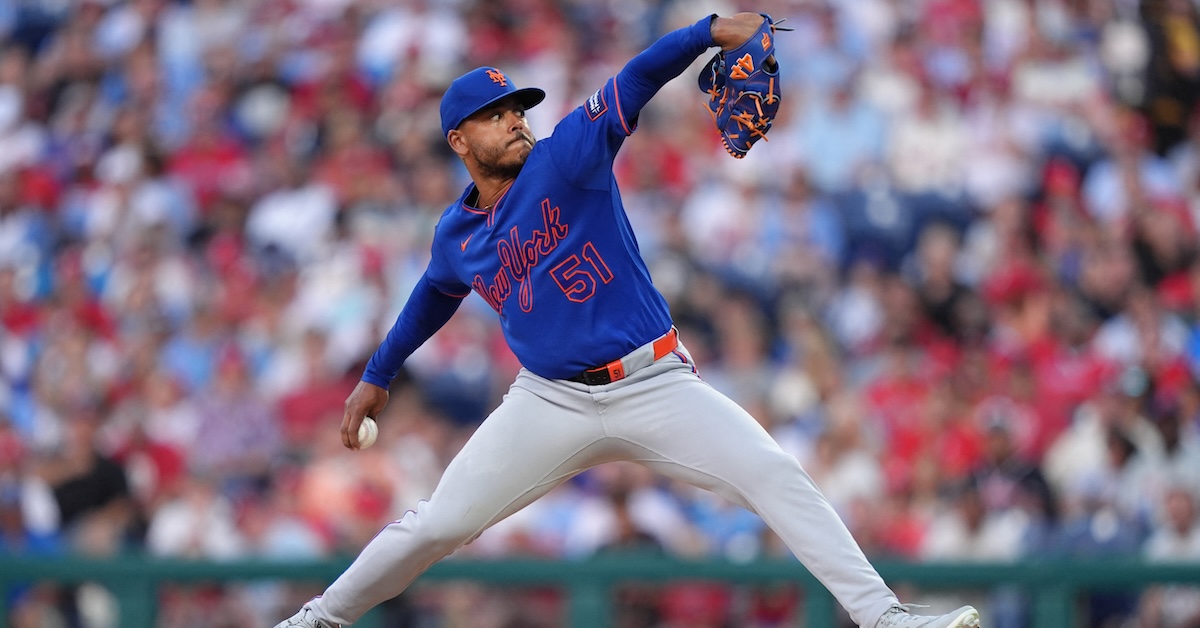
You and I might never know if the Rays could have outbid the Dodgers for Tarik Skubal, but with the no. 1 player on the trading block off the board, Tampa Bay swept into action within hours. For the cost of outfielder Aidan Smith, second baseman Émilien Pitre, and pitcher Gary Gill Hill, the Rays have acquired right-hander Freddy Peralta from the New York Mets. The Rays, in a departure from their habitual cheapskatitude, are assuming the remaining $2.47 million left on Peralta’s contract.
At the time of the trade, the Rays had a sizable-but-not-completely secure 3.5-game lead over the Yankees, both for first place in the AL East and the no. 1 overall seed in the American League. With the deepest farm system in the league to trade from, the Rays were wise to shore up their rotation, both for the stretch run and for the postseason itself.
The Rays have a pretty good staff already; they’re seventh in baseball in team ERA- and eighth in K-BB%. Their starters are fourth in ERA-. Tampa Bay sent not one but three pitchers — Drew Rasmussen, Nick Martinez, and closer Bryan Baker — to the All-Star Game last month.
But you can always use more.
As it stands, three of the Rays’ five starting pitchers — Martinez, Griffin Jax, and Ian Seymour — are recent conversions from at least a part-time bullpen role. Another starter, Shane McClanahan, tweaked his back during his start on Thursday and just went on the IL. McClanahan’s prognosis seems to be pretty rosy, and this IL stint brings the added benefit of rest for a pitcher who might wear down after missing all of 2024 and 2025 due to injury.
But it’s a reminder that the Rays were flirting with a postseason rotation of Rasmussen, Martinez, and pray for… actually, don’t bother praying. Not only does nothing rhyme with “Martinez,” the Rays play in a dome anyway. Still, no one ever regretted bringing too much competent big league pitching to October.
You Aren't a FanGraphs Member
It looks like you aren't yet a FanGraphs Member (or aren't logged in). We aren't mad, just disappointed.
We get it. You want to read this article. But before we let you get back to it, we'd like to point out a few of the good reasons why you should become a Member.
1. Ad Free viewing! We won't bug you with this ad, or any other.
2. Unlimited articles! Non-Members only get to read 10 free articles a month. Members never get cut off.
3. Dark mode and Classic mode!
4. Custom player page dashboards! Choose the player cards you want, in the order you want them.
5. One-click data exports! Export our projections and leaderboards for your personal projects.
6. Remove the photos on the home page! (Honestly, this doesn't sound so great to us, but some people wanted it, and we like to give our Members what they want.)
7. Even more Steamer projections! We have handedness, percentile, and context neutral projections available for Members only.
8. Get FanGraphs Walk-Off, a customized year end review! Find out exactly how you used FanGraphs this year, and how that compares to other Members. Don't be a victim of FOMO.
9. A weekly mailbag column, exclusively for Members.
10. Help support FanGraphs and our entire staff! Our Members provide us with critical resources to improve the site and deliver new features!
We hope you'll consider a Membership today, for yourself or as a gift! And we realize this has been an awfully long sales pitch, so we've also removed all the other ads in this article. We didn't want to overdo it.
And that’s what Peralta is. In fact, he was much better than competent just a year ago. Attrition (the trade of Corbin Burnes and Brandon Woodruff’s shoulder injury) left Peralta as Milwaukee’s ace in 2025, and he pitched like it: a 2.70 ERA over 176 2/3 innings across 33 starts. He led the National League with 17 wins, and had the third-lowest opponent batting average of any NL starter with at least 100 innings — ahead of Cristopher Sánchez, Paul Skenes, and Chris Sale, among numerous others.
That performance made Peralta an attractive trade target for the Mets this past offseason, but his four-month stint in the unfriendly confines of Citi Field will not be remembered well by anyone. Peralta is running career-worst marks in FIP, strikeout rate, ERA-, and opponent batting average. Last year, he was 15th out of 52 qualified starters in WAR; this year, he’s 51st out of 56.
Even the world’s biggest optimist would be forced to concede that Peralta is a less exciting rental now than he was in January, but there are a few bits of low-hanging fruit that the Rays can fix.
First, Peralta is running his highest BABIP and lowest strand rate since 2020. The dip in strikeout rate has brought his FIP into the mid-4.00s, but Peralta’s 3.83 xERA is exactly the same as it was in 2024. The Rays have a better defense than the Mets do — not by a huge amount, but it should help.
Peralta has also struggled as the game has worn on; not necessarily in a times-through-the-order way, but in terms of pitch count:
Freddy Peralta’s Splits by Pitch Count
Split PA K% BB% AVG OBP SLG BB Pitch 1-25 123 28.5% 8.9% .266 .344 .440 11 Pitch 26-50 139 23.7% 5.8% .260 .304 .441 8 Pitch 51-75 134 15.7% 9.7% .306 .373 .612 13 Pitch 76-100 109 20.2% 13.8% .215 .330 .269 15 Pitch 101+ 7 28.6% 14.3% .200 .429 .200 1Source: Baseball-Reference
You might’ve read something about this, but Rays manager Kevin Cash tends not to overextend his starting pitchers in the playoffs. So if Peralta only has 60 bullets on a given night, the Rays will set up to work around that.
There are only nine or 10 trips through the rotation left in this season, so there isn’t much time for the Rays to rebuild Peralta’s mechanics or repertoire. But even I can spot a couple areas for improvement.
Peralta is running his lowest average arm angle since Statcast started tracking that stat. His four-seamer, which used to have some cut that separated it from a devastating changeup, is now riding off to the arm side, to the detriment of both the heater and change. Peralta has also spent all season groping around for a breaking ball that works:
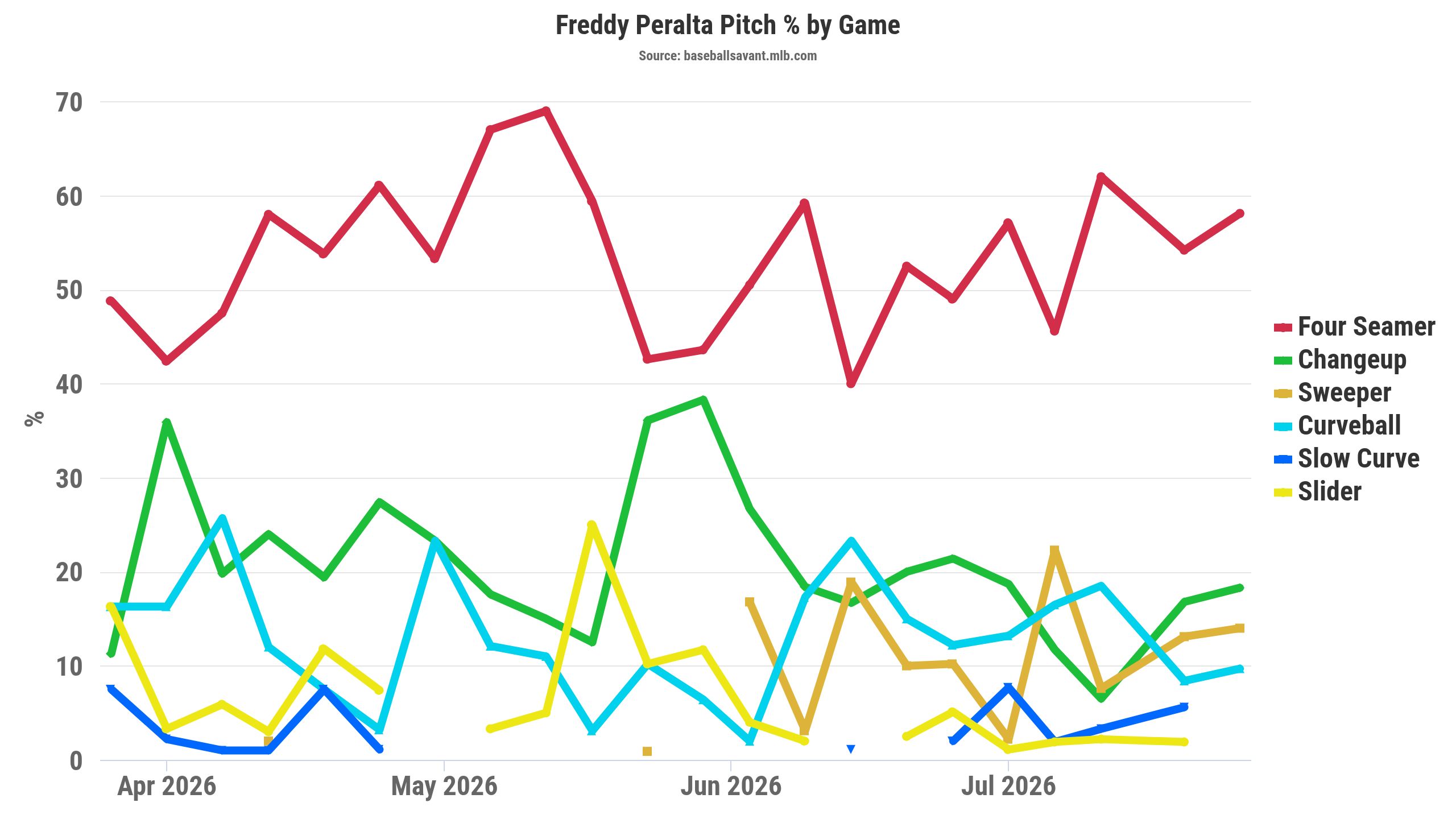
So far, nothing doing. Tampa Bay isn’t actually a bad place to land for a fastball/changeup guy who’s been struggling to find a breaking ball. Anecdotally, I just wrote about how Baker turned into a monster by getting rid of his slider. If you want numbers: The Rays have thrown by far the highest percentage of off-speed pitches of any team in the league this year, with clear daylight between themselves (21.8%) and the second-place Angels (19.8%). Conversely, the Rays have the second-lowest usage rate for breaking balls, trailing the Red Sox by fractions of a percentage point.
I don’t know if the Rays can snap their fingers and turn Peralta right back into the pitcher he was a year ago. But it’s worth a shot, because a year ago he was really good: The Game 1 starter for the team with the best record in baseball. Even if he can’t get all the way back there, he’ll be useful playoff rotation depth for a team that needed some.
From Tampa Bay’s perspective, what they gave up to get Peralta matters little. The Rays have so many prospects they’re followed everywhere they go by guys with beards, overalls, and pickaxes — this was why I thought they should’ve overpaid for Skubal in the first place — so they can afford to shell out for Peralta.
Mets fans, being as they are prone to spurts of emotional paroxysm, have no doubt noticed and honed in on the ordinal ranking of Gill Hill, Smith, and Pitre within the Rays’ system. Those rankings were, as of late June, as follows: 22nd (Gill Hill), 32nd (Smith), and 37th (Pitre). My persistent admonition around this time of year is not to worry about those numbers, because no two farm systems are alike.
Never has that advice been more relevant; with the depth of the Rays system, a 45 FV prospect like Gill Hill can end up in the 20s. In the context of a shallower Mets system, Gill Hill currently ranks eighth, Smith 15th (40+ FV), and Pitre 21st (40 FV). I’ll take each player in turn.
Gill Hill, in contrast to the Rays’ usual simple approach to pitcher development, mixes five pitches, the pick of the litter being an upper-70s sweeper with big lateral movement. Most of Gill Hill’s pitches work east-to-west because of his low arm slot, and his fastball has neither elite movement nor velocity. But he’s run minuscule walk rates throughout the minors, and projects to have plus command at the big league level. There isn’t a tremendous amount of upside here, but Gill Hill is going to have a career of some length as a big league starting pitcher.
Two deadlines ago, Smith was the cream of the Rays’ return in the Randy Arozarena trade. Quite a bit of shine has come off Smith since then, as he’s running a strikeout rate in the 30s in High-A for the second season in a row. Eric Longenhagen’s most recent writeup on Smith noted a new swing for 2026, with some improvement in both his underlying numbers and results — he’s hitting over .200 this time! — but not enough to get excited about. Smith runs well and has a decent chance to at least be playable in center field. That makes the offensive bar for him lower than it might’ve been, but still quite a ways from where he is now.
Pitre is a favorite of mine; whether that’s relevant to his being a good prospect is something you’ll have to figure out on your own. The former Kentucky standout is the second-best left-handed-hitting French-Canadian second baseman who put up massive on-base numbers in the SEC. So far, Pitre has inspired fewer rock and roll bangers than has Edouard Julien, but he’s still young. Don’t give up on him just yet.
Pitre is what I like to call an emphatic second base athlete. Not enough range for shortstop or center field, not enough arm for third, not enough power for a corner. His lone double-digit home run season at any level came during an era of offensive explosion in college baseball; after one total home run across his first two seasons at UK, Pitre hit 10 in 62 games in his draft year. He’ll steal a bag (46-for-59 in college, and 32-for-44 so far in 88 games this year), but he’s not terribly efficient on the basepaths.
What Pitre does is get on base and avoid strikeouts. Across two levels this season, he’s hitting .308/.438/.447, with an 18.2% walk rate and a 10.4% strikeout rate. He’s posted a double-digit walk rate at every stop at every level since high school. Last year, in his first full professional season, Pitre hit .268/.356/.393, with a 20.4% strikeout rate. That’s the only time, dating back to his sophomore year of college, that Pitre struck out in more than 13% of his plate appearances or failed to post a .400 OBP.
In addition to his positional limitations, Pitre is almost 24 years old, and right on the league average for his level. (Generally speaking, you want low-minors hitting prospects to be beating up on older competition.) I wouldn’t hold my breath waiting for Pitre to score 120 runs a year hitting in front of Juan Soto and Francisco Lindor. But across college and the pros, he’s done nothing but get on base. Send him to Binghamton and see if he keeps walking enough to float to the big leagues in a year or two. Best-case scenario: The third guy in this trade for a disappointing rental turns into a Francophone Jeff Cirillo or something.
The Mets will be bummed to deal Peralta when they had planned to be the ones loading up at the deadline. I also would’ve liked to see them target one riskier higher-upside prospect, rather than going high-floor/low-ceiling with both Gill Hill and Pitre. Nevertheless, this is a pretty good return for two months of a pitcher with a 4.99 ERA; at least one of these three prospects is going to play in the majors at some point.
The Rays should have a similar feeling of satisfaction, muted by regret that this move isn’t splashier. Peralta is likely to be quite useful, though not as useful as Skubal would’ve been.
Neither team got everything it wanted. But both, to quote the poet, will find they got what they needed.