
Remember me








Russia is introducing new technology into the Ukraine war. Will it help the Russians win in the conflict? Even more tantalizing, both were developed by private sector companies in Russia!
Russia and Ukraine often tout new products sold to the public as wunderwaffen. Soon it becomes clear that their role in the war is minimal, and the advertising moves on. Russia has launched two new products that promise a lot. But can they deliver?
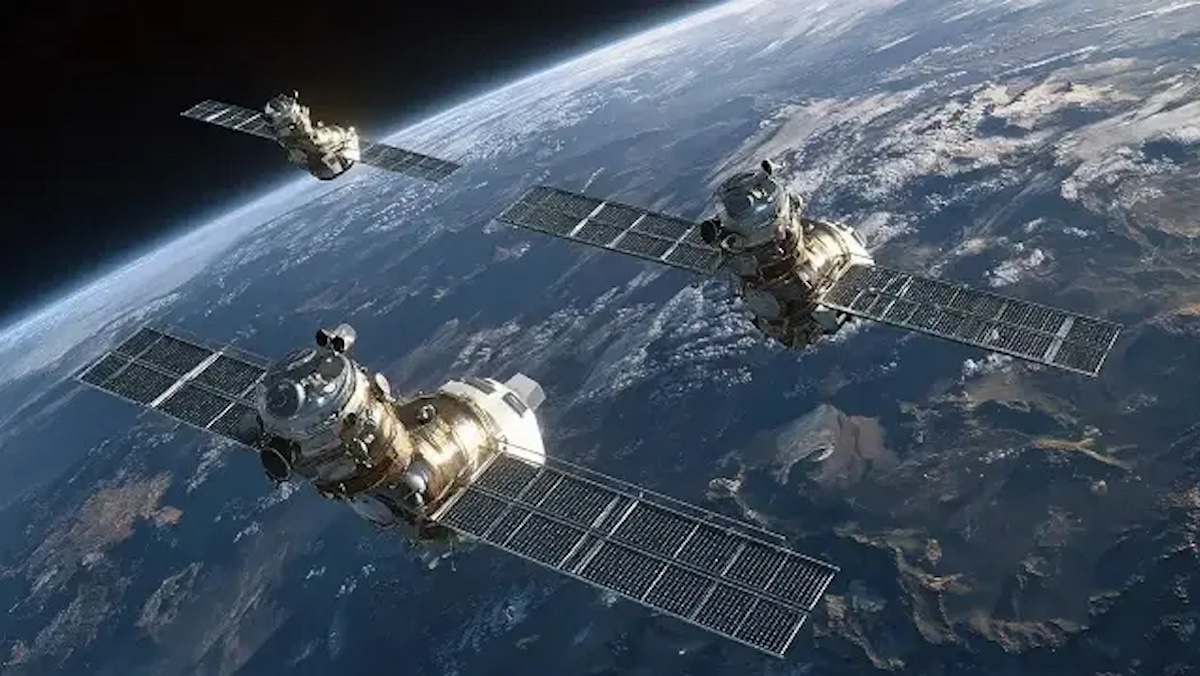
The first, and perhaps the most important, is a new satellite communications system called Rassvet-3 (”Dawn”). It is Russia’s answer to Starlink, Elon Musk’s fabulous network of between 10,870 to 10,890 satellites.
Ukrainian frontline forces rely heavily on Starlink for Command, Control, Communications, Computers, Intelligence, Surveillance, and Reconnaissance (C4ISR). It enables live video streaming from reconnaissance and strike drones, real-time fire adjustments for artillery and rocket systems, and encrypted coordination between unit commanders and troops in the trenches.
The Russians were using Starlink until Elon Musk shut them down in early February, 2026 by implementing a combination of geofencing and terminal “whitelisting” to cut off Russian usage.
This forced Russia into trying to replicate broadband battlefield connectivity some other way. Initially, the Russians turned to “mesh networks” – essentially linking platforms (mainly UAVs) to provide broadband connectivity.
To achieve this, Russia scaled up the integration of small, digital mesh modems (frequently using frequency-hopping spread spectrum/FHSS technology in the 1.3–1.5 GHz band) into strike and reconnaissance drones.
 By David Johnson, Karel Matthee, Dare Sokoya, Lawrence Mboweni, Ajay Makan, and Henk Kotze (Wireless Africa, Meraka Institute, South Africa)
Mesh networks on drones and on ground nodes work, but not without problems. They are generally limited in coverage, so different mesh networks need to be maintained to provide coverage. Because signals are processed and reprocessed, delays happen (called latency).
Latency is a very bad thing if you are guiding a suicide drone to a target or warning about an incoming threat. Mesh networks also continually transmit, so the enemy can easily detect them, and respond either with jamming or by destroying the node.
Starlink, because it uses hundreds of satellites at a time, has very little latency (20 – 50 ms) and the multiplicity of satellites makes jamming difficult. The most common jamming approach is to blank out signals in a specific battle area provided there are capable jammers available.
(Starlink uses very high radio frequencies typically used by radars, including the Ku and Ka bands. Starlink also links satellites with laser communications, which are not jammable.)
As Ukraine began to attack Russian drones with innovative technology such as the Zirka counter drone which uses artificial intelligence and, once launched, operates autonomously, the Russians could not be sure mesh networks would survive.
 Zirka counter drone
This led to the development of the Rassvet-3 (“Dawn”) satellite system. The first 12 to 15 satellites are already operational and Russia is rushing to build portable ground terminals so Rassvet can work on the battlefield.
Russia’s 12 to 15 satellites do not even come close to Starlink’s 10,000 in orbit. In fact, as of today, the coverage over Ukraine is around two to three communication windows per day, each lasting between 1 and 1.5 hours.
This is enough to work out bugs and test the satellite array, but not enough to provide sufficient coverage to meet the Russian army’s tactical needs. Russia launched another 16 satellites on July 19, but we do not yet have information on them. Russia’s goal is to have 156 satellites in orbit by the end of 2026.
 Orbital launch Rassvet-3 on March 23, 2026, The launch was not announced.
Like Starlink, Rassvet-3 (which is in a somewhat higher orbit) uses Ka and Ku bands and supports inter-satellite laser communications (demonstrating data speeds up to 10 Gbit/s in testing) and support the 5G NTN (Non-Terrestrial Network) standard for direct satellite-to-cellular connectivity.
Rassvet provides encrypted military data relay, drone command-and-control links, and secure backhaul—filling the operational gap left after Russian access to Starlink was blocked.
Rassvet was developed by the private Russian technology firm Bureau 1440 (a subsidiary of the Yadro technology group) under the government’s broader Sfera space program, the project has been elevated to a top strategic priority for Moscow. YADRO is the flagship subsidiary and primary revenue generator of IKS Holding (ИКС Холдинг).
IKS Holding is funding ~329 billion rubles (US$4 billion) of the total budget out of its own commercial capital, parent revenues, and private credit lines. Telecom giant MegaFon initially seeded the project in 2020 with 6 billion rubles, and Russian banking giant VTB Group acquired a 15% stake in 2021 for 2 billion rubles before the project was restructured under IKS Holding.
The Russian federal government committed 102.8–116 billion rubles (US$1.26–$1.3 billion) through its national “Data Economy” roadmap (“Advanced Space Systems and Services for the Period up to 2030.”)
Federal funds directly subsidize launch vehicle integration aboard Soyuz-2 rockets via Roscosmos, orbital frequency licensing, and manufacturing infrastructure for subscriber ground terminals.
The Rassvet project, therefore, is unique from an ownership and financial perspective and represents how Russia is finding ways to support high priority defense programs combining private sector and public investment.
Bureau 1440 also is charged with manufacturing terminals. Many of the components for the terminals are sourced in China and are commercial off-the-shelf systems (COTS). Terminal manufacturing could be a bottleneck for the Russians.
Because Rassvet is still in early days and not yet in widespread use, it remains to be seen if the system can meet its goals and provide the functionality the Russian army needs for Ukraine.
If it is successful, the Russians will have a functional alternative to Starlink to support military operations in Ukraine. Thus, the Rassvet project is real and not advertising. Once fully functional (end of 2026 to mid-2027), Russia will be able to match Starlink on the battlefield.
Jamming Starlink over Russian territoryUkraine has been hitting critical infrastructure in Russia, both to retaliate for Russia’s attacks on Ukraine’s infrastructure and military targets and as part of a Ukrainian effort to embarrass the Russian government with heavy costs at home that, the campaign appears to hope, will force the Russians to the bargaining table with major concessions Ukraine could potentially accept.
(Russia has retaliated in part by destroying gas stations in Ukraine. There are localized fuel shortages in Russia because of Ukrainian attacks.)
While the Russians are able to shoot down many Ukrainian drones, enough of them get through and past Russian air defenses to create serious trouble for the Russian government, especially as Russian leaders keep emphasizing they are winning the war.
Independent analysts say that in the Moscow region and Crimea, where the Russians have layered air defenses, between 80% and 90% of Ukrainian drones are intercepted. In heavily defended airspace (such as around Moscow or major military hubs), Russian air defenses and electronic warfare (EW) jamming stop the vast majority of incoming long-range UAVs. In less well-defended places, a higher percentage get through.
Since most Ukrainian long-range drones rely on both GPS and Starlink, Russia has been seeking to improve its jamming capabilities, recognizing that jamming Starlink is challenging.
 Volna Kupol Garant: Russia’s electronic weapon specifically designed to hunt Starlink. (Photo: Russian Ministry of Defense)
Russia is introducing a new jammer system dedicated to jamming Starlink. Known as Volna (”wave”) Kupol (”dome”) Garant, it was developed by the Crimean-based firm Rossiysky Kupol LLC, which is often styled in Russian media as AO Русский Купол or Russian Dome.
Kupol is a Crimean-based defense electronics contractor that has emerged as one of Russia’s primary private entities developing tactical counter-drone and counter-satellite EW hardware.
Kupol sells hardware directly to localized command structures, regional administrations, and defense units rather than going through traditional long-term state military acquisition pipelines.
US defense officials should take note of this sales approach as it eliminates red tape and delays in getting a product from the factory to the soldier. It may also account for lower costs by removing testing and evaluation processes that are often costly, although it carries some risk.
Kupol features a trailer-mounted uplink satellite jammer explicitly tailored to disable Starlink receivers overhead. Kupol is designed to form a wide RF suppression shield against NATO-standard and commercial Ukrainian drone frequencies over a 20-kilometer radius.
The Volna Kupol Garant array uses eight parabolic dish antennas distributed across six mobile trailers. Each dish is enclosed under a protective, egg-shaped composite radome. Rather than electronically shifting the beam across a flat array phase matrix, each dish uses physical motor mounts to mechanically rotate and track low-Earth orbit (LEO) Starlink satellites as they move across the sky.
Kupol chose not to use Active Electronically Scanned Arrays (AESA) technology for its jammers, although it would have been preferable. AESA arrays excel at multi-beam agility and rapid electronic scanning without moving parts, but they require advanced Gallium Nitride (GaN) or Gallium Arsenide (GaAs) Transmit/Receive (T/R) modules — components that are scarce and heavily sanctions-restricted in Russia.
However, while relying on far older technology, Kupol claims it has achieved the focused Effective Radiated Power (ERP) required to reach LEO satellites (~500-kilometer altitude) using simpler, commercially available RF components.
The Kupol problem is the limited coverage of each system, meaning that to protect critical infrastructure these units would need to be positioned close to the protected site. The cost of doing this in a complex, industrialized nation such as Russia could be prohibitive. Each Kupol unit costs $1.5 million (very little in Western terms, but a high cost if hundreds of units are needed).
There isn’t much information on how effective Kupol is against Starlink. However, the fact that Ukraine has targeted deployed systems suggests Kupol does work. Whether Russia can afford to deploy enough systems, and whether Kupol (a small company) can produce enough systems, are unanswered questions.
It is not likely that Rassvet or Kupol will dramatically change the war in Ukraine in Russia’s favor. But both systems offer solutions and improvements that were previously lacking. Moreover, both come out of the private sector, demonstrating that independent companies may be best positioned, even in Russia, to develop and manufacture badly needed military equipment.
Stephen Bryen is a former US deputy undersecretary of defense and special correspondent at Asia Times. This article was first published on his Weapons and Strategy Substack and is republished with permission.