
Remember me







Historians have long speculated that Europeans introduced smallpox to the Americas, which then killed hundreds of millions of Indigenous peoples. Genetic evidence has recently proved they were onto something.
In a newly published Science study, scientists revisited two mummies recovered from northern Chile in 1990 and performed an advanced DNA analysis of their genomes. The individuals, who presumably died between the late 15th and early 17th centuries, hosted a lost strain of variola viruses that cause smallpox—specifically the kind known to have affected Europeans around the same time period.
“This discovery provides the first molecular confirmation that smallpox was carried to the Americas during the colonial period,” Shigeki Nakagome, the study’s co-author and a geneticist at Trinity College Dublin in Ireland, said in a statement. “But beyond tracing the disease’s arrival, our study also sheds new light on how smallpox evolved.”
Unexpected discoveriesAs often happens with major discoveries, the team wasn’t looking for what it ended up finding, which in this case was traces of ancient smallpox DNA. Initially, the researchers wanted to study the ancestry and population history of people from northern Chile, Constanza de la Fuente Castro, the study’s co-author and an anthropologist at the University of Chile, told Scientific American. This was why the team revisited the mummies, which featured a woman in her 30s and a man around his 20s, both likely Inca and buried at an Indigenous site.
Further DNA analysis of the individuals revealed traces of smallpox—nearly identical in both mummies—which suggests that the two died during the same outbreak, de la Fuente Castro explained to Science. She added that previous studies noted skin lesions on the mummies, which were attributed to arsenic exposure at the time but now appear to have been signs of smallpox.
A lost history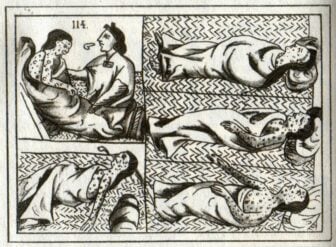 16th century Aztec drawing of smallpox victims. © Original artist unknown via Wikimedia Commons (Public Domain)
 What’s more, the genetic data allowed the researchers to investigate the evolution of variola virus around the world. According to the study, the virus strain evolutionarily lies between the types known in medieval Europe and those that circulated much later. It appears that the virus evolved much slower during the height of colonial expansion.
This was due to the lack of immunity in newly exposed populations—Indigenous communities—which meant it could “spread successfully with little further adaptation,” Lara Cassidy, the study’s co-author and a geneticist at Trinity College Dublin, explained in the statement. That was until around the 19th century, when English physician Edward Jenner introduced a vaccine for smallpox.
Faced with this barrier, so to speak, the virus resumed evolving again, although an overall increase in vaccination also meant more people were protected against the disease. (In 1980, the World Health Organization declared smallpox officially eradicated.)
Another beginningResearchers who were not involved in the new research commended the study’s findings. For instance, Ana Duggan, acting chief of computational and operational genomics at the Public Health Agency of Canada’s National Microbiology Laboratory, told Scientific American that two genomes might not sound like a lot of evidence, but it’s a huge step in our knowledge of variola viruses in history.
“Nobody would ever question that smallpox came to this hemisphere from colonization, but this proves it,” Patricia Foster, a biologist at Indiana University who wasn’t involved in the new work, noted to the Associated Press.
Study lead author Bruno Romero González, a PhD student at Trinity College Dublin, added that the findings show how “major historical events, including colonization, population change, and vaccination, likely shaped the evolution of one of humanity’s most devastating infectious diseases, while also demonstrating the power of ancient DNA to address longstanding historical questions.”