Death toll of devastating Japanese earthquake rises to 25, as survivors battle no water or electricity in heatwave
The majority of the deaths are from Nippon Paper Industries' paper mill and at Aeon's shopping mall
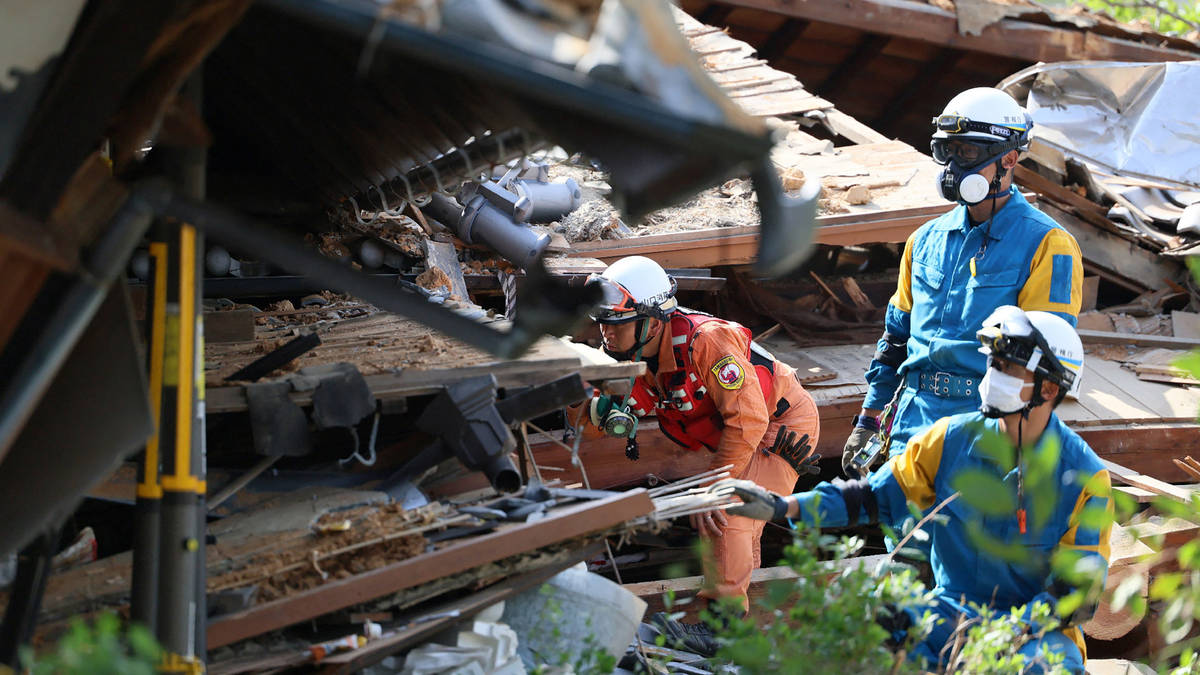
Rescue officials work at the site of a house, which was damaged in the July 28 earthquake, in Yatsushiro, Kumamoto prefecture on July 30, 2026.
Picture:
JIJI Press / AFP via Getty Images
The death toll of the 7.1 magnitude earthquake that struck Japan has risen to 25, as survivors face brutal heatwave conditions without access to running water or electricity. Two days on from the devastating earthquake, the Kumamoto prefectural government said the death toll was now at 25.The majority of the deaths are from Nippon Paper Industries' paper mill, which suffered major structural damage, and at Aeon's shopping mall, where a possible gas explosion occurred. Another six people are in cardiopulmonary arrest, it said.Read more: US launches 'heavy' strikes on Iran after attempted attack on American troopsRead more: 'We just tell them "Don't do it, it's dangerous"': French police reveal limits of Channel crackdown as '1,000 arrive'
An evacuee calls a phone at the evacuation centre in Minami Ward, Kumamoto City.
Picture:
The Yomiuri Shimbun via AP Images
One of the victims was a newlywed Vietnamese factory worker, survived by his wife and seven-month-old baby, according to Vietnamese news site Kenh14.In an interview with the news site, Vu Thi Thuy recalled her last conversation with her husband the night before the tremor struck."Every time we video-called, my son never wanted to look at his dad but that night, for some reason, he stayed glued to the screen, wanting to be with his dad," she said. "It was after 11pm when I finally told him, 'Let's hang up so dad can get some sleep. He has to work tomorrow.' I never imagined that would be our last call."
While rescue and relief efforts continue, a Kumamoto official warned of heatstroke risk in temperatures that were forecast to reach close to 40C on the weekend. The Self-Defense Forces (SDF) — Japan's military — is installing about 300 air-conditioning units in evacuation centres and other key sites around Kumamoto.Immediately after the quake, SDF trucks towed water tanks to community centres and schools across Yatsushiro city, returning to city hall to refill from emergency tanks beneath the building. Residents were limited to 5 litres each.Among them was Masahiro Miyamoto, who had been helping clear rubble from a temple gate that had toppled.He returned home after the late-afternoon quake to find his house still standing beside the collapsed remains of his neighbour’s home. But with no running water, he was forced to rely on military water bowsers.
A man visits the collapsed Yatsushiro Shrine in Yatsushiro, Kumamoto prefecture on July 29, 2026, after an earthquake struck southwestern Japan the previous day.
Picture:
Yuichi YAMAZAKI / AFP via Getty Images
The few shops still open were packed with people searching for supplies, he said, while cars formed long queues at petrol stations.“It would be better if disasters did not happen, but this is Japan, so perhaps it is something we simply have to live with,” Miyamoto said.Many of the port city's roughly 58,000 households were still without running water or power on Thursday.Akio Matsushita, a local official helping lead relief efforts, said he had no idea whether it would take days, weeks or months to repair the badly damaged water mains."Because of the summer heat, the lack of water is especially difficult," he said in the city hall.
Search operations continue for missing people at AEON MALL Kumamoto following an explosion in Kashima Town, Kumamoto Prefecture.
Picture:
The Yomiuri Shimbun via AP Images
With the city hall's toilets out of order, officials erected emergency toilets over sewer manholes outside the building, in temperatures of around 35 degrees and stifling humidity."It will require painstaking work, and there is currently no timetable," Matsushita added.A Kyushu Electric Power representative said the utility was aiming to restore power by Friday evening.Japan sits on the Pacific “Ring of Fire”, an arc of volcanoes and ocean trenches that account for about one-fifth of the world’s large earthquakes. Strict building standards and regular disaster drills reduce casualties, but powerful tremors can still cripple the regions in which they occur.Kumamoto and other parts of the Kyushu region have increasingly become key production sites for automobiles and semiconductors, raising concerns over a possible hit to the economy.
Tuesday’s quake has forced manufacturers such as Toyota, Honda, Nissan, Aisin and Sony to halt some production and prompted Taiwan's TSMC to evacuate workers and briefly suspend operations to assess any damage.Chief Cabinet Secretary Minoru Kihara said it was difficult to estimate the impact on the economy now."Our immediate priority is to restore and repair infrastructure, including ports and other key facilities. We will also closely monitor the impact on economic activity, particularly supply chains in sectors such as semiconductors and automobiles," he told reporters.Miyamoto and many residents of Yatsushiro and nearby Kumamoto city have endured major earthquakes before. Two powerful quakes in April 2016 killed more than 260 people and destroyed thousands of homes.But Tuesday’s shaking, which toppled shelves and hurled computers to the floor, was worse in Yatsushiro than anything Matsushita experienced a decade ago."I had never experienced the world moving like that before. It felt as though my body became weightless and was thrown through the air," Miyamoto said.