CHICAGO — They can acquire an outfielder, address their depth-starved starting rotation and add a right-handed leverage reliever, but the Houston Astros are going nowhere if Hunter Brown is anything less than an ace.
For most of the past month, Brown did not resemble one. It is a deficiency no trade deadline acquisition can conceal, compounding the urgency for Brown to find his best self. He awoke on Saturday with a 6.08 ERA across a five-start stretch fraught with subpar command and fleeting feel for his fastball.
“I just hold myself to a standard to be the best version of myself I can be for this team,” Brown said. “And I thought, quite frankly, I was underperforming that. It wasn’t due to the lack of preparation or mentality or anything like that, it was simply not executing at the level that I can.”
On a cloudy evening on the South Side of Chicago, Brown became the bully this ballclub had not seen since his mid-April shoulder strain, spurring hope that he could reprise his role as this rotation’s bedrock. Anything less lowers the ceiling of a team already navigating too many concerns to count — and carrying the third-highest ERA of any starting rotation in the sport.
It is a burden Brown has proven capable of bearing. He finished third in Cy Young voting last season while carrying an injury-ravaged starting rotation within one game of a playoff spot.
Missing more than two months of this season will prevent Brown from being back in awards consideration, but the value he can provide to this team is identical — if not higher — than last year.
“The expectations are just so high because he is Hunter Brown and he is our Cy Young pitcher,” shortstop Jeremy Peña said. “We have so (many) expectations for him and he showed it today.”
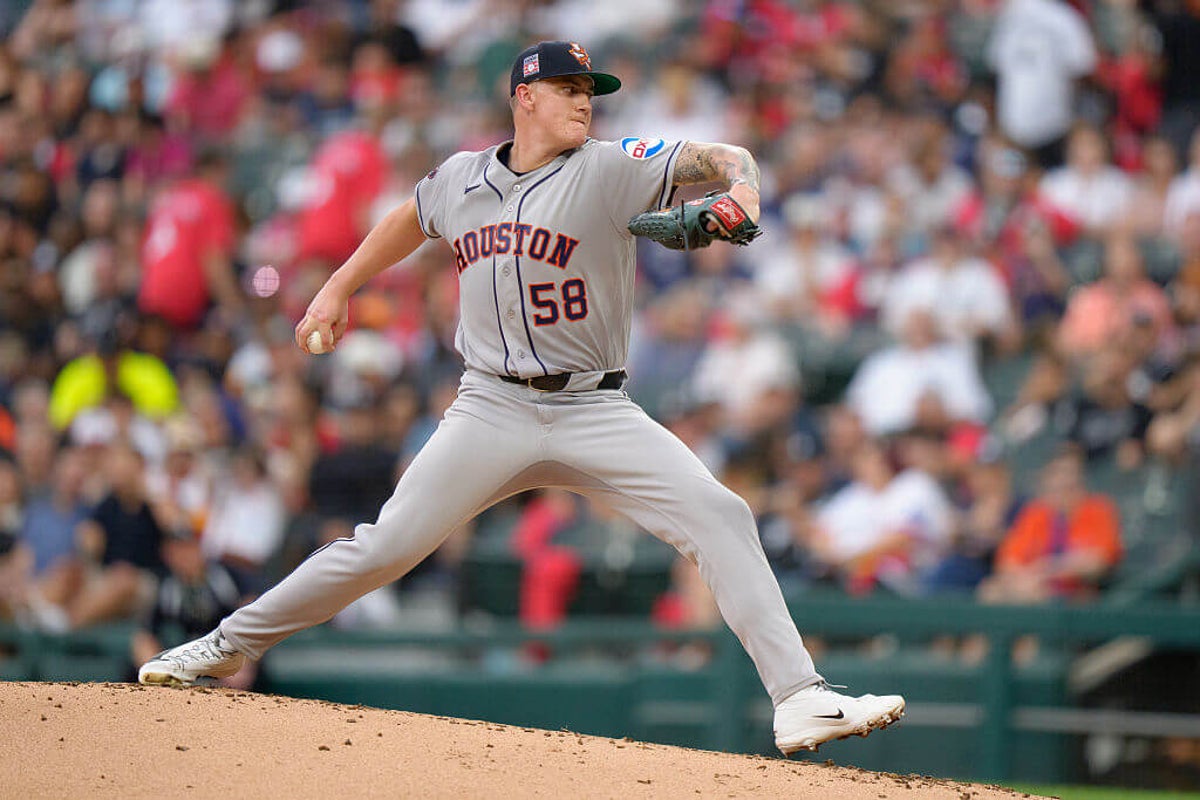
Brown battered the Chicago White Sox across seven scoreless innings, showing efficiency and strike-throwing that did not exist during his downturn. He retired the final 12 White Sox hitters he saw, appearing stronger in the seventh inning than he was in the first. Manager Joe Espada considered sending Brown back out for the eighth inning, but settled for seven of the best innings any of his starters have thrown all season.
“That’s Hunter Brown,” Espada said after the 4-1 victory. “He looked pissed, too. I thought he came out there and he was pissed. He was tired of the performances.”
Brown took a more tactful tone, but did not downplay the importance of dominating when he did. His performance helped Houston pass the Seattle Mariners for sole possession of second place in the American League West, a division the Astros will not win if Brown is a pedestrian pitcher.
“The goal is to play in October. We can taste that we’re close and that’s the goal — to creep back up,” Brown said. “Whether it’s winning our division or getting a wild-card spot, that’s always our goal.”
FanGraphs now gives the Astros a 33 percent chance to reach the postseason, odds that have continued to climb as Houston has reeled off five consecutive wins. Other issues are obvious, but having Brown at his peak form is the sort of separator this team must savor in a weak American League.
Seeing Brown at his best on Saturday only furthers optimism. He fell into just three three-ball counts and, for the first time this season, did not walk a batter. Six days earlier, Brown surrendered a career-worst six free passes against the Baltimore Orioles.
“I feel like my stuff has increasingly got better over the last couple weeks. Even Baltimore, I felt good about my curveball and the way my fastball was working,” Brown said. “I knew I was trending in the right direction. I knew I wasn’t too far away.”
Before straining his shoulder, Brown had never been injured in his professional baseball career. Rehabbing and returning after an in-season shutdown is uncharted territory for the 27-year-old. Perhaps it is an explanation for Brown’s uneven season, though neither he nor Espada want to use it as an excuse. It is nonetheless noteworthy.
“I know mechanically he’s been working on a few things, but you just have to give him some time,” Espada said. “He knows his craft very well. But just give him some time. He’ll figure it out. He knows. He sees the calendar, knows where we’re at. He knows that he’ll show up.”
Within the game’s first six hitters, Brown threw his two hardest pitches of the season: a 98.4 mph four-seam fastball to strike out Munetaka Murakami and a tailing, two-strike 98.6 mph sinker that Andrew Benintendi swung through in the second.
Seven of Brown’s fastballs arrived at 98 mph or harder. Across his previous eight starts, Brown had only thrown seven such pitches. Four of them came prior to his shoulder strain. Brown’s four-seam fastball sat 96.9 mph — a mile per hour harder than his season average — and concluded four of his seven strikeouts.
An inability to harness the pitch has plagued Brown since returning from injury. Mechanical tweaks this week helped him to get more on top of his four-seam fastball and drive it through the strike zone. Too often, Brown said, his misfires were high in the strike zone: a sign of imprecise timing in his delivery. Getting synced up solved the issue.
“If I’m doing that,” Brown said, “all my other pitches are better.”
Three of Brown’s pitches — his sinker, four-seamer and curveball — generated at least five swings and misses from Chicago’s lineup on Saturday. The White Sox whiffed 16 times on the first 31 swings Brown induced and finished the game with 20. Brown became just the fourth Astros starter in 106 games to generate at least 20 whiffs.
Brown needed 90 pitches to procure his 21 outs. He faced just two batters over the minimum and did not allow either baserunner to pass first base. Chicago chased outside the strike zone at a 36 percent clip against Brown, who threw 67 percent of his pitches for strikes.
Across Brown’s past five starts, he had just a 52 percent strike rate, among the myriad reasons for his misfortune. Perhaps this magnificent Saturday represented a first step toward something more normal: an ace at his apex when the Astros can afford nothing else.
“He knows,” Espada said. “It’s August. It’s go time. I think we, as a club, we need that.”