
Remember me







A set of footprints that date back more than 1.4 million years reveals our ancient relatives may have travelled in all–male gangs.
Researchers have discovered 21 footprints preserved in sediment along the edge of an ancient lake in northern Kenya.
Close analysis revealed they belonged to Paranthropus boisei, an extinct ancient 'cousin' of modern humans.
Scientists believe the footprints capture a single moment in time as eight individuals walked together along the shore.
The size of the footprints suggests the tracks were made by a group with multiple adult males – hinting at an unexpectedly complex social structure.
The researchers say the males may have travelled together for protection despite competing with one another for mates.
'The fact that eight, mostly adult male P. boisei individuals seemingly travelled together as a group, without females or children, hints at a complex social structure in this species,' co–author Neil Roach, from Harvard University, said.
'They may have lived in large groups, where males competed for mates, but also tolerated each other at times for safety in a dangerous environment.'

Close analysis revealed the footprints belonged to Paranthropus boisei, an extinct ancient 'cousin' of modern humans

Scientists believe the footprints capture a single moment in time as eight individuals walked together along the shore. Pictured: A model of a Paranthropus boisei male in the Museum of Human Evolution, Spain
The tracks were discovered in the Koobi Fora Formation on the eastern edge of Lake Turkana – one of the world's richest archaeological and fossil sites.
The thick layers of sediment here have preserved some of the most important evidence of early human evolution over the past two million years.
Researchers analysed the footprints using detailed 2D and 3D imaging before comparing them with tracks made by modern humans and other ancient hominin species.
They determined they belonged to P. boisei – a muscular, gorilla–like species which earned the nickname 'Nutcracker Man' due to its enormous jaws and huge molar teeth.
Although it lived alongside early humans such as Homo erectus, P. boisei belonged to a separate branch of the human family tree that eventually died out.
The size of the footprints was especially surprising – suggesting the species was far larger than previously expected.
'The sizes of the footprints indicate human–like body sizes – up to 6ft (1.8 metres) tall and around 75 kilograms (12 stone)', said lead author Kevin Hatala, from Chatham University.
The new findings challenge the long–held belief that P. boisei was much smaller than the contemporary Homo erectus.
Join the discussion
What do you think drove these ancient males to band together—protection, power, or something else entirely?

Researchers discovered 21 footprints preserved in sediment along the edge of an ancient late in northern Kenya. Some of the footprints are depicted here in red

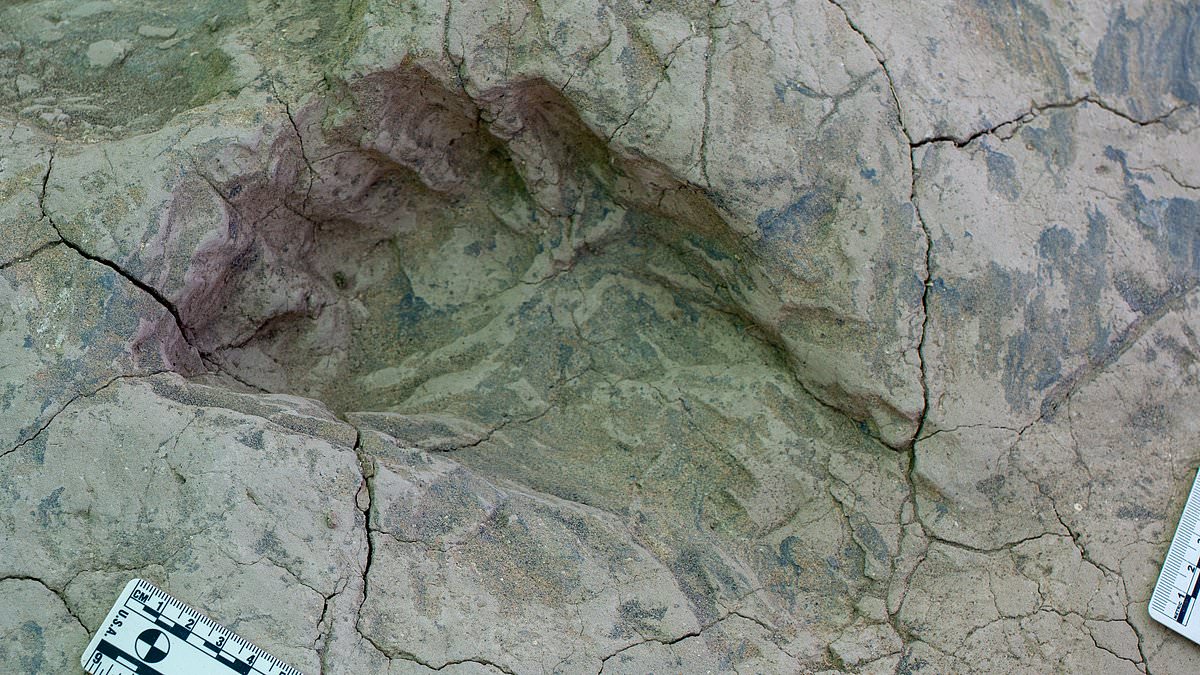
One of the large, 1.4–million–year–old footprints the team excavated on the eastern edge of Lake Turkana
Paranthropus boisei Lived 2.3–1.2 million years ago: P. boisei roamed East Africa during the Early Pleistocene, overlapping with early members of the genus Homo.Nicknamed the 'Nutcracker Man': The species earned its famous nickname because of its enormous jaws and huge molar teeth, although scientists now think it probably didn't crack nuts as often as once believed.Built for powerful chewing: It had some of the largest teeth of any human relative and a distinctive bony crest on top of its skull to anchor exceptionally strong jaw muscles.Lived in East Africa: Fossils have been discovered in Kenya, Tanzania, Ethiopia and Malawi, with many of the most famous finds coming from the Koobi Fora region and Olduvai Gorge.Not a direct human ancestor: Although it lived alongside early humans such as Homo erectus, P. boisei belonged to a separate branch of the human family tree that eventually died outMay have been larger than previously thought: New fossil footprint research suggests some individuals could have stood as tall as 6ft (1.8m) and weighed around 75kg (12 stone), considerably bigger than earlier estimates based on fossil bones alone.The team has now documented hundreds of ancient hominin footprints from more than half a dozen sites across Lake Turkana.
Together, the sites span more than 100,000 years of repeated visits to the lakeshore, with each footprint adding to the 'photo album' of human evolution.
The researchers hope that studying how the footprints were preserved will explain why ancient human relatives kept returning there.
'If the tracks were made by P. boisei, their large body mass estimates alter many reconstructed aspects of (their) biology and behaviour,' the team wrote in the journal Proceedings of the National Academy of Sciences.
'The body size estimates for six of the individuals fall well above published species average. We hypothesise these tracks likely represent adult males.
'At a minimum, the trackways indicate mutual tolerance of multiple P. boisei adult males on the same landscape at approximately the same time, and perhaps within the same social group.'
The researchers suggest that this species consumed relatively large quantities of plants such as papyrus – which would likely have been abundant in the area at the time.
This, along with nutritionally rich shellfish and mollusc shells, could have drawn our ancient relatives to the lakeside.

P. boisei was a muscular, gorilla–like species which earned the nickname 'Nutcracker Man' due to its enormous jaws and huge molar teeth. Pictured, P. boisei reconstruction at Natural History Museum Basel
The researchers plan to return to the area later this year to continue excavating the footprint sites.
They hope future discoveries will reveal even more about how our ancient relatives lived nearly one and a half million years ago.
In 2024, a team of scientists announced the discovery of footprints from both P. boisei and Homo erectus at Lake Turkana.
Until that point, the two species were thought to be unknown to each other.
The discovery was the first direct evidence that very distinctly different kinds of human relatives inhabited the same place at the same time, the researchers said.
And the tracks also opened the possibility the two groups may have interacted with and influenced one another.