
Remember me









Plans for the world's first octopus 'megafarm' have been cancelled amid a flurry of ethical and environmental concerns.
Nueva Pescanova, a Spanish seafood group, was aiming to build the aquaculture project in the maritime hub of Las Palmas, in the Canary Islands.
At its full capacity, the 31,000–square–meter fish farm would have slaughtered 3,000 tonnes of octopus per year – equivalent to more than one million animals.
Now, Nueva Pescanova has withdrawn its planning application to the Port Authority, putting an end to the controversial project.
According to a statement issued by the Port Authority, the seafood group blamed the failure on 'significant extension of administrative deadlines'.
The company also cited uncertainty regarding the 'completion of environmental and sectoral procedures'.
However, the project had faced staunch opposition from scientists and environmental and campaign groups from the moment of its inception.
In particular, scientists had slammed the group's decision to intensively farm sentient animals that are capable of feeling pain and experiencing emotions.

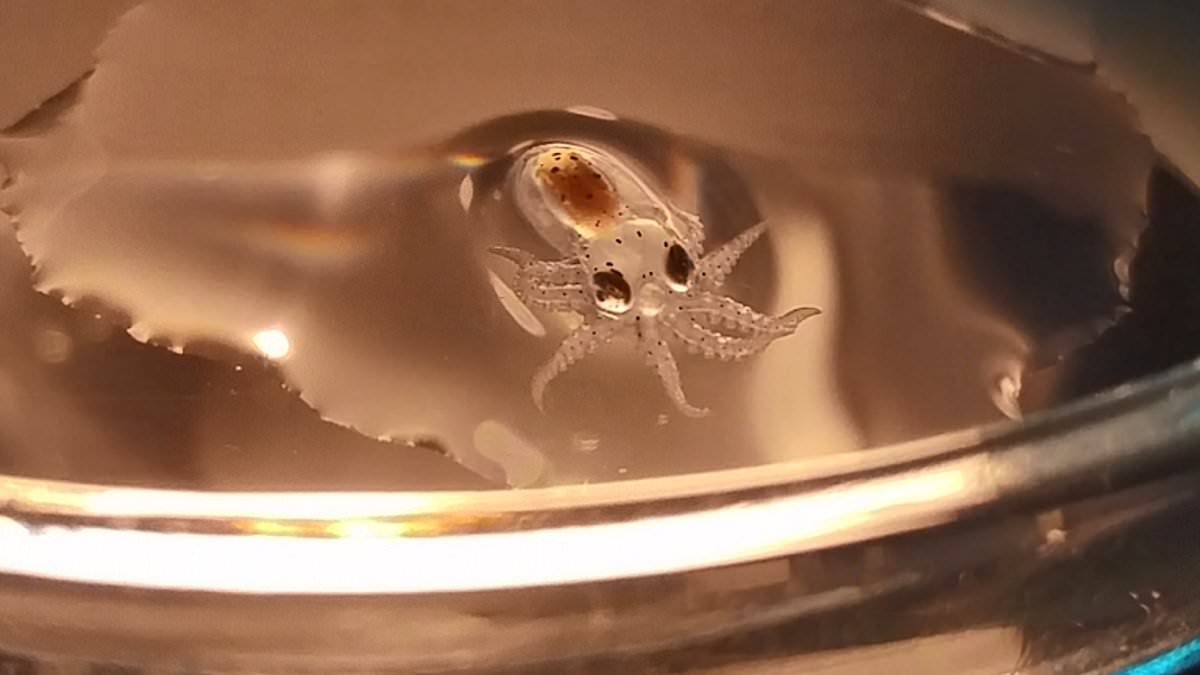
Nueva Pescanova, a Spanish seafood group, has abandoned its plans to make the world's first octopus 'megafarm' in the port of Las Palmas, in the Canary Islands. Pictured: One of the first octopus born in a farm in 2019
The global octopus market is estimated to be worth £2.2 billion, but there was previously no way to reproduce the entire octopus life cycle in captivity.
That changed in 2019 when Nueva Pescanova and the Spanish Institute of Oceanography (IEO) in Vigo announced they had found a way to raise octopus entirely in tanks.
In 2021, the company opened a file with the Port Authority of Las Palmas to begin plans for the world's first octopus mega farm.
According to plans uncovered by campaigners Eurogroup for Animals, the company expected that 10 to 15 per cent of the octopus would die before becoming fully grown.
These solitary animals, which are used to the dark, would be kept under constant bright lights and crammed in with up to 15 other animals per cubic metre.
The octopus would then be killed by being plunged into a tank of ice held at –3°C (27°F), a method which studies have shown to cause a slow, painful death.
Immediately, animal rights groups raised concerns that these conditions would be highly unethical.
Octopus are widely acknowledged to be extremely intelligent animals, with many studies suggesting that they are capable of feeling pain and even emotion.

The global octopus market is estimated to be worth £2.2 billion, but farming the animals has been widely criticised for being unethical and harmful to the environment
Are octopus sentient?Octopus are widely considered to be sentient due to an abundance of scientific evidence.
Studies have shown that these cephalopods have conscious awareness and are capable of feeling pain, pleasure, excitement, and fear.
Importantly, one 2022 study found that octopus avoid painful situations and try to remedy pain.
This suggests that they actually register and feel pain as a negative experience, rather than just avoiding harm by reflex.
Some research even proposes that octopus have distinct personalities.
In 2022, the UK officially recognised octopus' sentient status and enshrined this into law with the Animal Rights Bill.
Professor Jonathan Birch, of the London School of Economics, led a review of over 300 scientific papers which found that octopus feel pain and pleasure.
In the report, Professor Birch said there was 'strong scientific evidence decapod crustaceans and cephalopod mollusks are sentient'.
In 2022, this led to the UK becoming the first country to officially recognise that octopus are sentient, enshrining this fact into law with the Animal Rights Bill.
Scientists also raised pressing concerns about the proposed farm's environmental impact.
Reports estimated that the farm would require 2.1 billion wild–caught fish to feed the octopus within the first year alone.
This would have a significant impact on already over–pressured fish stocks in the region.
In 2023, the Aquatic Life Institute (ALI) issued a report warning that Nueva Pescanova was 'prioritizing profits and polluting Las Palmas'.
Experts warned that waste and excess chemicals, such as antibiotics used to prevent the spread of disease, would seep out into the surrounding waters.
Separately, 130 members of the Aquatic Animal Alliance, including prominent scientists, wrote an open letter to the Canary Islands' environmental agency raising concerns about the proposal.
The letter cautioned the environmental agency that the farm would cause'serious biophysical and biosecurity risks' that Nueva Pescanova had not taken steps to prevent.
Despite this opposition, Nueva Pescanova does not acknowledge that ethical or environmental considerations played a role in the decision to cancel the project.
A spokesperson for the company told the Daily Mail they could 'only confirm that we have cancelled the project in the Canary Islands'.
However, the Las Palmas Port Authority says the decision 'stems exclusively from business and regulatory considerations'.
Likewise, the company insists that the decision 'does not imply any acknowledgement regarding the potential future viability' of octopus farming in the Canary Islands or elsewhere.
OCTOPUS DEFENCE MECHANISMSOne of the most effective ways octopuses avoid predation is by camouflaging with their environment.
They have special pigment cells allow them to control the colour of their skin, much like chameleons.
As well as colour change they can manipulate the texture of their skin in order to blend in with the terrain.
As well as camouflage they can escape predators by using a 'jet propulsion' method of escape, where they rapidly shoot out water to propel them through the water rapidly.
The jet of water from the siphon is often accompanied by a release of ink to confuse and evade potential enemies.
The suckers on the tentacles of the eight-legged beasts are extremely powerful and are used to drag prey towards a sharp beak.
As well as protection from other animals, it has been recently found that octopuses can detect the ultrasonic waves that preempt a volcanic eruption or earthquake, giving them enough time to escape.