
Remember me



 by Nino LeitnerToday
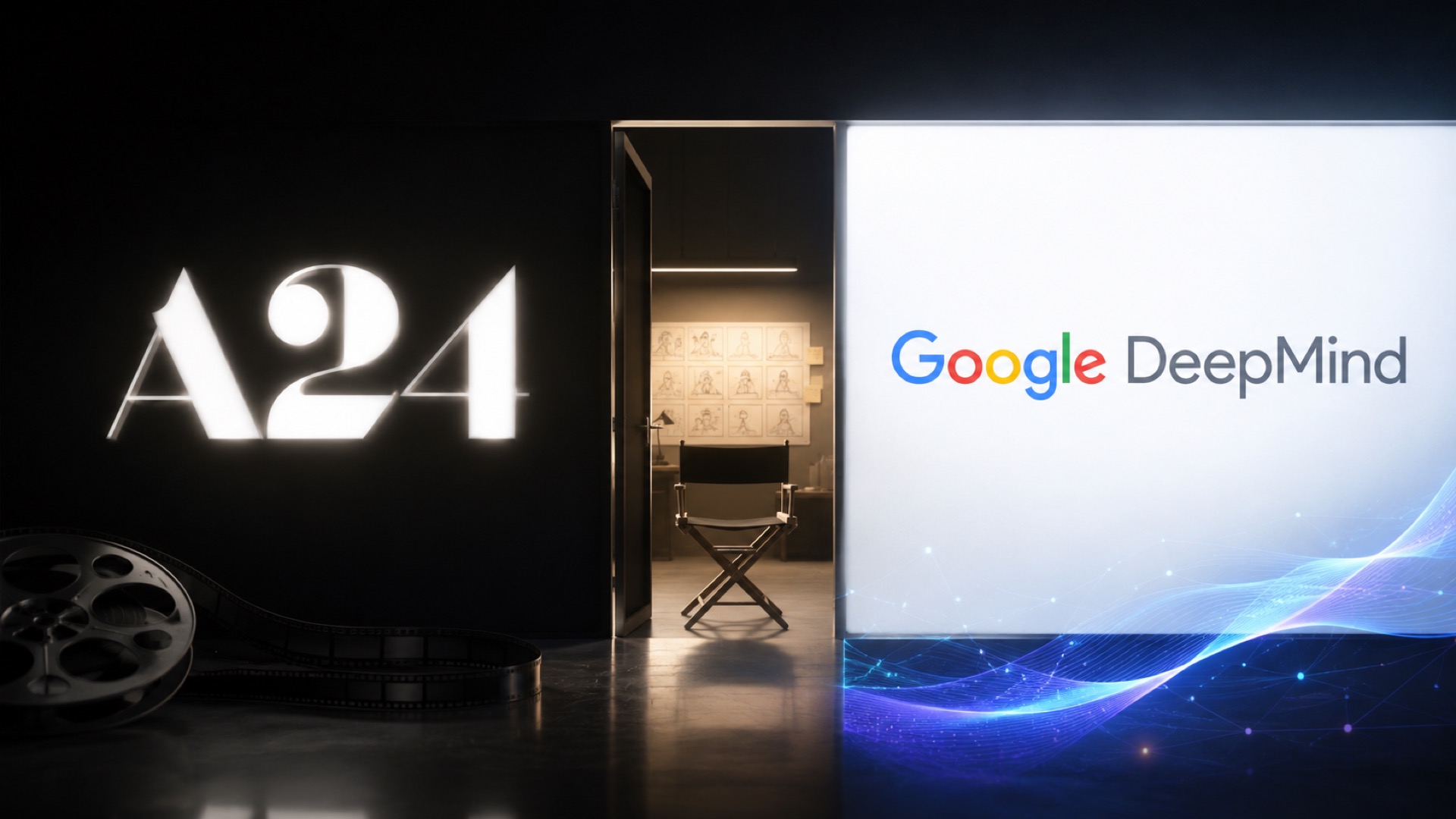
A24’s $75 million research partnership with Google DeepMind has now played out its full first act: the announcement, a revolt from the studio’s own fanbase, and an official defense built around wanting “a seat at the table.” With the dust settled, this is not an IP deal, not a data-training deal, and carries no mandate to put a single generated frame on screen. What Google gets instead is access to how A24 actually works, and that distinction, along with the reaction to it, is the whole story.
We deliberately let this one breathe rather than racing the announcement, because the story kept moving. Within days of the news breaking, A24’s social channels filled with accusations of betrayal, members of its AAA24 subscription program publicly canceled, and the studio was pushed into issuing a formal defense of the deal. Taken together, the week tells filmmakers considerably more about where the industry is heading than the press release alone ever could.
What the deal actually is, and is notThe agreement is structured as a non-exclusive, multiyear research partnership, announced by Google DeepMind as a first-of-its-kind collaboration spanning multiple projects over time. A24 gains access to DeepMind’s research and infrastructure, while DeepMind gets direct feedback and guidance from A24’s filmmakers and executives to help shape new tools, with learnings flowing back into Google’s broader ecosystem. Google’s roughly $75 million investment is, according to the Wall Street Journal’s reporting, in line with what Thrive Capital contributed during A24’s last funding round, which valued the studio at $3.5 billion. It is the first time Google has taken a financial stake in a film studio.
Crucially, this is not an IP deal and not a data-training deal. A24’s film and television library, and the rest of its content data, stay off-limits to Google. There is also no production mandate, meaning nothing is contractually required to be made from the collaboration. That framing matters because it sets this arrangement apart from the pattern of recent studio-AI pacts, where the studio’s library was the asset being monetized.
 Why this differs from the Lionsgate and Disney playbooks
Most of the studio-AI deals we have covered until now followed one of two scripts: license the catalog to train a model, or sue the model maker for scraping it. Lionsgate’s arrangement with Runway, which set out to build custom text-to-video models trained on the John Wick and Hunger Games libraries and has since expanded toward AI-driven series, sits firmly in the first camp. The second camp produced the Disney and NBCUniversal lawsuit against Midjourney, a landmark case over alleged wholesale reproduction of studio characters. Disney’s own short-lived collaboration with OpenAI collapsed earlier this year, and Netflix went a third route by acquiring Ben Affleck’s AI startup InterPositive, reportedly for around $600 million, to build filmmaker tools in-house.
The A24 deal is a third thing. It treats workflow, not the back catalog, as the valuable input. As IndieWire framed it, Google can’t access Moonlight, but it can take a seat in the room where the next Moonlight gets made. For an independent studio whose entire identity rests on how projects get selected, how risk gets encouraged, and how problems get solved when the answer isn’t simply more money, that is arguably a more intimate thing to hand over than a library license.
A24 Labs and the storyboard toolThe practical work runs through A24 Labs, a roughly 20-person technology division led by studio partner Scott Belsky, who joined A24 from Adobe in early 2025 after co-founding the creative platform Behance. Belsky has positioned the partnership as a deliberate rejection of the cheaper-and-faster sales pitch that has alienated so many working creatives. The new tools, he told the Wall Street Journal, “won’t look anything like the prompted generation type of AI that people feel uncomfortable with,” and should instead “preserve creative control and support risk-taking.”
The first concrete project underway is an application for AI-generated storyboards: the rough visual sketches directors use to block out scenes and flag logistical problems before cameras roll. It is a telling choice of starting point. Storyboarding is pre-production scaffolding rather than final imagery, the kind of labor audiences never see, and it lets A24 experiment with the technology without putting generated footage in front of viewers. Martin Scorsese reportedly signaled a similar interest in AI storyboarding only weeks earlier, suggesting this particular use case is quietly becoming a default rather than an outlier.
It is also, notably, contested ground. During the Animation Guild’s recent contract negotiations, union leadership described executives who openly hoped to fully automate storyboarding, and the resulting agreement was fought precisely over AI provisions for crafts like this one. Storyboard artists are among the first people whose work this partnership touches, and any claim that the tools serve artists will be measured against how that particular craft fares.
DeepMind’s angle, and the Veo connectionFor Google DeepMind, the value is a proving ground for creative-professional tools rather than the mass-market generators that have drawn lawsuits and hostility. “We believe breakthroughs happen when you get technology into the hands of the best minds in the field,” said Eli Collins, a vice president of product at DeepMind. DeepMind CEO Demis Hassabis added that working directly with filmmakers from the beginning lets the company build features that support, in his words, authentic and meaningful storytelling in service of a creative vision.
DeepMind arrives at this with a video model already regarded as one of the strongest in the field. When the company unveiled Veo 3 and the Flow toolset, the system stood out for generating synchronized sound alongside picture and for giving directors handles over camera movement and character consistency without endless reprompting. The same DeepMind group has since pushed into adjacent creative tooling, including Lyria 3 for AI music generation inside Gemini. What it has not done before is partner with a full studio or distributor. Its previous creative collaborations were with individual filmmakers and their own AI initiatives, such as Darren Aronofsky, which makes the A24 tie-up a notable step deeper into Hollywood for the company.
The credibility questionThere is an unavoidable tension here, and it is worth stating without dressing it up. A24’s whole proposition to filmmakers is that taste and creative authority are themselves a viable business strategy. That argument is now, in part, a research asset. Belsky’s promise that the tools will preserve creative control and support risk-taking could prove to be a real structural commitment, or it could be the reassuring thing that gets said before a tool quietly becomes load-bearing in a pipeline. As IndieWire put it, we can’t yet know which.
A24’s own creative roster is not uniformly enthusiastic, either. Kane Parsons, the young director behind the studio’s recent box-office breakout Backrooms, recently called generative AI a symptom of broader cultural and economic rot, said he gets no creative enjoyment from the tools, and added that if he could, he would make generative AI disappear forever. That a studio can sign a major AI deal while one of its signature directors talks like that captures the genuinely unsettled state of this moment, and it is the reason the deal deserves scrutiny rather than either cheerleading or reflexive dismissal.
This also lands against a wider backdrop CineD readers will recognize, from Runway’s Aleph editing model reshaping post-production to the way data and AI are steering creative decisions at scale at the largest streamers. The A24 deal is distinctive precisely because it tries to insert the technology upstream, at the level of how decisions get made, rather than only at the level of what ends up on screen.
A seat at the table, not the sidelinesThe announcement landed badly with a chunk of A24’s audience, and not in the vague sense that AI news always annoys someone. Fans flooded the studio’s Instagram and X posts with accusations that A24 had betrayed the audience it serves, with one widely shared comment asking simply whether the company knows its own fanbase. On the A24 subreddit, users posted screenshots of canceled AAA24 memberships, the subscription program that includes a ticket to every A24 release. For a brand whose following treats the logo as shorthand for taste, the reaction was less a controversy than a small identity crisis.
The demographics explain the intensity. Roughly 85 percent of the opening-weekend audience for Backrooms was under 35, according to PostTrak data, and a Pew Research study published the same week found that about half of adults under 30 believe AI will harm society. A24’s core customer is, statistically, the person most hostile to this deal.
 DeepMind is Google’s AI research lab, and premier film studio A24 has drawn lots of criticism for taking their investment. Image credit: Google
There was history feeding it, too. A24 drew criticism back in 2024 for AI-generated marketing posters for Alex Garland’s Civil War, so for parts of the fanbase this deal read as confirmation of a direction rather than a first step. On the filmmaker side, the studio had previously accommodated the opposite instinct: the directors of Heretic, Scott Beck and Bryan Woods, included a disclaimer in that A24-distributed film’s credits stating that no generative AI was used in its making, reportedly without any pushback from the studio. Both things are true of the same company, which is rather the point.
A few days into the backlash, A24 moved to defend the deal directly rather than let the reaction harden. Spokesperson Sophia Shin reiterated that this is a research partnership, describing a side-by-side arrangement with DeepMind’s researchers to learn, iterate, and build, focused on addressing pain points in workflows behind the scenes. Notably, Shin also acknowledged that the studio does not necessarily love any of the generative AI projects released so far. The central argument was about positioning: artists should have a voice in what tools get built rather than having tools handed to them, and the company would rather have a seat at the table than a spot on the sidelines.
It is a clean line, and by most accounts it has not calmed the situation; some fans read the very existence of the statement as proof that pressure on the studio is working. The seat-at-the-table argument only holds if the resulting tools genuinely defer to creative judgment, which is unknowable until something ships and filmmakers actually use it. For now it tells us how A24 wants the deal understood, which is itself useful, but it does not settle the underlying question of whether shaping the technology from inside is meaningfully different from legitimizing it.
It is also a reminder of how differently the same week can read. As the festival world wrestles with generative features arriving uninvited at Cannes, here is the opposite approach: a studio inviting the technology in deliberately, on its own terms, and keeping its library locked behind the door.
What to watch from hereA few weeks on, the open questions are sharper than they were on day one. An embedded-researcher arrangement is easy to announce and hard to scope, and nothing public yet says which A24 production will actually host DeepMind researchers first, what the data firewall looks like in practice once an engineer is in the room during pre-production, or how the guilds will respond to any of it. Those three answers will reveal far more about this deal than any statement has.
The stakes for A24 are not small. Its revenue has more than doubled over the past two years as it expanded into unscripted television, theater, and international production, with its most expensive film to date, a roughly $175 million adaptation of Elden Ring directed by Alex Garland, currently in the works. The studio is betting it can take the capital and the infrastructure without surrendering the judgment that makes it A24, while some of its most loyal customers loudly doubt that such a thing is possible.
So, is a studio inviting AI into its workflow on its own terms the responsible model, or just a slower path to the same place? Don’t hesitate to let us know in the comments below!