
Remember me




 by Nino LeitnerToday
Zaxcom has published a white paper detailing Narrow Band Direct Conversion, a new receiver architecture the company has been developing since 2023. The technology filters incoming RF through a 200kHz window before analog-to-digital conversion, uses a tunable tracking front-end filter adjustable in 1MHz steps across the 470 to 698MHz UHF band, and debuted in May 2026 with the DCiRX, a compact device combining a receiver, four-track recorder, automixer, and USB-C interface.
Anyone who has recorded production sound in a city center, a convention hall, or near an LED wall knows that finding a clean frequency is only half the battle. Zaxcom’s white paper argues that in today’s congested RF landscape, packed with cellular networks, Wi-Fi, Bluetooth, intercoms, and two-way radios, a receiver’s ability to reject interference matters as much as the frequency it sits on. The document lays out why the company believes established receiver designs are reaching their limits and how its new architecture responds. Zaxcom has a long track record in this field, as we have covered over the years with products like the ZMT4 wireless transmitter and the Nova mixer/recorder.
Why current receiver designs are under pressureThe white paper examines two established architectures. Superheterodyne receivers, which Zaxcom itself first designed in 2000, convert incoming RF to one or more intermediate frequencies where the signal is filtered and processed. According to the company, this approach has served professional wireless audio reliably for decades, but the conversion process can introduce IF leakage, image-frequency sensitivity, crosstalk, and interference between multiple receivers mounted close together. Zaxcom notes these limitations are inherent to the architecture itself rather than a matter of poor implementation.
Wideband Direct Conversion, the second approach discussed, works well in applications like cellular infrastructure, where power budgets, antenna placement, and operating conditions can be controlled. Translated to production sound, however, Zaxcom argues the hardware becomes less cost-effective, draws substantial power, and takes up more physical space; three things that clash directly with what recordists actually want on their carts and in their bags: compact, lightweight, power-efficient gear that performs reliably at ground level, often right next to other transmitters.
 Production sound mixer Marcin Matlak on set of “Chopin, Chopin!”. Image via ZaxcomFiltering before digitization
The core idea behind Narrow Band Direct Conversion is to deal with interference before the signal ever reaches the analog-to-digital converter. A tunable tracking front-end filter first selects the slice of spectrum containing the desired signal. That signal is then down-converted and filtered through a 200kHz window before digitization, so frequencies outside that window are rejected before they can degrade the A/D converter’s performance.
The contrast with conventional wideband receivers is central to Zaxcom’s argument. Those designs typically digitize 25MHz or more of spectrum and rely on software to isolate the desired channel afterwards. That is flexible, but it exposes the converter to RF energy the receiver does not need. If a strong unwanted signal overwhelms the converter’s dynamic range, the desired signal can be compromised before any digital processing begins, and as the paper puts it, information lost during conversion cannot be recovered in software. Zaxcom offers a fitting analogy: on a plane full of rowdy passengers and a crying baby, Narrow Band Direct Conversion is the pair of noise-canceling headphones that only lets through what you want to hear.
According to Zaxcom, the practical payoff shows up in near/far situations, where a receiver has to recover a weak signal while a much stronger transmitter operates nearby, and in resisting out-of-band sources such as walkie-talkies. These are exactly the scenarios that plague camera hops and bag work on busy sets.
A front-end that follows your frequenciesThe tracking front-end filter operates across the 470 to 698MHz UHF spectrum and can be tuned electronically in 1MHz increments. This lets the receiver’s 30MHz front-end follow the usable frequencies in a given location rather than staying open to spectrum it does not need. Zaxcom points out that the filter is not limited by fixed-frequency SAW filters, which is what constrains many conventional designs to predetermined blocks.
There is also an efficiency argument. Digitizing 200kHz requires far less data handling than digitizing 25MHz or more, and according to the company, the reduced processing burden translates into lower power consumption, longer runtimes, smaller devices, and less heat. For anyone who has watched a receiver chew through batteries or warm up inside a sound bag, those are not abstract benefits.
Independent channels and spectrum efficiencyWith Zaxcom’s ZHD96 modulation, each wireless channel occupies 100kHz, which the company says allows up to 30 independent channels within 6MHz of spectrum. Each transmitter and receiver remains a complete, self-contained wireless link, so a system can grow one channel at a time and receivers can be positioned wherever they are most useful. Productions deploy only the spectrum and hardware they need, without making several audio channels dependent on a single shared RF transmission.
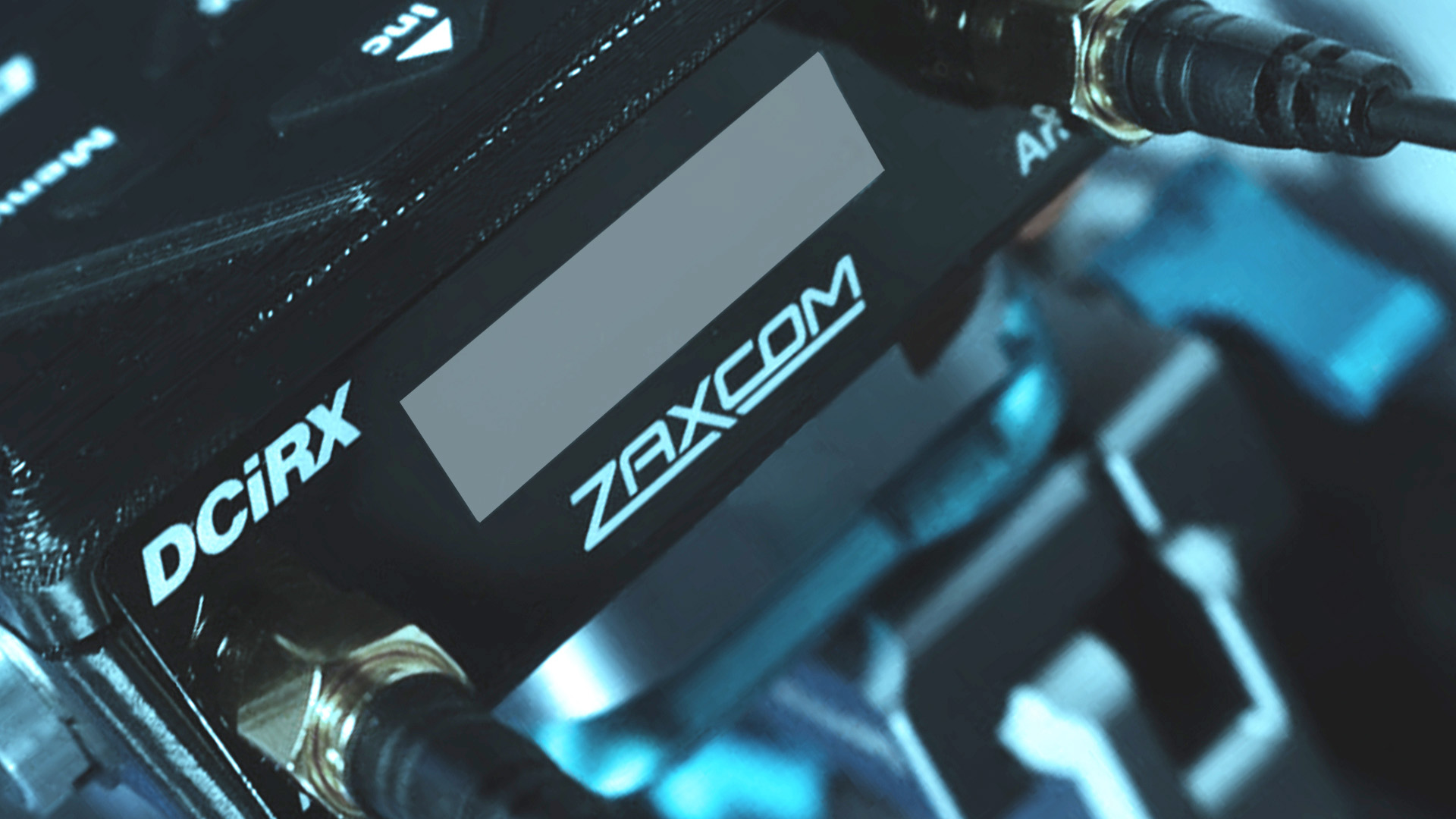
DCiRX, the first product built on the architectureThe technology made its commercial debut in May 2026 with the DCiRX, the first UHF receiver built around Narrow Band Direct Conversion. The unit combines mono or stereo wireless reception with a direct input for a 5V lavalier or a 48V phantom-powered microphone. Its internal four-track recorder captures up to three ISO tracks plus one automix track with timecode, in either 32-bit float or 24-bit fixed formats; a welcome inclusion given how quickly 32-bit float has become a buying factor for many of our readers. A four-channel USB-C interface connects to compatible mobile devices, computers, and cameras and also carries timecode.
 Zaxcom DCiRX. Image credit: Zaxcom
In practice, this means a single box can serve as a wireless receiver, a camera link, a wired microphone input, an isolated backup recorder, an automixer, or a computer and mobile interface, reducing the amount of separate equipment a small crew needs to carry. It follows a design philosophy Zaxcom has pursued for a while, as seen in multifunction devices like the URX50 IFB receiver.
A scalable architecture, not a one-off featurePerhaps the most interesting takeaway from the white paper is that Zaxcom frames Narrow Band Direct Conversion as a scalable architecture rather than a single product feature. The company states it is now applying the same principles, prioritizing the desired signal and rejecting unwanted RF before it can affect performance, to a new generation of multichannel wireless receivers. As with any manufacturer white paper, the performance claims come from Zaxcom itself and will need to prove themselves in the field, but the engineering rationale addresses pain points every location sound professional will recognize.
Do you struggle with RF interference on your shoots, and would a narrow-band receiver architecture change your wireless setup? Don’t hesitate to let us know in the comments below!