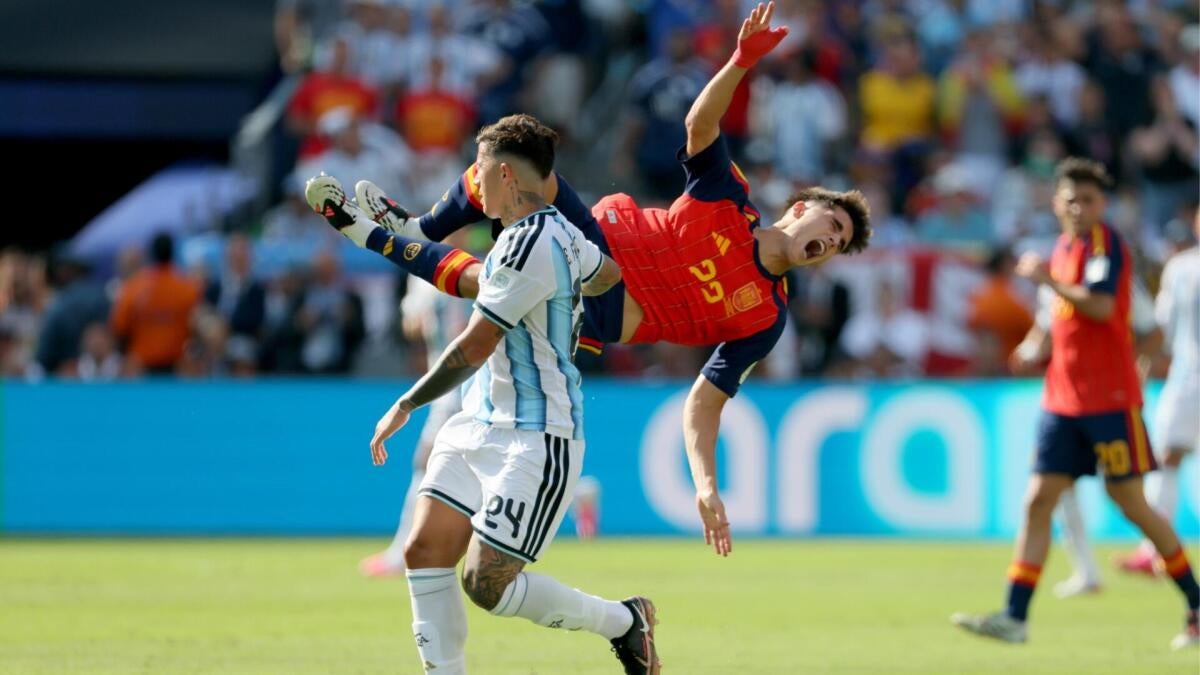
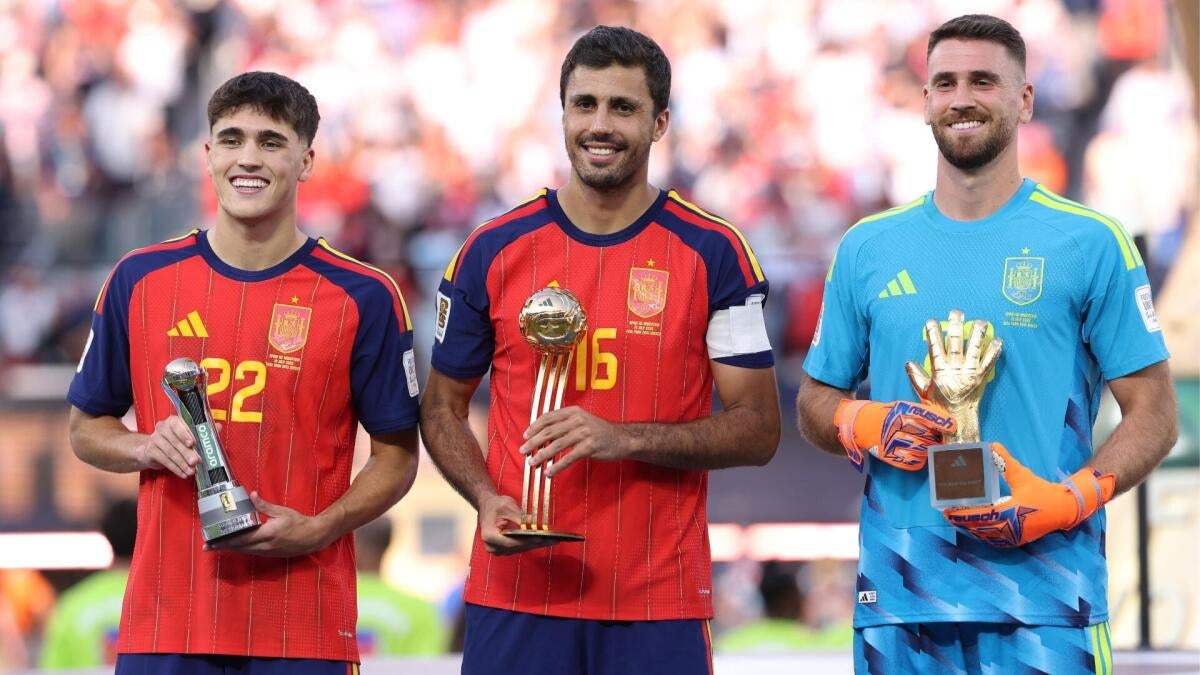
EAST RUTHERFORD, N.J. – Ferran Torres spent an extended amount of time lying on the pitch at MetLife Stadium, a right he had earned after breaking the deadlock in Sunday's World Cup final 106 minutes into the game. The Spain attacker was hardly the only one breathing a sigh of relief, though, as he put his team on course to win a second title, 1-0, at Argentina's expense.
The World Cup villains, after all, had finally been slayed.
Less than four years after the world championed Lionel Messi, before he won the title that had eluded him, Argentina literally pulled a line from one of film's most famous bad guys -- they did not die the heroes, instead living long enough to become the villains. Their run to Sunday's World Cup final was improbable because it was obvious that a golden generation was on its dying embers. Messi, still brilliant, was well past his prime at 39. Argentina were not as deep as some of their competitors for the title, Spain chief among them. Goalkeeper Emiliano Martinez played the entire tournament with a broken hand, refusing to undergo surgery despite receiving advice from medical professionals to do so.
They could have slipped into plucky underdog territory and they almost did, but circumstances favored them in ways few could foresee. Nine of their 11 goals in the knockout stages came after the 75th minute, resulting in dramatic comebacks that saw them snatch victories from the likes of Cape Verde, Egypt, Switzerland and England. Refereeing fortune favored them, even when Spain had a goal disallowed moments after extra time began. They did not take a shot until the 117th minute on Sunday, a feat for a team that has benefitted from Messi pulling a rabbit out of a hat on days he is invisible.
At long last, it did not work.
It is to Spain's credit that Argentina ran out of their inexplicable magic. Luis da la Fuente's team never abandoned Plan A and had been the better team all afternoon. A tepid first half, where they took just three shots, gave way to a second half that showcased both their intention and their talents with the World Cup trophy on the line. They took 12 shots in the second half alone, all while possessing and passing their way around Argentina. Rodri, the 2024 Ballon d'Or winner, was in peak form. The opponents applied little pressure on him, and he had free rein in midfield, which was never a guarantee at age 30 and on the back of an ACL injury that he recovered slowly from -- but just in time for the World Cup.
Spain's ability to render their opponents useless kicked in sooner rather than later. In what was likely his World Cup swan song, Messi managed just 54 touches on the ball in 120 minutes, well below his per-game average of 77.52 in the build-up to Sunday's game. There was no fairytale ending from a star whose brilliance feels inevitable, but who already has nearly universal adoration and appreciation. He missed out on a second World Cup title, the golden boot award and the competition's all-time goalscoring record in one fell swoop.
"Whilst all finals are tough, when you're up against Messi, you do get a bit nervous," Spain head coach Luis de la Fuente said post-match in a press conference in which he said several times that the win felt like destiny of sorts, their own dynasty in focus after winning the Euros in 2024 and the UEFA Nations League last year. His answer for Messi was a simple one.
"We played better football."
It was perhaps a harsh end for Messi in particular, who had once again carried Argentina as far as he could take them, but an appropriate conclusion for a team that had perhaps stumbled into a World Cup final. They may have gotten close to the trophy but did not play like World Cup winners on Sunday, mustering two shots in 120 minutes and generating just 0.17 expected goals along the way. They may have limited Spain to 1.94 expected goals from 20 shots, but even if the conversion rate was low, they had played well enough to get at least one of those shots across the line.
The trajectory is stunning, if not all that surprising. Argentina head coach Lionel Scaloni chose a cynical strategy where Argentina absorbed as much pressure as they could, opted out of going forward for the most part and tried to make the game physical to disrupt Spain's momentum. It nearly worked, but that is mostly due to Martinez's efforts in goal. Argentina were the most notable "vibes only" World Cup contender in recent memory, especially when standing next to a tactically sound and balanced, if sometimes unglamorous, Spain.
It is not an unfamiliar playbook for plucky underdog types, even if Argentina were not exactly made of that mold. As they chased one final accolade in a dynastic run that saw them win two Copa America titles and one World Cup in between, they arrived at this tournament on the dying embers of that version of the team. A traditional Plan A in the ilk of new world champions Spain was not actually an option for them. Underdogs often opt for the grueling, disruptive game plan because that's what works against the opponents that are destined to dictate the tempo of a game -- and walk away with the win that should accompany it. This edition of Argentina were probably always going to default to that, especially since they have historically been a "vibes only" team even at their best.
You don't get to be the underdogs though when you're the defending champions. Doubly so when you have the best player the world has ever seen.
But they leaned into the bit fully at this World Cup, mounting as unique an attempt at a title defense as any team has mustered in some time. The good news for them is that they will likely reset once the dust settles and the confetti gets swept away in New Jersey. Messi has not announced his international retirement and Scaloni has not officially stepped away, but both of those things seem likely, making this tournament a victory lap for this team regardless. Scaloni had said as much going into the semifinal against England, attempting to relish the moments over the last week even as they attempted to win the World Cup in the most arduous way possible.
Their villain arc is both confirmed and complete, to the point that a ring of Messi chants broke out during the trophy presentation ceremony at MetLife Stadium. It marked the end of an era in more ways than one, Scaloni acknowledging the sentiment in an emotional press conference. He said at point he had already cried his heart out in the locker room, only to burst into tears again and leave early after pondering his own future with Argentina, which is likely in his own hands.
"I will talk to the president [of the Argentina Football Association]," he said. "I believe it's only fair that I can take this time for myself to think this through. I never thought I would get to this place and it's wonderful. In order to continue, you need a great deal of things, resetting your mind, rebooting, creating a group like this again -- that is very difficult. I am very sorry."
Messi, too, looked overwhelmed by the occasion, likely for a range of reasons – there are probably few feelings as sore as losing a World Cup final, but perhaps he was taking in his last moments on a World Cup pitch. Victory was not his on Sunday but his legacy has been established for quite some time, in great contrast to his last tearful moment in this very building. A decade ago, he briefly quit Argentina's national team after a fourth loss in a major final, that time a defeat in penalties to Chile at the Copa America.
His final run was not always spectacular but a decade after declaring that "this is not for me," he proved even as the other, better team won that the big stages were most certainly meant for him.
"He's 39 years old now," Scaloni said. "It was crystal clear for me that he was going to play up until he decided not to."I hope that everyone feels proud of him, of what he's achieved because he's the best football player ever to set foot on a pitch. I have no doubt about this, and what he did during this World Cup was incredible. But also what he did before this."