
Remember me
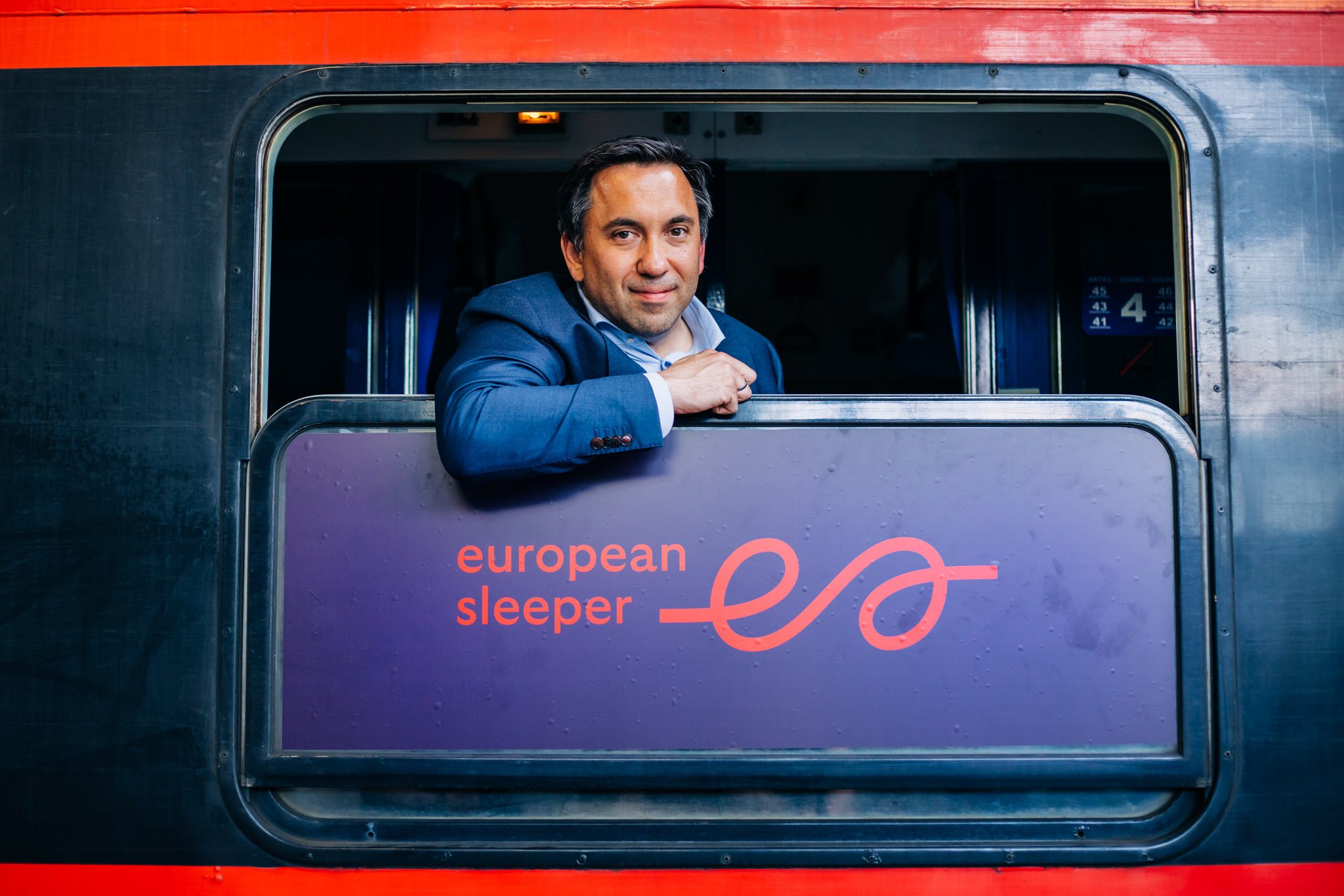



As European Sleeper prepares to launch a service to Milano in September, the open-access operator must still clear regulatory hurdles to enable it to serve destinations in France and Spain. Speaking to Esther Geerts, co-founder Elmer van Buuren explains that overcoming these barriers could create a ‘snowball effect’ for the industry.
European Sleeper is a rare beast: a truly independent, small-scale new entrant that has fulfilled its dream of using crowdfunding to create a night train operation connecting European cities that have lost their sleeping car services over recent decades. It is structured as a co-operative, and in 2021 co-founders Elmer van Buuren and Chris Engelsman raised €500 000 in starting capital within three months by selling shares to over 350 small investors. In 2022 it raised a further €2m by selling shares. The service operates on a purely commercial basis, with no public service contract.
The independent night train operator continues to scale up its international network, and a service to Italy is currently in the works. ‘On September 9, the first European Sleeper train between Milano and Brussels should start running’, anticipates Van Buuren, who is now Managing Director of the company.
 The launch of the Paris – Berlin service in March 2026.
It currently operates six train services per week on two routes. The operator has run a service connecting Brussels, Amsterdam and Berlin since May 2023, extending it to Praha from March 2024. In addition, the company launched a second route between Paris and Berlin on March 26 2026 after ÖBB had discontinued its Nightjet service. This gives the operator a train between Brussels and Berlin six days a week. The Paris – Berlin service will add a stop in Hamburg from this month.
The night train operator also ran a seasonal service linking Brussels with Innsbruck and Venezia in February and March 2025. With a fresh set of expansionist goals on the horizon, Van Buuren says that ‘ultimately, we are doing almost only ambitious things’.
Hoping for a ‘snowball effect’Starting new international passenger routes requires significant capital. The initial period often operates at a financial loss, as passenger demand can take time to build up, especially if a direct rail connection did not exist beforehand. ‘A new train connection is never completely profitable right from day one’, Van Buuren says. These launch periods present significant challenges for private operators. Securing external finance is difficult without state backing, limiting how quickly new routes can be launched. ‘Every expansion of your network produces a financial risk’, he adds.
Resolving these initial financial risks could transform the sector. ‘If you address that risk, you’ll attract investors. And if you can attract investors, you can also adapt your organisation so that you can expand your network. So ultimately, the best way to sum it up would be as a sort of snowball effect, fixing a missing piece of the puzzle.’
Profile: Elmer van BuurenAfter starting in the sector as a travel agent selling train journeys at the Dutch Treinreiswinkel in 2005, he joined the Dutch national operator Nederlandse Spoorwegen as a guard on the Amsterdam to Brussels a year later.

Before co-founding European Sleeper, Elmer van Buuren worked in various roles in the railway industry.
He worked for more than 10 years at NS in a variety of positions before becoming a public transport and rail consultant, first at Royal Haskoning, and later at Inno-V. He co-founded European Sleeper with Chris Engelsman in 2020. Since December 2024, Van Buuren has been President of the AllRail association of passenger rail new entrants.
One of the ways to reduce risks would be through the issuing of guarantees from governments. Banks prefer the security offered by government-owned transport companies and are wary of lending money to a new entrant. ‘If you are a private operator and you have no state ownership, then it is very difficult to get financing’, says Van Buuren.
‘A public guarantee can only be invoked if unexpected circumstances arise that are beyond the control of the operator’, Van Buuren explains, adding that national governments do not have to include the full amount upfront in their budgets. Instead, as little as 20% of the overall amount has to be put on the balance sheet of a ministry, he explains. However, ‘financial guarantees have historically been uncommon in the rail sector because most operators are state-owned and do not need them’, the European Sleeper co-founder explains.
The revised EU state aid rules issued on March 30 should help to expand the funding options. The Land & Multimodal Transport Guidelines explicitly mention night trains. They allow EU countries to provide operating support to cover initial losses for new overnight passenger trains on routes that have been without a night train service for at least three years. ‘It expands the possibilities’, Van Buuren believes.

Beyond financial barriers, network access still remains a formidable obstacle. Securing track access rights and viable paths across multiple countries is ‘incredibly complex’. Germany presents a particularly difficult operational environment. ‘The rules around capacity allocation change constantly with the many engineering works.’
Navigating capacity bottlenecksSome infrastructure managers frequently adjust their schedules to accommodate track works, and operators must constantly navigate these bureaucratic processes. ‘We spend a great deal of time keeping up with all the developments, responding to consultations and trying to ensure that the rules don’t suddenly become a lot more complicated during the game’, Van Buuren explains.
On top of scarce capacity on some corridors and a general lack of diversionary routes across the EU, Van Buuren also sees resourcing problems among the continent’s infrastructure managers. ‘They simply have too few people to make the planning systems work well, especially when dealing with outdated systems’, he observes.
 A night train of European Sleeper.
Some cross-border routes face especially severe infrastructure constraints. The main line linking Germany and the Czech Republic used by European Sleeper’s Praha – Brussels train, is highly congested. ‘There is only one electrified line available, and every day 300 freight trains run over it’, Van Buuren remarks, describing it as a ‘Panama Canal for trains’.
He reports that this creates a massive bottleneck for passenger services. Alternative routes often lack electrification throughout, so costly diesel ‘drags’ become necessary, further damaging the delicate business case for the new entrant’s service.
Expanding the network towards southern Europe introduces entirely different challenges. European Sleeper is still hoping to reach Barcelona in the future, a goal that was first announced back in 2022 and added to a list of 10 cross-border connections backed by the European Commission, though more for symbolic value than with any financial or practical assistance. The company is currently targeting April 2028 for this route. ‘It is complicated because the timetabling and access to rolling stock for France is complicated’, Van Buuren says.
Tackling French ‘folklore’Despite the onset of market liberalisation in the French passenger market and the requirements of the EU’s Fourth Railway Package, securing viable train paths through France is notoriously difficult. Negotiating with SNCF Réseau involves challenging established practices, Van Buuren says. ‘In France, you always have to ask yourself the question, are we dealing with a rule that is really important? Or are we dealing more with folklore?’
A major problem remains over the scheduling of track maintenance work, he adds. The infrastructure manager reserves extensive overnight possessions for engineering work. However, these blockades are not always fully utilised — ‘much more capacity is allocated for track works than is actually used’, Van Buuren claims.

This challenge is exacerbated because of the difficulty conventional trains have in accessing the French high speed network. Routing night trains entirely via the legacy network would lead to excessive journey times for services bound for the French riviera or northern SPain, for example. Van Buuren says the official reason for the lack of paths on LGVs is that maintenance is carried out, but he suggests the scale of the restrictions are excessive. ‘Are you really going to actually do maintenance on tracks on the entire 750 km from Paris to Marseille every night of the year?’ he asks.
Even if access was granted, rolling stock remains a barrier. Van Buuren says that very few locomotives are equipped for French high-speed lines, creating a significant technical hurdle for new entrants. ‘There are two locomotives in all of France that can run over the high speed lines’, he quips, although the gradual roll-out of ETCS on routes including LGV Sud Est and LGV Nord towards the Channel Tunnel offers hope that interoperable trains could access sections of the network in the future.
But that still leaves the question of how multi-system locos and suitable coaches can be financed. ‘If there were more certainty in the market, then you could get those locomotives built’, he insists.
Looking northWhile the southern route options remain difficult, northern expansion looks more promising. European Sleeper is exploring new connections from Brussels towards Scandinavia, which could open up a fresh market for the operator. ‘For April next year we are looking at Stockholm’, he says.
Developing this northern route involves discussions with potential operating partners, although Van Buuren would not be drawn on who these could be. ‘Collaborating could ease the operational burden, and also help share the financial risks involved. If we manage to work together, then this service could be implemented relatively quickly’, he hopes.
The company also has to navigate complex European ticketing systems. Independent operators struggle to gain visibility on the large booking platforms, as state-owned incumbents dominate the digital ticket distribution landscape, says Van Buuren. ‘In my view, the passenger simply wants to be able to book their whole journey in one place’, he states.
 A train attendant pours a morning coffee on the Brussels – Prague train.
The EU is currently planning massive ticketing reforms, which Van Buuren welcomes. The proposed regulations of the upcoming Passenger Package aim to simplify multimodal bookings, improve rail passenger rights and open up the ticketing market for rail by forcing platforms with a large market share to sell tickets of other operators. However, this legislation could take years to fully implement. ‘The previous time that the Passenger Rights Regulation was revised, they had been working on it for 12 years’, he recalls.
Third-party vendors face limiting conditions when selling incumbents’ tickets. According to Van Buuren, they receive minimal commission for their services, which forces them to add booking fees, making tickets more expensive. But the established booking platforms are typically controlled by the national railways, and Van Buuren says these dominant booking platforms should be viewed as essential infrastructure, just like the tracks are. ‘Taxpayer money largely funded their development over the decades. So why should we not be allowed to use this distribution infrastructure?’, Van Buuren questions.
‘It has to become hassle-free’Reforming passenger rights is another critical piece of the puzzle. Van Buuren strongly believes that improving passenger rights and ticketing will drive sector growth. Passengers should simply be able to travel without having to worry, he says. ‘Questions like, “what happens if my journey is delayed, will I know where to go? Can I make arrangements to have a roof over my head if I miss the last train of the day? Will I get my money back if I sort it out myself?” We shouldn’t be bothering passengers with basic questions like that any more. And yet that’s exactly what we do in the rail sector.
‘Sometimes it feels like passengers are accused of wanting to make a train journey that’s too complicated. We really need to get rid of that. It simply has to become hassle-free, that’s the only way to attract the large number of people who do not yet use the train. After all, there are more people that do not take the train than people who do. This is the only way to get those people onboard.’

This article first appeared in the July 2026 issue of Railway Gazette International
See also:
Subscribe to gain access to all newsAlready have a subscription? Log in.
Choose your subscription Most popular! Digital Onlyi Prices are displayed as monthly rates (exc. VAT), but billed annually. Please refer to our subscription terms for more details.
€18,17 per month per user *
£15.75 per month per user *
$19.17 per month per user *
Unlimited access to all Railway Gazette content Monthly digital Railway Gazette International Magazine 2000+ Operator Profiles Newsletters & Breaking News Updates Subscribe with 1, 3, or 5 user logins Digital + Printi Prices are displayed as monthly rates (exc. VAT), but billed annually. Please refer to our subscription terms for more details.
€25,67 per month per user *
£22.33 per month per user *
$26.67 per month per user *
Monthly print Railway Gazette International Magazine Unlimited access to all Railway Gazette content Monthly digital Railway Gazette International Magazine 2000+ Operator Profiles Newsletters & Breaking News Updates Subscribe now ›Considering a corporate subscription? Contact us to find out more.