The Faintest Planet Ever Imaged From Earth Was Hiding in 11 Years of Old Photos
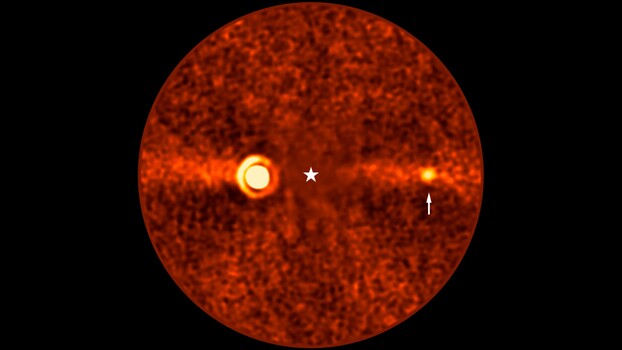
Astronomers have directly imaged the faintest exoplanet ever seen from Earth, a gas giant called Beta Pictoris d — and it turns out the planet had been sitting in telescope archives for more than 11 years before anyone managed to pull it out of the noise.
The detection was made with the ERIS instrument on the European Southern Observatory's Very Large Telescope, pointed at Beta Pictoris, a young star 63 light-years away that is already one of the most heavily photographed systems in the sky. The new planet is roughly 100 times fainter than Beta Pictoris b, the bright, well-known planet in the same system, which is what kept it hidden for so long. Based on its infrared brightness and color, the ESO team puts it at about 2.4 times the mass of Jupiter.
The part that should feel familiar to anyone who has ever dug through their own archive: once the team knew where to look, they went back and found the planet had been recorded all along. It shows up in VLT/SPHERE frames going back to December 2014 and in James Webb Space Telescope data from 2023 and 2025. The reason no one had spotted it is almost painfully photographic — in the 2014 observations, the faint planet and its much brighter sibling were sitting nearly on top of each other from our viewing angle. Beta Pictoris d only emerged once the brighter planet's light was subtracted out of the frame.
An independent team led by Aidan Gibbs at the University of California, San Diego found the same planet in Webb data, which is about as good as confirmation gets. Beta Pictoris is now only the second star system where three planets have been directly imaged rather than inferred. If you want to point your own glass at the night sky, our beginner's guide to astrophotography is a reasonable place to start — the gear is different, but the problem is the same one: getting signal out from under something much brighter.
Image credit: ESO/B. Sutlieff, M. Bonse et al., licensed under CC BY 4.0.
Sources: ESO and NASA.