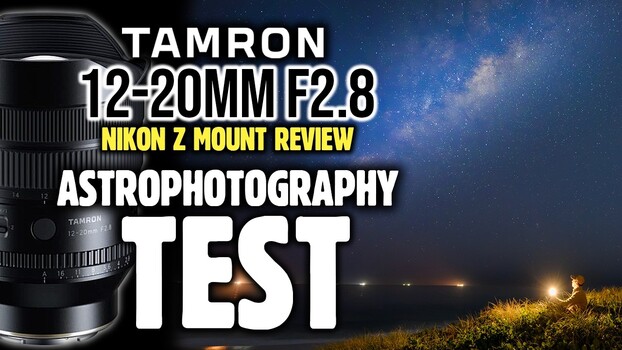
A 12-20mm zoom at f/2.8 sits right in the sweet spot for astrophotography, wide enough to swallow the Milky Way and fast enough to pull in faint starlight. Most shooters reach for a prime when the sky gets dark, which makes a zoom that can keep pace worth a real look.
Working a clean beach near the Port of Brisbane a day off the new moon, Adrian Alford puts the Tamron 12-20mm f/2.8 through a full night of Milky Way work. He scouts in daylight first, using the PhotoPills augmented reality feature to see exactly where the galactic core will sit at a given hour, then marks out three spots along the dunes. One has an old dead tree, another a pair of pandanus trees, and each gets planned around the Milky Way rising through the frame. Alford also nails focus on distant ships waiting to enter port, then flips the lens's manual focus lock switch so a stray bump won't ruin the whole session.
The results are where the lens earns its keep. Shooting single exposures at 12mm, 14mm, and 16mm, Alford pushes into the corners at f/2.8 and finds sharp, well-defined stars with no smearing, which he describes as close to prime lens quality. He light paints the foreground trees during the last few seconds of each exposure and drops a warm 4,500 K white balance on the sky to bring out color in the core. There's a bonus in the frames too: faint meteors, satellite streaks, and even planes lining up for the local airport show up across the sky. His favorite shot lands at 12mm with the dead tree lit on both sides and the Milky Way climbing straight up the center.
The bigger story here is planning. Astrophotography rewards the shooter who does the boring work in advance, and Alford's routine is a clean template you can copy. Check the moon phase and aim for a window near the new moon so the sky stays dark. Use a weather tool to pick the clearer of two nights rather than gambling on the calendar date. Scout in daylight so you already know your compositions when you arrive in the dark, and use an app like PhotoPills to confirm where the core will be and when. Focus locking matters more than people expect once you're fumbling in the dark, and a small light source, in his case an old fishing lantern, turns an empty foreground into a subject. None of this depends on owning the exact lens he used; the process travels to any fast wide angle you already have.
Corner performance is the number that separates a good astro lens from a frustrating one. Wide open, cheaper wide angle glass tends to turn stars near the edges into little comets, and stopping down to fix it costs light you can't spare at night. An ultra-wide zoom that stays clean in the corners at f/2.8 removes that compromise, and that's the specific thing Alford keeps returning to across all three locations.
Watch the full field test in the video above to see how each of the three compositions turned out and how the corners held up at f/2.8.