Classic Film Review: A Brit DJ with a Dead Brother hears the Birth of New Wave
“Radio On” is an archetypal ’60s “art film” mystery drama released on the cusp of the New Wave ’80s.
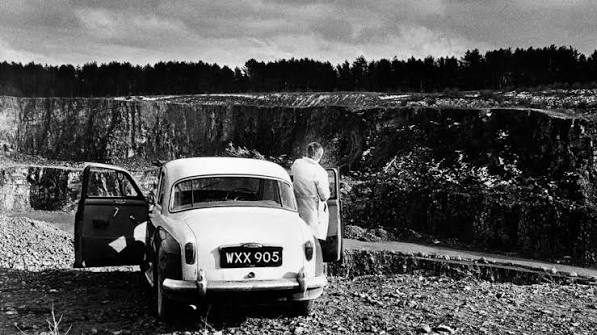
The tone is downbeat, the story and performances are minimalist and the narrative is literally driven by a 1960 Rover 80 that our hero takes forever to navigate from London to Bristol (118 miles), where he’s just learned his estranged brother died.
But this self-conscious black and white 1979 film makes for a fascinating snapshot of Britain in the early stages of Thatcherism, an artifact of its age. We view an economy in the doldrums, Northern Ireland a bloodier and bloodier thorn in the national psyche and a generation’s limited horizons utterly lashed-out in punk, danced-out in disco, desperate for a New Wave to give them escape.
That’s the “hook” of Christopher Petit’s indi film (co-financed by the British Film Institute), the changing music of a coming decade. Here’s a film filled with Bowie and Kraftwerk, Devo, The Rumour, Ian Dury, Robert Fripp. Wreckless Eric and Lene Lovich.
Whatever Petit’s merits as an out-of-his-time filmmaker — he’d go on to direct “An Unsuitable Job for a Woman,” “Chinese Boxes” and the much more recent “D is for Distance” — he had a John Hughes-like knack for building a narrative and a vibe out of the music of the unfolding moment.
And that broke guitarist bloke our anti-hero DJ (David Beames) runs into at a remote gas station and sings an impromptu duet of Eddie Cochran’s “Three Steps to Heaven” with? He’d turn a lot blonder as he became even more famous than he was when he popped up in this, his second film appearance as Sting.
Robert’s the sort of bored DJ who takes “requests” for songs like “Help Me Make it Through the Night,” and sighs “Here’s something better” into the microphone.
He’ll play that caller “Sweet Gene Vincent” by Ian Dury instead.
Robert takes the news that his brother’s dead without emotion. He takes the news that his openly unhappy live-in girlfriend (Sue Jones-Davies) won’t be going with him the same way.
He’s got his old car, one of the last British clunkers to come with a crank handle so that you could start it when the inevitable electrical failures of British motoring pop up.
He makes his leisurely B-road way from capital to coast, picking up and quickly ditching a talkative, edgy Army deserter (Andrew Byatt) fresh off service in Northern Ireland, stumbling through car troubles, drinking and driving when he isn’t stopping into pool halls and arcades in the process of transitioning from pinball to video games.
He doesn’t speak much, but we gather that Robert is looking “for answers,” the implication being that his brother offed himself in the tub. He won’t find them, no matter how much he badgers the sibling’s live-in girlfriend (Sandy Ratcliff) or the streetwise Bristol kid (Paul Hollywood) who gives him tips about where the “action” is.
It’s the German women (Lisa Kreuzer and Katja Kersen) he gives a lift to that distract Robert the most. Ingrid (Kreuzer of “The American Friend” and “The Grand Budapest Hotel”) is looking for her ex who has run off with their daughter.
The ladies eye him warily and launch into untranslated discussions in German of whether Robert can be trusted or who is attracted to him. This also happens when Robert takes Ingrid to her ex’s aunt’s house, with the Germans having the nerve to call him “rude” for stepping out as they chatter in a tongue they know he doesn’t understand.
He and Ingrid pass time together on the waterfront, in a vintage car museum. But she is still on her quest even if his is strictly a non-starter.
For obvious reasons, I kept hearing “D.J,” the song Bowie released the year this film came out but not on this film’s soundtrack while watching “Radio On.”
“I am a D.J., I am what I play,” Bowie crooned in a tune that could have been written expressly for this film.
But Petit’s artistic ambition comes in a bit of graffiti as thesis statement in the dialogue-free opening eleven minutes of “Radio On.”
“We are the children of (filmmaker) Fritz Lang and (rocket designer) Werner von Braun,” looking for “the link between the ’20s and the ’80s” as the ’80s are about to begin.
Petit didn’t know what a shadow Margaret Thatcher would cast over Britain, how big a deal Sting would become or the brevity of the post-punk/post-disco and pre-“New Romantics” era known as New Wave.
But even this slippery grasp of all that was beginning, all that was ending and the ennui settling in on a generation too bored to care about much more than their haircuts was enough to hang an interesting film on, a movie that remains mysterious and downbeat even as the years pass and its music and ethos curdle from cutting edge into sentimental.
Rating: TV-MA, adult subject matter, profanity
Cast: David Beames, Lisa Kreuzer, Sandy Ratcliff, Andrew Byatt, Katja Kersten, Paul Hollywood and Sting.
Credits: Scripted and directed by Christopher Petit, additional writing by Heidi Adolph. A British Film Institute co-production on Tubi, other free streamers.
Running time: 1:44