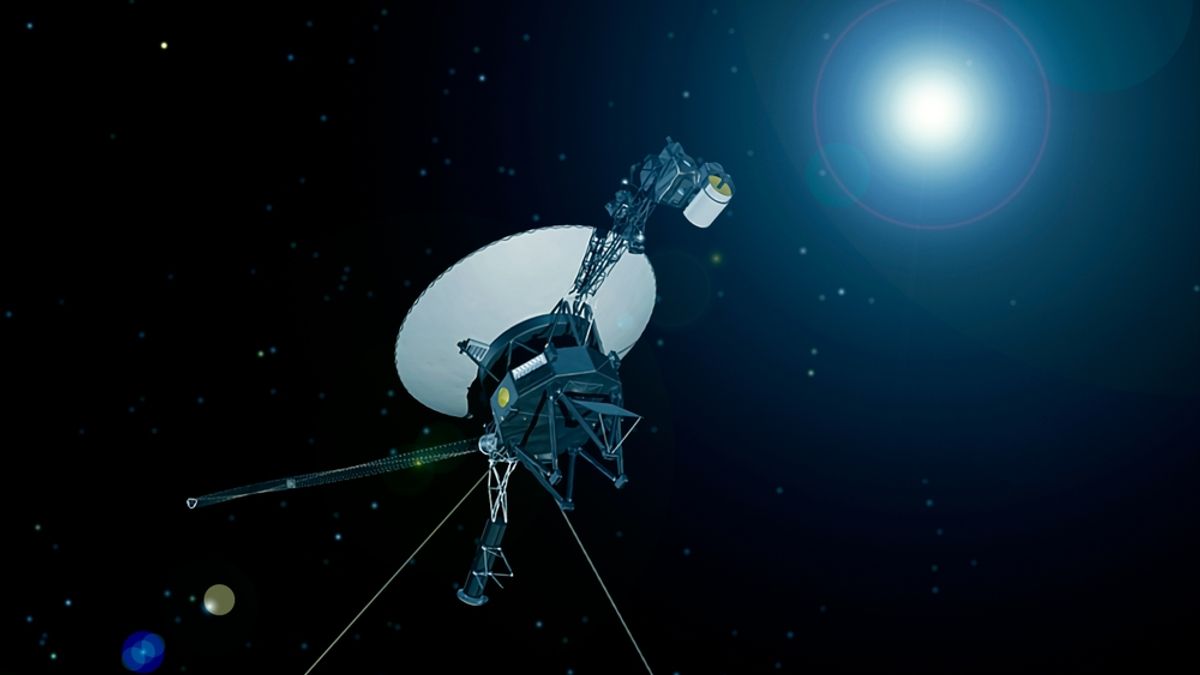
Voyager 1 has been streaming its way through the cosmos since Sept. 5, 1977, sending data back to Earth and carrying on board key parts of humanity, including our voices, our laughter, our languages, and music.
According to NASA, Voyager 1 is traveling at about 38,026.79 mph relative to the sun, making it the first human-made object to leave our Solar System and enter interstellar space. Though it’s been traveling at high speeds for about 50 years, the craft has not yet hit one light-day — the distance light travels in 24 hours — away from Earth.
However, NASA experts have officially calculated exactly when Voyager 1 will reach one light-day, and it’s closer than you think. On Nov. 18, 2026, at 2:16:07 a.m. PST, the craft will officially reach one light-day if all goes to plan.
This will be a major feat for Voyager 1 and for space exploration, but unfortunately for the craft, NASA has begun shutting down certain instruments to keep it moving. Though the craft will reach one light-day from Earth, what will happen to it as instruments begin to shut down?
“While shutting down a science instrument is not anybody’s preference, it is the best option available,” said Kareem Badaruddin, Voyager mission manager at NASA’s Jet Propulsion Lab, in a press release.
Read More: Carl Sagan and the Cosmos: How His Contributions Changed Space Science
Shutting Down Voyager 1 Instruments
Voyager 1 and its twin, Voyager 2, carry specialized equipment to help gather data on various objects in space. One of those tools is the Low-Energy Charged Particles experiment, or LECP. This experiment helps Voyager 1 measure the energy spectrum, intensity, and composition of electrons, cosmic rays, and ions. According to Johns Hopkins Applied Physics Laboratory, the tool is great for measuring solar wind.
However, now that Voyager 1 is starting to lose power, turning off the LECP is the best way to help keep this interstellar traveler going, according to NASA.
“Voyager 1 still has two remaining operating science instruments — one that listens to plasma waves and one that measures magnetic fields. They are still working great, sending back data from a region of space no other human-made craft has ever explored. The team remains focused on keeping both Voyagers going for as long as possible,” said Badaruddin in the release.
This Isn’t the First Instrument to Shut Down
The plan to shut down the LECP was not taken lightly and, according to NASA, has been in the works for a few years. Both Voyager 1 and Voyager 2 carry the same set of 10 instruments, and so far researchers have already shut off 8 of the 10 and are now adding this one to the list. Voyager 2’s LECP was already shut down in March 2025.
Shutting down the instruments is not a simple procedure. Now that Voyager 1 is more than 15 billion miles away from Earth, it will take about 23 hours for the command to reach the craft. From there, it will take an additional 3 hours and 15 minutes for the shutdown process to be complete.
According to NASA, a small motor will become active in the LECP so that it can one day be turned back on and continue collecting data.
What’s Next for Voyager 1?
Voyager 1 has already helped researchers discover some amazing things in the cosmos, such as a thin ring around Jupiter and new moons orbiting Saturn. As it reaches its one light-day mark from Earth, its mission is far from over.
As Voyager 1 continues into the cosmos, it will one day lose its connection to Earth and no longer be able to send data or receive commands. Experts still aren’t sure when that day will be, but estimates point towards the 2030s. Even so, Voyager 1 will continue as a cosmic ambassador.
According to NASA, it took about 35 years for Voyager 1 to enter interstellar space, and it will take about 40,000 years before it comes closer to the star Gliese 445 (AC+79 3888) than to our own sun.
Voyager 1 is about to break a new record, and only time will tell what it will achieve next.
Read More: NASA’s Nancy Grace Roman Space Telescope's ‘Spy Mirror’ Could Transform How We Map the Universe
Article Sources
Our writers at Discovermagazine.com use peer-reviewed studies and high-quality sources for our articles, and our editors review for scientific accuracy and editorial standards. Review the sources used below for this article: