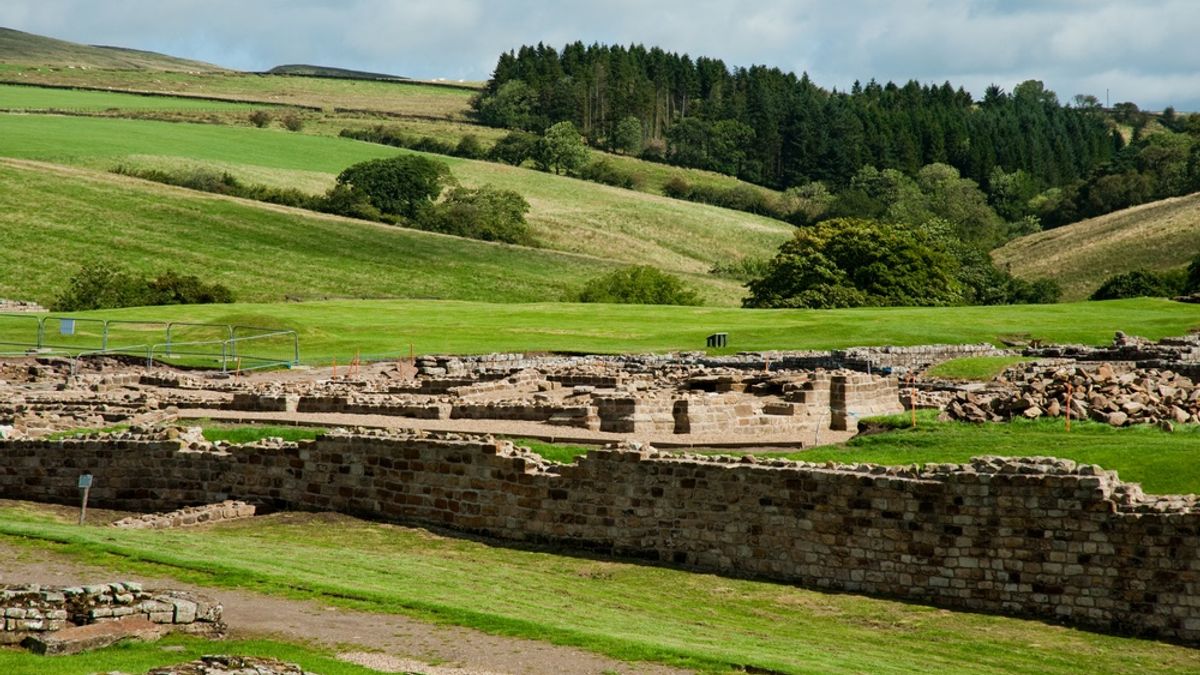
Andrew Birley has spent much of his life looking down at the soil of Vindolanda. His grandfather began excavating the Roman fort in the 1930s. His father followed, devoting decades to uncovering the lives buried there. Now Birley directs the excavations himself, the third generation of his family to work the same ground near Hadrian’s Wall.
On June 16, 2026, he was kneeling inside the remains of a fourth-century barrack when an oddly rounded flagstone caught his attention. Birley loosened it, turned it over, and found a face staring back at him.
Carved into the sandstone was a Roman figure sealed beneath the barracks floor for roughly 16 centuries. It held a cornucopia in one hand and a shallow offering dish in the other, clues that would soon identify it as a Genius, a protective spirit associated with a household or place.
For a family that has spent nearly a century bringing Vindolanda’s past back into view, the identity of the figure felt almost uncannily fitting.
"Once we knew who we had found, it somehow felt entirely appropriate. It was almost as though Vindolanda itself had reached out to the team and quietly said, 'We approve of what you are doing.' As archaeologists, moments like these are incredibly rare, and we feel privileged to have uncovered and preserved such an important part of the site's story,” Birley shared in a press release.
Roman Guardian Found Beneath a Vindolanda Barrack
Vindolanda stood just south of Hadrian’s Wall in northern England and housed generations of Roman soldiers, families, and civilians. The relief came from beneath the floor of a fourth-century barracks, placing it in the closing centuries of Roman rule in Britain.
"My first thought was simply, 'Who on earth am I looking at?',” Birley stated.
He sent photographs to three Roman archaeology specialists who agreed that the figure represented a Genius, a protective spirit invoked to bring security, prosperity, and good fortune to a household or place.
In one hand, the figure holds a cornucopia, a symbol of abundance. In the other is a patera, a shallow dish used in ritual offerings.
“I was completely unprepared for what I found on the other side of this stone. It was an extraordinary moment, one that we were able to share with the team of archaeologists and volunteers,” Birley shared.
Read More: Ancient Sewers Reveal Intestinal Parasites Sickened Roman Soldiers Near Hadrian’s Wall
Three Generations of the Birley Family at Vindolanda
The sandstone relief measures 44 centimeters high, 23 centimeters wide, and 8 centimeters deep. Archaeologists believe it originally formed part of a domestic shrine. At some later point, builders appear to have removed it from that setting and reused it as construction material beneath the barrack floor.
That second use may be the reason the carving survived so well. With its decorated side sealed beneath the building, the relief escaped much of the weathering that damages exposed stone.
Why it was reused remains unclear. It may simply have been treated as a convenient slab after the shrine fell out of use, rather than deliberately buried as part of a ritual.
Archaeologists also believe the relief was carved locally, either at Vindolanda or by a sculptor working within a regional tradition, possibly connected to the Roman fort at Lanchester in County Durham.
Why the Roman Genius Is a Rare Find
Inscriptions dedicated to a Genius are common across Roman Britain, but surviving carved stone reliefs are comparatively rare. Because archaeologists found this one beneath a dated barrack floor, they can study both its religious role and how it was later reused.
The people who once turned to this figure for protection are long gone, but the guardian they left behind survived. Conservators are now preparing it for display at the Vindolanda museum.
Read More: The London Hammer Mystery Points to a Modern Tool, Not an Ancient Relic
Article Sources
Our writers at Discovermagazine.com use peer-reviewed studies and high-quality sources for our articles, and our editors review for scientific accuracy and editorial standards. Review the sources used below for this article: