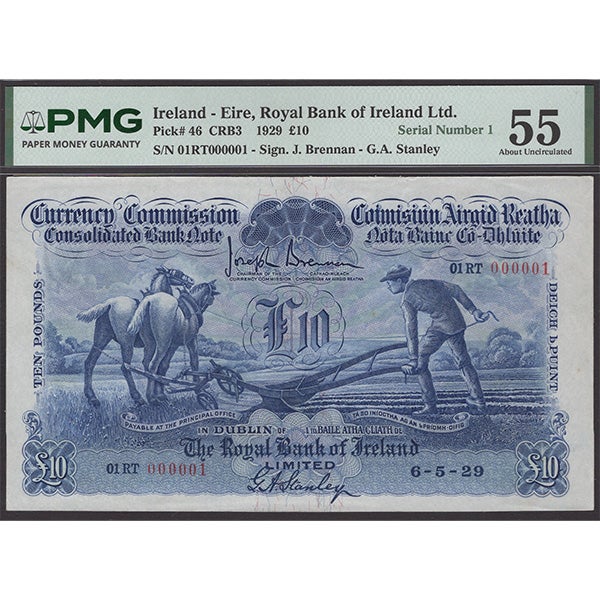
Three extremely rare Irish banknotes, all bearing the serial number 000001, fetched a combined hammer price of £34,500 in Noonans' auction of British and Irish Banknotes on Wednesday, July 8, 2026. The trio of extremely special notes - a set of Ploughman notes (£10, £5 and £1) issued by the Royal Bank of Ireland, all bearing serial number 000001 were expected to fetch in the region of £20,000 [lots 407-405].
Following the sale, Ted Edmunds, Banknote Specialist at Noonans, said: “The Ploughmans were all bought by the same overseas buyer, so we are delighted that they are staying together. They were the perfect combination of condition, rarity, and serial number.”
Among the Scottish section of the auction was a Pudsey £5 note from the Bank of Scotland, dating from July 2015, with serial number PUDSEY05, which sold for a hammer price of £9,500 against an estimate of £5,000-7,000. Only 50 of these notes were produced, and this example attracted a lot of attention internationally [lot 500].
Within the section devoted to English banknotes were several examples from the Bank of England. An excessively rare £10 note that had been cut in half and was signed by Abraham Newland sold for a hammer price of £13,000. It was dated 29 October 1798 and had the serial number 249 [lot 98].
As Ted Edmunds said: ”Notes of this era were often cut in half for sending through the post or being transported - for security reasons. They would be rejoined at a later date. It was bought by a long-time, serious collector of Bank of England notes.”
While a very fine and exceptionally rare £20 note, dated 28 June 1918 and signed by Ernest M Harvey, that was issued in Birmingham, with only two examples known – sold for a hammer price of £9,500 against an estimate of £4,000-£5,000 [lot 112].
From the States of Guernsey, a superb example of an incredibly rare emergency First World War Issue 5 Shillings (6 Francs) banknote dating from 5 August 1914, sold for a hammer price of £8,500 against an estimate of £4,000-£5,000 [lot 761].
Ted Edmunds added: “This was an exceptionally rare World War I emergency issue, they virtually never come to market so when they do, the dedicated Guernsey collectors compete for them.”