This Series of 1902 $20 plain back, now in the author’s collection, was issued by the First National Bank of Huntingburg, Indiana. Note the lovely pen signatures. Unless noted, all photographs are courtesy of the author.
I hope everyone is enjoying the summer months. A recent addition brings us this month’s visit to Huntingburg, Indiana. The state of Indiana has always impressed me as quintessentially Midwestern. Others might well suggest Iowa or Kansas, but I have traveled in Indiana, and the well-kept, classic nature of its towns made me think of the Midwest. I have maintained a small but well-thought-out collection of Indiana notes for some years.
The First National Bank of Huntingburg also issued small-size notes, which are more plentiful than the large, with around 25 currently reported. Here is a $20 example. Courtesy Heritage Auctions.
Huntingburg is a small city in Patoka Township, Dubois County, Indiana, located in the far southwestern part of the state. Today, Huntingburg has a current population of just over 6,500. During the height of the national currency era, between 1910 and 1930, the city had an average population of around 3,200. The city has a classic downtown area on the National Register of Historic Places and is known locally as the “Hollywood of the Midwest,” as several major motion pictures were filmed there, including A League of Their Own (1992). Huntingburg is easily reached off Interstate 64 at the exit for U.S. Route 231. Huntingburg is just 10 miles north of the interstate.
Colonel Jacob Geiger, a veteran of the American Revolution from Louisville, Kentucky, purchased 1,920 acres of land from the Federal Government to establish the village he called Huntingburg. He lived there from 1840 until his death in 1867. It was through Mr. Geiger’s generosity in donating land that the town’s first churches, schools, public buildings, and cemeteries were established. The name Huntingburg was chosen because of the abundance of wild game in the area. A post office was established in 1842.
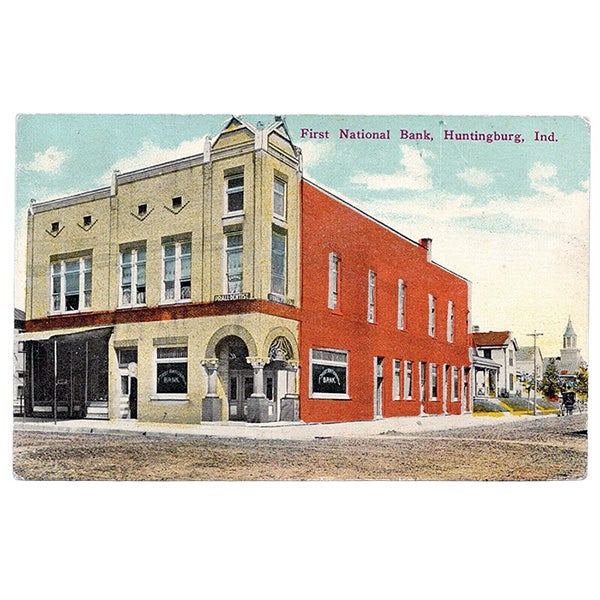
Between 1908 and 1919, the First National Bank of Huntingburg operated out of this building at the corner of 4th and Main Streets. This vintage postcard view shows the bank circa 1915.
By the 1880s, Huntingburg was a principal railroad and commercial center of Dubois County, and was situated at the junction of the Evansville Branch and the main stem of the Louisville, Evansville and St. Louis Railroad. The town’s population consisted mainly of German immigrants and their descendants. Tobacco and wagon factories were mainstays of the local economy. In 1889, a large fire swept through the town, destroying most of the commercial structures, which were then constructed of wood. An extensive rebuilding project, using locally made brick, was embarked on to create an impressive all-brick downtown area. The most repeated architectural style in Huntingburg is Italianate. This was a new style that swept America in the mid-19th century, with both homes and public buildings built in this style, borrowed from Italian villas. Italianate quickly became the most common architectural style, helped by the ease of access and the low cost of its decorative elements. This style was used on two- and three-story commercial buildings with flat roofs, and it remained popular into the 20th century.
The original First National Bank of Huntingburg building still stands in town today, though no longer a bank.
Banking in Huntingburg was originally dominated by the Huntingburg Bank, which opened in the 1880s and built a beautiful bank building in 1897 that still stands today. National banking did not come to Huntingburg until 1907, when the First National Bank of Huntingburg received charter #8929 and opened for business. The first officers were Charles Moenkhaus, president, and W.E. Gassaway, cashier. This was not a particularly large issuing bank. During more than 28 years of operation under the National Banking System, it issued just under $375,000 in national bank notes. Starting with the Series of 1902 red-seal notes, the bank issued all manner of 1902 issues, as well as small-size notes of both Type 1 and Type 2. Only $10 and $20 notes were issued by the bank; no $5 notes or high denominations. Just 11 large and around 25 small notes are reported in the census.
I recently added a pleasing Series of 1902 $20 plain back with lovely pen signatures of W.E. Menke, cashier, and A.H. Koerner, president.
One of the grandest edifices in Huntingburg is the 1865 Old Town Hall and Fire Engine House, which has been preserved for community use.
The First National Bank of Huntingburg operated out of its first structure on the southern corner of 4th and Main Street in town, a building it constructed circa 1908. The bank occupied only a small first-floor space, with a dentist and other tenants upstairs. By 1919, however, the bank had outgrown its small digs. Accordingly, the bank, along with the local Masonic Lodge, contracted with the H.E. Boyle Company of Evansville to erect a new building in the Neo-Classical Revival style, directly across 4th Street from its old building. It is a running bond of brick and mortar, both in a deep burgundy hue, with accents of carved limestone. Its fluted Ionic columns with carved volutes, classical Greek-shouldered window hoods, window sills, window corner lozenges, and enhanced entablatures are all of native limestone. The building is still a bank, now known as the Old National Bank of Huntingburg.
In 1919, the First National Bank of Huntingburg erected this much larger structure directly across the street from its former location. The Masonic Lodge occupied the top floor. The building, considerably enlarged over time, is now a branch of Old National Bank.
Huntingburg today has a simply beautiful, well-preserved downtown, much of which is listed on the National Register of Historic Places. One of the grandest structures is the 1865 Old Town Hall and Fire Engine House, an outstanding example of Italianate design that housed the city government for many years, even after the second story was deemed unsafe for occupancy. An earlier generation would have flattened it for six parking spaces, but the Huntingburg Foundation rehabilitated it, and it is in daily use by the senior citizens, the Huntingburg Chamber of Commerce, and the Huntingburg Foundation, as well as for numerous social events.
Prior to the opening of the First National Bank in 1907, the Bank of Huntingburg handled the majority of banking needs in town. In 1897, it erected an impressive structure which still stands today.
The Huntingburg Historic District includes many good examples of Italianate commercial buildings that show the influence of Italianate architecture in the district, seen in the sheet metal brackets and cornice, hooded windows, and elaborate brick craftsmanship. During the late 19th century, two companies locally owned in Evansville, Mesker Steel and International Steel, manufactured stamped metal and cast-iron storefront appointments and advertised them as “cheap” storefronts. Both are represented in Huntingburg, as their company names are emblazoned on or stamped into the plinths of structural elements. Among these well-preserved buildings are the Miller-Poetker Building (1890) and the Huntingburg Bank (1897).
Several Huntingburg buildings have classic cast-iron facades, including this one, the original Miller-Poetker Building erected in 1890.
Together, these structures help make Huntingburg one of the best-preserved small-town commercial districts in southern Indiana and a rewarding destination for anyone interested in architecture, local history, or national bank notes.
Readers may address questions or comments about this article or national bank notes in general to Mark Hotz at markbhotz@gmail.com.
Click below for more numismatic adventures with Hotz off the Press: