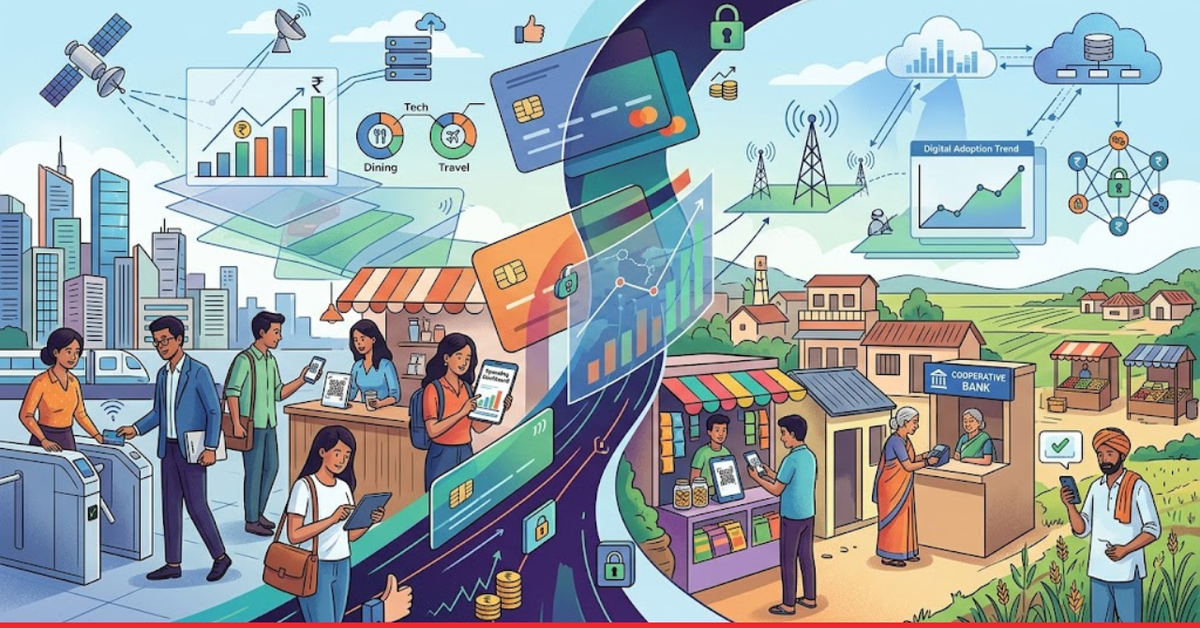
Half of India’s new-to-credit card (NTCC) consumers are now Gen Z and nearly half live in semi-urban and rural markets, according to a new TransUnion CIBIL whitepaper that points to a broader shift in how credit cards are being adopted and used in India.
The report, Beyond the Swipe 2026: How India Uses Card as a Credit Instrument, said 50% of NTCC consumers were aged 30 years or below as of March 2026, up from 43% in March 2022. At the same time, 46% of NTCC consumers lived in semi-urban and rural markets, compared with 42% four years earlier.
The findings suggest that credit cards are no longer expanding only through metro-led customer acquisition, but are increasingly reaching younger borrowers and consumers in deeper geographies. They also show that for a growing section of new cardholders, a first credit card is not necessarily the first formal credit product in their wallet.
TransUnion CIBIL said 25% of NTCC consumers already had three or more open credit products at the time of analysis, indicating that many first-time cardholders are entering the segment with an existing borrowing history rather than using cards as a first entry point into formal credit.
Bhavesh Jain, Managing Director and Chief Executive Officer of TransUnion CIBIL, said the expansion of India’s card market is increasingly being shaped by a more active and varied borrower wallet.
“The decade-long expansion of India’s credit card market is now being shaped by a more active and varied borrower wallet. Many consumers use cards alongside small-ticket personal loans, consumer durable loans and other short-tenure credit products,” he said. “At the same time, it places greater responsibility on the ecosystem to ensure that growth remains aligned with affordability, repayment capacity and the borrower’s overall obligations.”
Card Balances Rise Faster Than Cardholder Growth
The report shows that India’s credit card market has expanded sharply over the past decade, though penetration remains low compared with several other markets. Between March 2016 and March 2026, the number of consumers with live credit cards rose 3.6x from 1.4 crore to 5.2 crore, while the number of live cards grew 5.1x from 2.1 crore to 10.7 crore. Outstanding credit card balances rose even faster, increasing 8.3x from ₹0.4 lakh crore to ₹3.1 lakh crore. The average balance per consumer also more than doubled to ₹65,000 from ₹31,000 over the same period.
Still, India remains an underpenetrated credit card market relative to global peers. As of March 2026, credit card penetration in India stood at 25% of credit-active consumers, compared with 70% in the United Kingdom, 62% in Colombia and 98% in Hong Kong, the report said.
Cards Are No Longer The Default Unsecured Product
A key theme in the whitepaper is that credit cards are increasingly part of a wider consumption-led credit stack rather than the default unsecured credit product for consumers.
The share of live credit cards within consumption-led credit products fell to 38% in March 2026 from 56% in March 2016. Card balances as a share of consumption-led credit balances in the industry also declined to 26% from 36% over the same period. Meanwhile, the share of consumers holding other consumption loans in their wallet doubled to 32% from 16%, while the share of consumers holding three or more cards rose to 22% from 12%.
The report also noted that the share of consumers who held only a credit card as their unsecured product fell to 33% from 50% over the decade, reflecting a broader diversification of borrowing behaviour.
That shift matters because it changes how lenders compete. Instead of competing only for new card customers, issuers are now competing for a higher share of spending and balances within a consumer’s broader credit wallet.
Gen Z Is Entering The Card Market With Prior Credit Exposure
The report’s NTCC analysis suggests younger consumers are arriving with a more active credit profile than earlier cohorts.
Among 24- to 30-year-old Gen Z consumers who entered the card market in 2024, 31% already had two or more open credit accounts at the time of first card origination. About 18% had an open consumer durable loan and 23% had a small-ticket personal loan in their wallet when they got their first card. By contrast, the share of consumers with no prior credit experience was 30% for Gen Z in 2024, compared with 56% for Millennials in 2018.
Gen Z consumers also appeared more active after getting their first card. Around 28% of Gen Z NTCC consumers had balances above ₹25,000 within the first three months of card origination, compared with about 20% of same-age Millennial consumers in 2018, according to the release. Over the following 12 months, 69% of Gen Z NTCC consumers opened another credit product, compared with 55% of Millennials.
The whitepaper said this behaviour points to a changing role for the first credit card. For younger borrowers, the first card increasingly functions as one product within a larger credit relationship rather than as a standalone first step into formal credit.
Four Cardholder Personas Show Diverging Risk And Growth Patterns
TransUnion CIBIL also segmented non-NTCC cardholders into four personas based on card utilization and the mix of other products in their wallet: card-centric users, occasional card users, diversified credit users and high exposure users.
Card-centric users formed the largest segment at 33%, followed by occasional card users at 18%, diversified credit users at 12%, and high exposure users at 10%. Another 9% of cardholders were classified as new to credit card and could transition into one of the more stable personas over time.
The report found these segments behaved differently on growth and risk. Between March 2024 and March 2025, 62% of diversified credit users and 48% of high exposure users opened a new unsecured product, compared with 27% of card-centric users and 12% of occasional card users. Delinquency patterns also varied, with high exposure users showing higher forward risk than occasional or card-centric users.
Jain said the role of the first credit card is changing in ways lenders will need to track more closely, particularly as Gen Z consumers add products earlier and show stronger engagement with their first issuer.
“The opportunity is not just to acquire the customer at the point of first card issuance,” he said. “It is to earn trust, remain relevant as the customer’s credit needs evolve and build a relationship that supports access to credit while maintaining discipline across the lifecycle.”
The findings come at a time when India’s unsecured credit market is becoming more layered, with credit cards, small-ticket personal loans and consumer durable finance increasingly overlapping in how consumers fund everyday spending. For card issuers, the next phase of growth may depend less on adding first-time users alone and more on understanding where cards sit within a borrower’s wider credit stack.