
Remember me
From the July 1992 issue of Car and Driver.
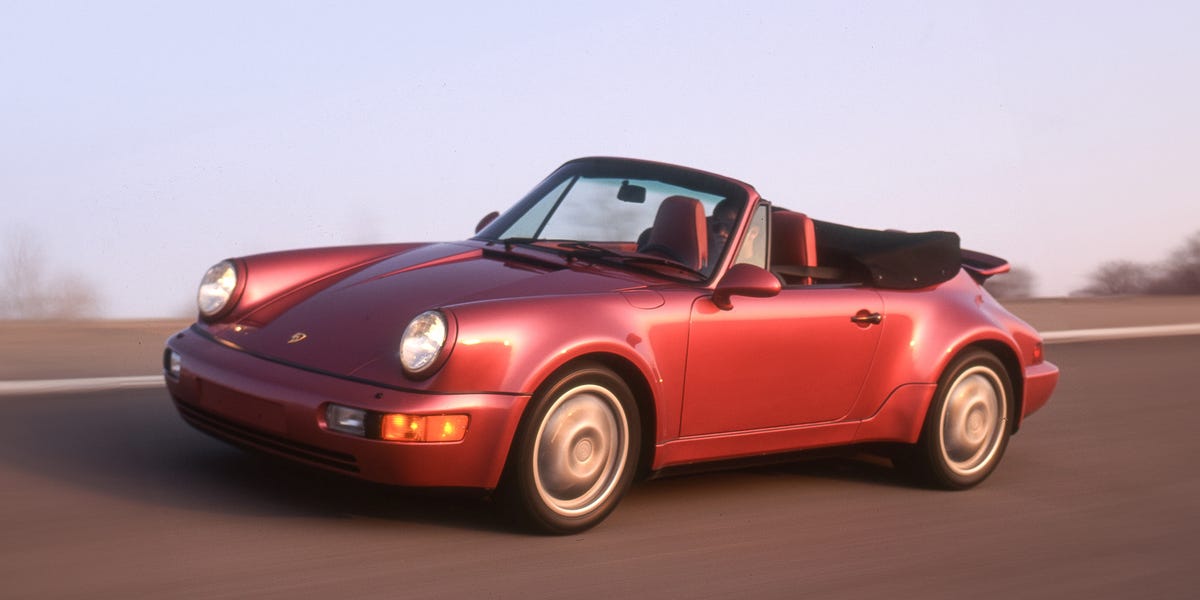
Maybe it was the $2450 raspberry red paint job that made this Porsche 911 America Roadster so quick. Because underneath the extended shoulder pads of the wheel wells, borrowed from the bulldog-like design of the 911 Turbo, beats the heart of a mostly standard Carrera 2 with one of the planet's swellest convertible tops.
After a 1600-rnile blowout through six states, including stops for spiritual rejuvenation in newly trendy Asheville, North Carolina (novelist Thomas Wolfe would be shocked to find that his mean old home town now has a Cuban-Jamaican bistro where the chicken is "jerked"), and two hours in Joey's Bar and Grill in Charleston, West Virginia ("the chemical valley of America!"), where a basket of barbecued "ribs" appeared to have come instead from the spinal column of an unfortunate animal, our Porsche America Roadster returned home to a cold spring day in Michigan. Where it promptly turned in a 0-to-60-mph sprint of 4.9 seconds. That is only a tenth of a second slower than the last manual-transmission Carrera 2 we tested (a European pre-production car in January 1990). We say "only" because we expected this convertible to be hobbled by the extra weight its soft top inevitably imposes—in this case, a penalty of about 100 pounds. The America wasn't much slower belting through the quarter-mile, either: 13.6 seconds at 103 mph, versus the Carrera 2's 13.3 at 106. (So that you have all the facts, you may want to know that the all-wheel-drive Carrera 4, 135 pounds heavier than the America, dispatches the quarter-mile in 13.9 seconds at 101 mph.)
See all results for Porsche 911 for sale near r93
It would make for a better story if we could attribute the America's git-go to the rose-hued leather and trim in the cockpit—a decidedly vivid $5066 option sufficient to make Charo leap up and do the fabled hoochie-coochie—but who's going to buy that? More likely, it's the tire setup. The America has huge 255/40ZR-17 Yokohamas in back, compared with the standard Carrera 2's 225/50ZR-16s. In any event, the power for either model is the same: 247 horsepower from a 3.6-liter six that has long reminded owners driving at three-digit speeds to update their wills.

Dick Kelley|Car and Driver
Porsche's promotional material says this limited edition is offered in tribute to the open-cockpit Porsches of the glory 1950s, when the notable Porsche 356 America Roadster won a slew of SCCA races. The sticker price on the car is $94,460, or $26,400 more than a hardtop Carrera 2, but our frosty raspberry paint job and rosebud leathers upped the ante another—who's got the smelling salts?—$7761, reminding us just how much the world should mourn the recent passing of Earl Scheib. On the reality front, some suggest that Porsche has simply created another model for its sparse lineup—last year, the company sold 3264 examples of the three 911 models it offers in the U.S.—figuring it can do as fashionable a job attaching a turbo shell and chassis to a 911 as can the aftermarket-conversion crowd, like Germany's Strosek Auto Design (see sidebar below).
See all results for Porsche 911 for sale near r93
Certainly, the fine convertible top did not slow down our car. It is a remarkable top to go with the car's remarkable price and performance, one that is lowered or raised by nothing more than the application of an index finger to a button—no releasing of latches, no contortionist exercises. The rear window does require unzipping, but it's a big, industrial-strength zipper that looks as if it could serve forever without failure. Porsche has come a long way from the fingernail-splitting zipper we bitched about in the '82 911 SC Cabriolet, not to mention the tug of war that was part of latching down the top ("The effort," we noted then, "really makes you long for two hands to tug and a third to twist").
More 911 Reviews From the ArchiveThat analysis of ten years ago also held that wind noise caused by the soft top "reached the threshold of annoyance at 80 mph," but that's no longer the case. However, at its top speed of 157 mph, our Frank Markus noted, somewhat pale-faced and pink-knuckled, that the car becomes "quite light." When it encountered pavement irregularities at great speeds, it jumped position laterally by as much as a foot or so. This inspired Frank, a devotee of understatement, to remark: "Not fun."
Under hard acceleration, the tremendous traction of the big rear tires causes the chassis to flex, or wind up. This winding, and unwinding, results in a brutal form of axle hop. We doubt that Porsche owners will be as hard on their cars as we must be to compile numbers at the track, but the cure is big amounts of clutch slip—gradually releasing it at about 5000 rpm and not permitting the tach to slip below 4000 rpm before the clutch is fully engaged. In the stiffer hardtops, a more abrupt dropping of the clutch will result in smoking tires from 5000 rpm until "hookup" at 4000 revs.
On the skidpad, the 247-hp engine isn't mean enough to power the big tires gradually into controllable minor oversteer. Instead, to induce oversteer, you must lift off rather abruptly, after which point it is very difficult to control that oversteer. Still, this new roadster's larger tires and smaller weight yield a skidpad score of 0.86 g, compared with the Carrera 4 Cabriolet's 0.81 g.

Dick Kelley|Car and Driver
As regards that soft top, true perfection of the mysterious plastic arts is found in the material that serves as the rear window. The Porsche stuff is so clear and distortion-free that this humble servant was able to discern through it, coming out of the woods somewhere in West Virginia, if that car that suddenly appeared 500 feet back had on its roof a device capable of flashing. Rain encountered in Kentucky and light snow in the Carolinas did nothing to distort that visual clarity. This material deserves an explanation on the Mr. Wizard show (as does "jerked" chicken). Finally, the boot has a gratefully low number of snaps that are spaced well apart, and the whole thing can be secured in less than a minute. However, revealing this throbbing-pink interior to the great unwashed public will attract a level of attention right up there with Mickey O'Rourke's casual drop-by at John Gotti's persecution; folks will be all over you.
As on all Porsches, two airbags come standard. The aging-but-wise design of Porsche's upright windshield, coupled with the deep seating position, means you will avoid death by drowning in the jetstream of air that in some short-windshielded convertibles pours violently into your face at speed.
The braking system on the America, as on all Porsches, uses discs all around. The rotors are cross-drilled—same as on the Turbo—and the fronts are extra large and grasped by huge four-piston calipers.
In the downer department, there is only enough luggage space in this or any other 911 to accommodate a weekend outing by the actress Linda Hunt (The Year of Living Dangerously). This car is going to hurt your golf game, because you won't be able to bring your clubs. The pink "fur" running along the lower door panels and all over the rear storage shelf was described by one passenger as "tacky" and "gauche" and something denigrating if you happen to be a style maven from Manila—and this critic was from Cleveland! Our car had a CD player but no tape deck, which seems silly because the age group most able to afford this car is not going to throw out 30 years of collected tapes to start all over with CDs.
To sum up, it's a Porsche 911 Turbo convertible without the turbo. It's too bad that Porsche's sticker prices continue to dismay an entire generation of drivers over 40. If you have mucho dinero, this Rosebud's for you. If not, you might try writing some kissy-face flattery about what a swell guy John Gotti is in a national magazine, and hope that, wherever he is, he appreciates it. A lot.
CounterpointsIf you're thinking about a 911 America Roadster, you would be well advised to anesthetize the value-sensitive portion of your brain. This is a boutique car, and like a Karl Lagerfeld dress, you won't see one on every corner, especially in a watermelon hue like this. Nor can you easily duplicate this Porsche's mixture of speed, grip, and nervous reflexes—a combination guaranteed to light up even old-line Porsche fanatics. Even if it were cheap, the America Roadster is too individualistic to appeal to everyone. Its lofty price is just a bit of extra exclusivity insurance. —Csaba Csere
Billion-dollar-selling Mary Kay Cosmetics reps and Beverly Hills housewives with rich and guilty husbands need to scoot on down to their nearest Porsche dealership and sign up for this little passion-fruit-pink number. Hit the company (or the louse) up for a driving school while you're at it, because commanding these 247 rear-mounted horseys is an art. Those giant tires mean higher, less forgiving cornering limits, and achieving maximum acceleration takes some fancy footwork. Of course, looking cool idling up in front of Gucci comes naturally. —Frank Markus
As the office hog of the long-term 911, I couldn't wait to get behind the wheel of this Crunchberry-red beast. Yet two days of driving it left me longing for the taut, solid feel of the long-term Carrera 4. Tar strips that were unobtrusive in that car became jarring annoyances in the America Roadster, due mostly to the wide, low-profile rubber on its rear wheels. Gone with the roof, the lower price, and the classic look was the over-the-road composure I had come to expect of this species of Porsche. This may be a great sunny-day, top-down profiling car. But for everyday hard driving, a Carrera 4 wins hands down. —André ldzikowski
The Strosek Version—Softer Ride, Sleeker Ride Dick Kelley|Car and Driver
Bill Phillips’s sleek Strosek Porsche, at right, is the winner in the looks department.
Bill Phillips recently retired from the front office of a fast-food and chain-restaurant combine (Hardee's, Quincy's, Denny's). Judging by the highly stylized iron in his two garages, he did quite well in a business that evolved from 25-cent burgers and Southern-style biscuits. Under those roofs next to his woodsy home in Fountain Inn, South Carolina, are an '89 Bentley Turbo R (red with white upholstery), a red '58 Porsche Speedster, a white '88 Turbo-bodied Carrera coupe, a golden concours-winning '65 Austin-Healey, and a black '67. And over in a corner is a nasty-black BMW 850i.
Despite this sheik-like display of success, Phillips has remained an unpretentious, friendly Bill with a linebacker's handshake and the simple, clear language of a South Carolina homeboy. From beneath the bill of a Super Bowl cap, he explains this deal: "I like cars."
Bill recently purchased, sight unseen, a seventh addition to his stable, an aftermarket Strosek Porsche Carrera 2. A product of Strosek Auto Design of Munich, it's what may have encouraged Porsche to produce the America Roadster. The two cars are twins in concept: they're Carrera 2s underneath, with the bulging-fendered bodies of the Turbo model on top. We wanted to see them side by side.
Strosek Porsches are old in the U.S. by Fred Opert Racing of Ramsey, New Jersey. Opert raced 911s in the 1960s and then ran the Porsche teams in this country until 1983. He says the Strosek car's suspension is completely modified, with special springs front and rear and gas-charged rear shock absorbers. The big rear tires are Goodyear Eagle 265/40ZR-17s, with smaller 235/45ZR-17s in front. Strosek also builds a Carrera 4 model similarly modified.
The sound produced by the Strosek Carrera 2 is at first quite startling. The stock muffler has been replaced with a stainless-steel fabricated exhaust reportedly good for a 10-hp increase. At idle, it sounds as if someone slipped a V-8 into the deal. Through the gears, it's reminiscent of 1950s glass-pak or a 1970s Challenger: a deep gurgling rumble that turns into a tenor-like dare to play catch-me-if-you-can.
On the road, the Strosek offers a clearly softer, less-jarring ride than the stocker. The Strosek's seats, with subtle magenta-colored inlays, feel firmer. Both tops go up and down with the touch of a single button.
In the province of beauty, the Strosek body has it all over the Porsche factory car. It's just no contest. The Strosek's bulging rear wheel wells are perfect half-moons, whereas the factory Porsche fenders flare out then drop off sharply, suggesting a stamping machine did the work. Where the body panels of the factory car meet, Porsche has joined them with rubber material, and the seams break the flow of its line and give it a piecemeal appearance. The Strosek has none of that—its joints are metal-to-metal in a tight fit, giving the car the uninterrupted, glistening smoothness of a single unit. It sits an inch and a half lower than the America, and there are two air ducts at both rear fenders, for style and for brake and engine cooling.
Price. Opert's sticker on the Strosek—including the bulging fenders, a sleek front air dam, a rear lower valance, the suspension, the exhaust system, and the heated mirrors, plus some very expensive tires and racing wheels—adds up to about $111,000 (compared with the $103,051 as-tested price of the America Roadster). Bill Phillips, however, didn't go to school to eat lunch, and he negotiated Opert right into the ground and walked off with a '91 car that was sitting in inventory for $91,500, luxury tax included. Other hagglers might not be so fortunate. You can call Opert, but last we heard, he had only one car on the shelf. And after Phillips, he's probably not in the mood for another pounding. —SS
 Specifications
Specifications
1992 Porsche 911 America Roadster
Vehicle Type: rear-engine, rear-wheel-drive, 2-passenger, 2-door convertible
PRICE
Base/As Tested: $94,460/$103,051
Options: raspberry red leather interior, $4605; raspberry red metallic paint, $2450; CD player, $755; luxury tax on options, $781
ENGINE
SOHC 24-valve flat-6, aluminum block and heads, port fuel injection
Displacement: 220 in3, 3600 cm3
Power: 247 hp @ 6100 rpm
Torque: 228 lb-ft @ 4800 rpm
TRANSMISSION
5-speed manual
CHASSIS
Suspension, F/R: struts/semi-trailing arm
Brakes, F/R: 12.7-in vented disc/11.8-in vented disc
Tires: Yokohama A008P
F: 205/50ZR-17
R: 255/40ZR-17
DIMENSIONS
Wheelbase: 89.4 in
Length: 168.3 in
Width: 69.9 in
Height: 51.6 in
Passenger Volume: 43 ft3
Cargo Volume: 4 ft3
Curb Weight: 3152 lb
C/D TEST RESULTS
60 mph: 4.9 sec
100 mph: 12.4 sec
1/4-Mile: 13.6 sec @ 103 mph
130 mph: 25.1 sec
140 mph: 36.0 sec
Rolling Start, 5–60 mph: 5.7 sec
Top Gear, 30–50 mph: 7.8 sec
Top Gear, 50–70 mph: 8.1 sec
Top Speed: 157 mph
Braking, 70–0 mph: 170 ft
Roadholding, 300-ft Skidpad: 0.86 g
Interior Sound
Idle: 63 dBA
Full Throttle: 87 dBA
70-mph Cruising: 78 dBA
C/D FUEL ECONOMY
Observed: 20 mpg
EPA FUEL ECONOMY
City/Highway: 17/25 mpg
