
Remember me








More than 100 countries around the world can be considered democracies, yet no two of them do democracy exactly the same way. Even so, the United States – which celebrates the 250th anniversary of the Declaration of Independence this year – stands apart from other democratic nations in several respects.
We looked at key aspects of the world’s 106 democracies (as defined by expert ratings from three organizations) to see how they compare with the U.S. and vice versa. Here are eight ways the U.S. political system differs from most – or all – of its peers.
106 countries and territories around the world are democracies

Note: Data is based on 106 countries classified as democracies and includes some fully self-governing territories whose sovereign status is disputed. Refer to the methodology to learn more about how we identified democracies.
Source: Pew Research Center analysis using data from Freedom House, the Economist Intelligence Unit and the Varieties of Democracy Institute.
106 countries and territories around the world are democracies
DemocracyratioISO3pop_2026RegionAlbania19650ALB2751000EuropeAndorra3000AND84000EuropeAntigua and Barbuda5588ATG95000AmericasArgentina179004ARG46004000AmericasArmenia27393ARM2931000EuropeAustralia181513AUS27227000Asia-PacificAustria49765AUT9107000EuropeBahamas9878BHS405000AmericasBarbados9433BRB283000AmericasBelgium78500BEL11775000EuropeBelize13839BLZ429000AmericasBhutan17064BTN802000Asia-PacificBolivia98069BOL12749000AmericasBotswana40046BWA2603000AfricaBrazil416302BRA213563000AmericasBulgaria27783BGR6668000EuropeCanada117983CAN40468000AmericasCape Verde7361CPV530000AfricaChile128684CHL19946000AmericasColombia294732COL53936000AmericasCosta Rica90789CRI5175000AmericasCroatia25311HRV3822000EuropeCyprus17446CYP977000EuropeCzech Republic52640CZE10528000EuropeDenmark33654DNK6024000EuropeDominica2063DMA66000AmericasDominican Republic61105DOM11610000AmericasEast Timor22108TLS1437000Asia-PacificEcuador122152ECU18445000AmericasEstonia13178EST1331000EuropeFiji17036FJI937000Asia-PacificFinland28110FIN5622000EuropeFrance115678FRA66746000EuropeGermany132768DEU83644000EuropeGhana129341GHA35698000AfricaGreece32990GRC9897000EuropeGrenada7800GRD117000AmericasGuyana12938GUY841000AmericasHungary48171HUN9586000EuropeIceland6381ISL402000EuropeIndia2724402IND1476626000Asia-PacificIreland30787IRL5357000EuropeIsrael80400ISR9648000Middle EastItaly147315ITA58926000EuropeJamaica44968JAM2833000AmericasJapan263286JPN122428000Asia-PacificKiribati3067KIR138000Asia-PacificKosovo13892XKX1667000EuropeLatvia18360LVA1836000EuropeLesotho19908LSO2389000AfricaLiberia80192LBR5854000AfricaLiechtenstein1600LIE40000EuropeLithuania19837LTU2797000EuropeLuxembourg11450LUX687000EuropeMalawi99502MWI22786000AfricaMalaysia163896MYS36385000Asia-PacificMalta8194MLT549000EuropeMarshall Islands1061MHL35000Asia-PacificMauritius19167MUS1265000AfricaMicronesia, Federated States8143FSM114000Asia-PacificMoldova29317MDA2961000EuropeMonaco1583MCO38000EuropeMongolia28230MNG3557000Asia-PacificMontenegro7728MNE626000EuropeNamibia32844NAM3153000AfricaNauru632NRU12000Asia-PacificNepal107742NPL29629000Asia-PacificNetherlands122993NLD18449000EuropeNew Zealand42984NZL5287000Asia-PacificNorth Macedonia15033MKD1804000EuropeNorthern Cyprus8100CYP405000EuropeNorway33450NOR5653000EuropePalau1125PLW18000Asia-PacificPanama65155PAN4626000AmericasParaguay88688PRY7095000AmericasPeru268631PER34922000AmericasPhilippines370201PHL117724000Asia-PacificPoland82267POL37843000EuropePortugal45196PRT10395000EuropeRomania56801ROU18801000EuropeSamoa4333WSM221000Asia-PacificSan Marino567SMR34000EuropeSao Tome and Principe4455STP245000AfricaSenegal117376SEN19367000AfricaSeychelles3971SYC135000AfricaSlovakia36340SVK5451000EuropeSlovenia23500SVN2115000EuropeSolomon Islands17160SLB858000Asia-PacificSouth Africa163633ZAF65453000AfricaSouth Korea172000KOR51600000Asia-PacificSpain136717ESP47851000EuropeSri Lanka103769LKA23348000Asia-PacificSt. Kitts and Nevis3133KNA47000AmericasSt. Lucia10588LCA180000AmericasSt. Vincent and the Grenadines4304VCT99000AmericasSuriname12647SUR645000AmericasSweden30662SWE10701000EuropeSwitzerland45040CHE9008000EuropeTaiwan203637TWN23011000Asia-PacificTonga3433TON103000Asia-PacificTrinidad and Tobago36902TTO1513000AmericasTuvalu563TUV9000Asia-PacificUnited Kingdom107588GBR69932000EuropeUnited States802379USA349035000AmericasUruguay34172URY3383000AmericasVanuatu6596VUT343000Asia-PacificNote: Data is based on 106 countries classified as democracies and includes some fully self-governing territories whose sovereign status is disputed. Refer to the methodology to learn more about how we identified democracies.
Source: Pew Research Center analysis using data from Freedom House, the Economist Intelligence Unit and the Varieties of Democracy Institute.
About this researchAhead of the 250th anniversary of the signing of the Declaration of Independence, Pew Research Center is exploring ways that American democracy stands out around the world.
Why did we do this?Pew Research Center works to help the public, media and decision-makers understand important topics. This analysis brings together and expands on our previous work comparing various aspects of American government and politics with other countries.
How did we do this?To develop a comparison group of global democracies, we used the same methodology as in our 2025 analysis of districting methods in democracies around the world. That analysis combined democracy ratings from three leading research organizations to identify countries that are generally considered democracies. (For more details, read the methodology.)
Using the most current democracy ratings, 106 nations and self-governing territories, including the U.S., qualified as democracies for this analysis.
For each country, we examined constitutions, statutory texts, official government websites and third-party sources for the elements of our analysis. In particular:
The U.S. Constitution is really hard to change.
In Pew Research Center surveys, Americans overwhelmingly favor several proposed changes to the U.S. political system, from term and age limits for government officials to campaign finance limitations. But many of those changes would require amending the Constitution, which is extremely difficult. The Constitution has been in effect for 237 years but has been formally amended just 27 times.
Using a classification scheme developed by the late political scientist Donald S. Lutz, we scored the amendment rules of 101 democratic constitutions. (The other five democracies have “uncodified” constitutions, meaning their governance rules are distributed across multiple statutes, legal precedents, customs and unwritten norms.) For constitutions that contain more than one amendment procedure, we used the “least difficult” path, which may or may not be the most frequently employed.
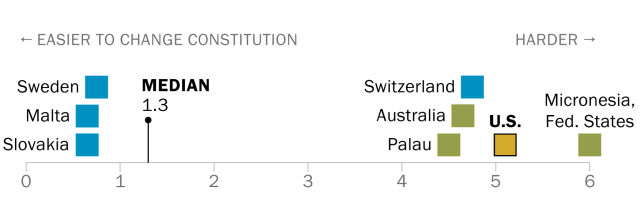
Of all 101 constitutions, the U.S. Constitution has the second-most onerous amendment process. Amendments must be approved by two-thirds votes in both the House and Senate – itself a tall order in these polarized times – and then be ratified by three-quarters of state legislatures, or 38 of 50.
Hardest and easiest national constitutions to amend
Difficulty score based on easiest pathway, as specified in constitution
Note: When a constitution specifies more than one amendment process, the “difficulty of amendment” scores represent the least difficult process. Data is based on the 106 countries we classify as democracies and includes some fully self-governing territories whose sovereign status is disputed.
Source: Pew Research Center analysis using scoring system based on “Toward a Theory of Constitutional Amendment” by Donald S. Lutz (American Political Science Review, June 1994).
Hardest and easiest national constitutions to amend
Difficulty score based on easiest pathway, as specified in constitution
DemocracyDifficulty of amendmentMicronesia, Federated States6.00United States5.10Switzerland4.75Australia4.65Palau4.50Fiji3.80Costa Rica3.65Liberia3.60Romania3.35Grenada3.30Philippines3.30Marshall Islands3.25Belgium3.10Japan3.10Netherlands3.10Paraguay3.00Taiwan*2.90Brazil0.90Denmark2.75Northern Cyprus2.55South Korea2.55Ireland2.50Bolivia2.40Andorra2.55Ecuador2.30Liechtenstein2.30Colombia2.25Italy2.25North Macedonia2.25Greece2.20Argentina2.10Nepal2.10Lithuania2.00Montenegro2.00Peru2.00Dominican Republic1.80Chile1.75Ghana1.75Luxembourg1.75Solomon Islands1.75Uruguay1.75Poland1.70Estonia1.65Germany1.60India1.60Namibia1.60Finland1.55Croatia1.45Antigua and Barbuda1.30Monaco1.30South Africa1.30St. Lucia1.30Czech Republic1.25Iceland1.25Jamaica1.25Spain1.25Bulgaria2.00Guyana1.15Lesotho1.15Senegal1.15Albania1.05Armenia1.05Kosovo1.55Moldova1.55Slovenia1.05Bahamas1.00Barbados1.00Botswana1.00Malaysia1.00Tonga1.00Trinidad and Tobago1.00Bhutan0.90France0.90Mongolia0.90Panama0.90Austria0.80Belize0.80Cape Verde0.80Cyprus0.80Dominica0.80East Timor0.80Hungary0.80Kiribati0.80Latvia0.80Malawi0.80Mauritius0.80Nauru0.80Norway0.80Portugal0.80Samoa0.80Sao Tome and Principe0.80Seychelles0.80Sri Lanka0.80St. Kitts and Nevis0.80St. Vincent and the Grenadines0.80Suriname0.80Tuvalu0.80Vanuatu0.80Sweden**0.75Malta0.65Slovakia0.65* The data in the table refers to the “Additional Articles of the Constitution,” which effectively rewrote the old 1947 Republic of China constitution.
** Although Sweden’s constitution formally consists of four “fundamental laws,” the data in the table refers specifically to the Instrument of Government, which contains most of the basic principles of government. However, the difficulty of amendment score applies to all four fundamental laws.
Note: When a constitution specifies more than one amendment process, the “difficulty of amendment” scores represent the least difficult process. Data is based on the 106 countries we classify as democracies and includes some fully self-governing territories whose sovereign status is disputed.
Source: Pew Research Center analysis using scoring system based on “Toward a Theory of Constitutional Amendment” by Donald S. Lutz (American Political Science Review, June 1994).
The only democracy whose constitution is even harder to change is the Federated States of Micronesia (FSM), a former U.S. trust territory in the South Pacific with about 76,000 inhabitants. The easiest path to changing the FSM’s constitution involves two separate two-thirds majority votes in the 14-person legislature, approval by the country’s president, and subsequent approval by three-quarters of voters in at least three of the FSM’s four states.
Other countries with constitutions that are nearly as hard to change are Palau, Switzerland and Australia. Like the U.S. and the FSM, these countries all require ratification at both the national and state levels.
At the other extreme, many countries with unicameral (single-chamber) legislatures can amend their constitutions much like how they pass regular laws, just requiring a larger majority in favor.
Almost everyone born in the U.S. is automatically a citizen.
Democracies that recognize birthright citizenship
Democracies where birthright citizenship is …
Note: Additional modes of acquiring citizenship by birth may apply to particular groups. Data is based on 106 countries classified as democracies and includes some fully self-governing territories whose sovereign status is disputed. Data is unavailable for four countries.
Source: Pew Research Center analysis of GLOBALCIT Citizenship Law Dataset, v3.0.
Democracies that recognize birthright citizenship
Democracies where birthright citizenship is …
CountryForm of birthright citizenship, if anyRegionAlbaniaNot recognizedEuropeAndorraData unavailableEuropeAntigua and BarbudaRecognizedAmericasArgentinaRecognizedAmericasArmeniaNot recognizedEuropeAustraliaLimited to those with parents who are legal residentsAsia-PacificAustriaNot recognizedEuropeBahamasNot recognizedAmericasBarbadosRecognizedAmericasBelgiumLimited to those with parents born in countryEuropeBelizeRecognizedAmericasBhutanNot recognizedAsia-PacificBoliviaRecognizedAmericasBotswanaNot recognizedAfricaBrazilRecognizedAmericasBulgariaNot recognizedEuropeCanadaRecognizedAmericasCape VerdeLimited to those with parents who are legal residentsAfricaChileLimited to those with parents who are legal residentsAmericasColombiaLimited to those with parents who are legal residentsAmericasCosta RicaRecognized, but parents or individual must applyAmericasCroatiaNot recognizedEuropeCyprusNot recognizedEuropeCzech RepublicNot recognizedEuropeDenmarkNot recognizedEuropeDominicaRecognizedAmericasDominican RepublicLimited to those with parents who are legal residentsAmericasEast TimorLimited to those with parents born in countryAsia-PacificEcuadorRecognizedAmericasEstoniaNot recognizedEuropeFijiNot recognizedAsia-PacificFinlandNot recognizedEuropeFranceLimited to those with parents born in countryEuropeGermanyLimited to those with parents who are legal residentsEuropeGhanaNot recognizedAfricaGreeceLimited to those with parents born in countryEuropeGrenadaRecognizedAmericasGuyanaRecognizedAmericasHungaryNot recognizedEuropeIcelandNot recognizedEuropeIndiaNot recognizedAsia-PacificIrelandLimited to those with parents who are legal residentsEuropeIsraelLimited to particular ethnic or religious groupsMiddle EastItalyNot recognizedEuropeJamaicaRecognizedAmericasJapanNot recognizedAsia-PacificKiribatiNot recognizedAsia-PacificKosovoLimited to those with parents who are legal residentsEuropeLatviaNot recognizedEuropeLesothoRecognizedAfricaLiberiaLimited to particular ethnic or religious groupsAfricaLiechtensteinNot recognizedEuropeLithuaniaNot recognizedEuropeLuxembourgLimited to those with parents born in countryEuropeMalawiNot recognizedAfricaMalaysiaLimited to those with parents who are legal residentsAsia-PacificMaltaLimited to those with parents born in countryEuropeMarshall IslandsNot recognizedAsia-PacificMauritiusNot recognizedAfricaMicronesia, Federated StatesNot recognizedAsia-PacificMoldovaRecognized, but parents or individual must applyEuropeMonacoData unavailableEuropeMongoliaNot recognizedAsia-PacificMontenegroNot recognizedEuropeNamibiaLimited to those with parents that are legal residentsAfricaNauruNot recognizedAsia-PacificNepalNot recognizedAsia-PacificNetherlandsLimited to those with parents born in countryEuropeNew ZealandLimited to those with parents who are legal residentsAsia-PacificNorth MacedoniaNot recognizedEuropeNorthern CyprusData unavailableNot recognizedNorwayNot recognizedEuropePalauNot recognizedAsia-PacificPanamaRecognizedAmericasParaguayRecognized, but parents or individual must applyAmericasPeruRecognizedAmericasPhilippinesNot recognizedAsia-PacificPolandNot recognizedEuropePortugalLimited to those with parents born in countryEuropeRomaniaNot recognizedEuropeSamoaNot recognizedAsia-PacificSan MarinoData unavailableEuropeSao Tome and PrincipeLimited to those with parents who are legal residentsAfricaSenegalLimited to those with parents born in countryAfricaSeychellesNot recognizedAfricaSlovakiaNot recognizedEuropeSloveniaNot recognizedEuropeSolomon IslandsNot recognizedAsia-PacificSouth AfricaNot recognizedAfricaSouth KoreaNot recognizedAsia-PacificSpainLimited to those with parents born in countryEuropeSri LankaNot recognizedAsia-PacificSt. Kitts and NevisRecognizedAmericasSt. LuciaRecognizedAmericasSt. Vincent and the GrenadinesRecognizedAmericasSurinameNot recognizedAmericasSwedenNot recognizedEuropeSwitzerlandNot recognizedEuropeTaiwanNot recognizedAsia-PacificTongaNot recognizedAsia-PacificTrinidad and TobagoRecognizedAmericasTuvaluRecognizedAsia-PacificUnited KingdomLimited to those with parents who are legal residentsEuropeUnited StatesRecognizedAmericasUruguayRecognizedAmericasVanuatuNot recognizedAsia-PacificNote: Additional modes of acquiring citizenship by birth may apply to particular groups. Data is based on 106 countries classified as democracies and includes some fully self-governing territories whose sovereign status is disputed. Data is unavailable for four countries.
Source: Pew Research Center analysis of GLOBALCIT Citizenship Law Dataset, v3.0.
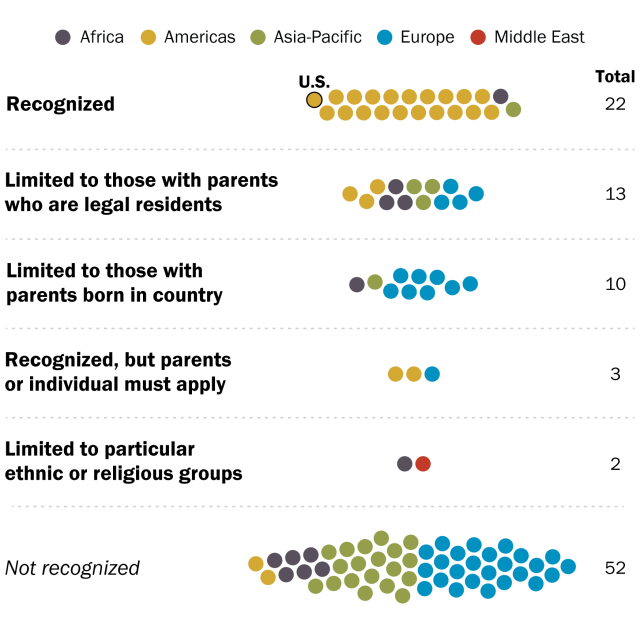
Only 21 other countries we classify as democracies have “birthright citizenship” in a form substantially like the United States. In those countries, most of them in the Western Hemisphere, virtually all children born there are automatically citizens, regardless of their parents’ citizenship or immigration status. In the U.S., birthright citizenship is guaranteed by the 14th Amendment, as the Supreme Court recently reaffirmed.
In three other democracies, nearly all children born to noncitizen parents are eligible to become citizens, but they or their parents must formally apply for it.
Another 25 democracies limit birthright citizenship to children whose parents are legal residents (13), whose parents were also born there (10), or who belong to specific ethnic or religious groups (2).
But nearly half of the 106 democracies (52) don’t recognize any kind of birthright citizenship. In all but one of those countries, newborns are automatically citizens only if at least one parent is also a citizen. (The remaining four democracies weren’t covered by the database of citizenship laws we used for this analysis.)
No other country fills its top executive position quite like the U.S.
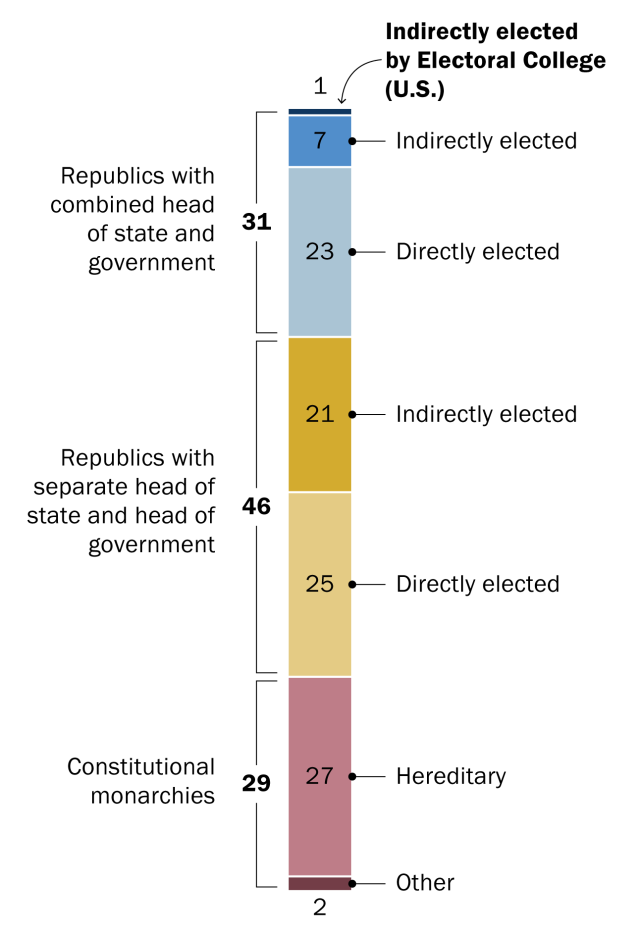
U.S. among few democracies that indirectly elect combined head of state and government
Number of democracies where leaders are …
Note: Data is based on 106 countries classified as democracies and includes some fully self-governing territories whose sovereign status is disputed.
Source: Pew Research Center analysis.
U.S. among few democracies that indirectly elect combined head of state and government
Number of democracies where leaders are …
DemocracyStructure of government leadershipHow leader is chosenUnited StatesRepublic with combined head of state and governmentIndirectly elected (by Electoral College)BotswanaRepublic with combined head of state and governmentIndirectly elected (by legislature)Marshall IslandsRepublic with combined head of state and governmentIndirectly elected (by legislature)Micronesia, Federated StatesRepublic with combined head of state and governmentIndirectly elected (by legislature)NauruRepublic with combined head of state and governmentIndirectly elected (by legislature)South AfricaRepublic with combined head of state and governmentIndirectly elected (by legislature)SurinameRepublic with combined head of state and governmentIndirectly elected (by legislature)SwitzerlandRepublic with combined head of state and governmentIndirectly elected (by legislature)ArgentinaRepublic with combined head of state and governmentDirectly electedBoliviaRepublic with combined head of state and governmentDirectly electedBrazilRepublic with combined head of state and governmentDirectly electedChileRepublic with combined head of state and governmentDirectly electedColombiaRepublic with combined head of state and governmentDirectly electedCosta RicaRepublic with combined head of state and governmentDirectly electedCyprusRepublic with combined head of state and governmentDirectly electedDominican RepublicRepublic with combined head of state and governmentDirectly electedEcuadorRepublic with combined head of state and governmentDirectly electedGhanaRepublic with combined head of state and governmentDirectly electedKiribatiRepublic with combined head of state and governmentDirectly electedLiberiaRepublic with combined head of state and governmentDirectly electedMalawiRepublic with combined head of state and governmentDirectly electedNamibiaRepublic with combined head of state and governmentDirectly electedPalauRepublic with combined head of state and governmentDirectly electedPanamaRepublic with combined head of state and governmentDirectly electedParaguayRepublic with combined head of state and governmentDirectly electedPeruRepublic with combined head of state and governmentDirectly electedPhilippinesRepublic with combined head of state and governmentDirectly electedSeychellesRepublic with combined head of state and governmentDirectly electedSouth KoreaRepublic with combined head of state and governmentDirectly electedSri LankaRepublic with combined head of state and governmentDirectly electedUruguayRepublic with combined head of state and governmentDirectly electedAlbaniaRepublic with separate heads of state and governmentIndirectly elected (by legislature)ArmeniaRepublic with separate heads of state and governmentIndirectly elected (by legislature)BarbadosRepublic with separate heads of state and governmentIndirectly elected (by legislature)DominicaRepublic with separate heads of state and governmentIndirectly elected (by legislature)EstoniaRepublic with separate heads of state and governmentIndirectly elected (by legislature)FijiRepublic with separate heads of state and governmentIndirectly elected (by legislature)GermanyRepublic with separate heads of state and governmentIndirectly elected (by assembly of national and local lawmakers)GreeceRepublic with separate heads of state and governmentIndirectly elected (by legislature)HungaryRepublic with separate heads of state and governmentIndirectly elected (by legislature)IndiaRepublic with separate heads of state and governmentIndirectly elected (by assembly of national and local lawmakers)IsraelRepublic with separate heads of state and governmentIndirectly elected (by legislature)ItalyRepublic with separate heads of state and governmentIndirectly elected (by assembly of national and local lawmakers)KosovoRepublic with separate heads of state and governmentIndirectly elected (by legislature)LatviaRepublic with separate heads of state and governmentIndirectly elected (by legislature)MaltaRepublic with separate heads of state and governmentIndirectly elected (by legislature)MauritiusRepublic with separate heads of state and governmentIndirectly elected (by legislature)NepalRepublic with separate heads of state and governmentIndirectly elected (by assembly of national and local lawmakers)SamoaRepublic with separate heads of state and governmentIndirectly elected (by legislature)San MarinoRepublic with separate heads of state and governmentIndirectly elected (by legislature)Trinidad and TobagoRepublic with separate heads of state and governmentIndirectly elected (by legislature)VanuatuRepublic with separate heads of state and governmentIndirectly elected (by assembly of national and local lawmakers)AustriaRepublic with separate heads of state and governmentDirectly electedBulgariaRepublic with separate heads of state and governmentDirectly electedCape VerdeRepublic with separate heads of state and governmentDirectly electedCroatiaRepublic with separate heads of state and governmentDirectly electedCzech RepublicRepublic with separate heads of state and governmentDirectly electedEast TimorRepublic with separate heads of state and governmentDirectly electedFinlandRepublic with separate heads of state and governmentDirectly electedFranceRepublic with separate heads of state and governmentDirectly electedGuyanaRepublic with separate heads of state and governmentDirectly electedIcelandRepublic with separate heads of state and governmentDirectly electedIrelandRepublic with separate heads of state and governmentDirectly electedLithuaniaRepublic with separate heads of state and governmentDirectly electedMoldovaRepublic with separate heads of state and governmentDirectly electedMongoliaRepublic with separate heads of state and governmentDirectly electedMontenegroRepublic with separate heads of state and governmentDirectly electedNorth MacedoniaRepublic with separate heads of state and governmentDirectly electedNorthern CyprusRepublic with separate heads of state and governmentDirectly electedPolandRepublic with separate heads of state and governmentDirectly electedPortugalRepublic with separate heads of state and governmentDirectly electedRomaniaRepublic with separate heads of state and governmentDirectly electedSao Tome and PrincipeRepublic with separate heads of state and governmentDirectly electedSenegalRepublic with separate heads of state and governmentDirectly electedSlovakiaRepublic with separate heads of state and governmentDirectly electedSloveniaRepublic with separate heads of state and governmentDirectly electedTaiwanRepublic with separate heads of state and governmentDirectly electedAntigua and BarbudaConstitutional monarchyHereditary monarchAustraliaConstitutional monarchyHereditary monarchBahamasConstitutional monarchyHereditary monarchBelgiumConstitutional monarchyHereditary monarchBelizeConstitutional monarchyHereditary monarchBhutanConstitutional monarchyHereditary monarchCanadaConstitutional monarchyHereditary monarchDenmarkConstitutional monarchyHereditary monarchGrenadaConstitutional monarchyHereditary monarchJamaicaConstitutional monarchyHereditary monarchJapanConstitutional monarchyHereditary monarchLesothoConstitutional monarchyHereditary monarchLiechtensteinConstitutional monarchyHereditary monarchLuxembourgConstitutional monarchyHereditary monarchMonacoConstitutional monarchyHereditary monarchNetherlandsConstitutional monarchyHereditary monarchNew ZealandConstitutional monarchyHereditary monarchNorwayConstitutional monarchyHereditary monarchSolomon IslandsConstitutional monarchyHereditary monarchSpainConstitutional monarchyHereditary monarchSt. Kitts and NevisConstitutional monarchyHereditary monarchSt. LuciaConstitutional monarchyHereditary monarchSt. Vincent and the GrenadinesConstitutional monarchyHereditary monarchSwedenConstitutional monarchyHereditary monarchTongaConstitutional monarchyHereditary monarchTuvaluConstitutional monarchyHereditary monarchUnited KingdomConstitutional monarchyHereditary monarchAndorraConstitutional monarchyOtherMalaysiaConstitutional monarchyOther* Switzerland’s Federal Council acts as a collective executive body. Each year the title of “president of the Confederation” rotates among the Council’s 7 members.
Note: Data is based on 106 countries classified as democracies and includes some fully self-governing territories whose sovereign status is disputed.
Source: Pew Research Center analysis.
The U.S. president combines the roles of head of government (the political leader) and head of state (the symbolic leader of the nation). Only 30 other democracies have one person who fills both those roles. The others have a monarch, ceremonial president or similar figure as head of state, and a prime minister or similar official as head of government.
That in itself doesn’t make the U.S. too much of an outlier. However, of the 31 countries with combined heads of state and government (almost universally termed “presidents”), 23 are elected directly by the people, and another seven are chosen by the national legislature.
That makes the U.S. the only country where the people vote for a special body – the Electoral College – whose sole function is to choose the president. That means the popular vote for president doesn’t necessarily determine the Electoral College winner.
Four times since 1828, when U.S. presidential elections began to resemble today’s system, a candidate won the Electoral College and became president despite getting fewer popular votes than the runner-up. The most recent instance was in 2016, when Donald Trump won the electoral vote – and the presidency – 304 to 227 despite getting 2.9 million fewer popular votes than Hillary Clinton. (In Trump’s second win in 2024, he won both the Electoral College and the popular vote.)
Majorities of Americans have long favored abolishing the Electoral College, Pew Research Center surveys have found. The last time we asked this question, in 2024, more than six-in-ten (63%) said they preferred changing the system so that the person who wins the most votes nationally wins the presidency. About a third (35%) favored retaining the Electoral College system.
Related: As Trump turns 80, who are the oldest – and youngest – current world leaders?
Few countries draw legislative districts the way the U.S. does.
Until recently, redrawing the boundaries of U.S. House districts between decennial censuses has been fairly rare. But instances of midcycle redistricting have been more frequent in the current election cycle, and it’s already reshaping the 2026 midterm elections.
Most other democracies don’t – or can’t – experience anything similar.
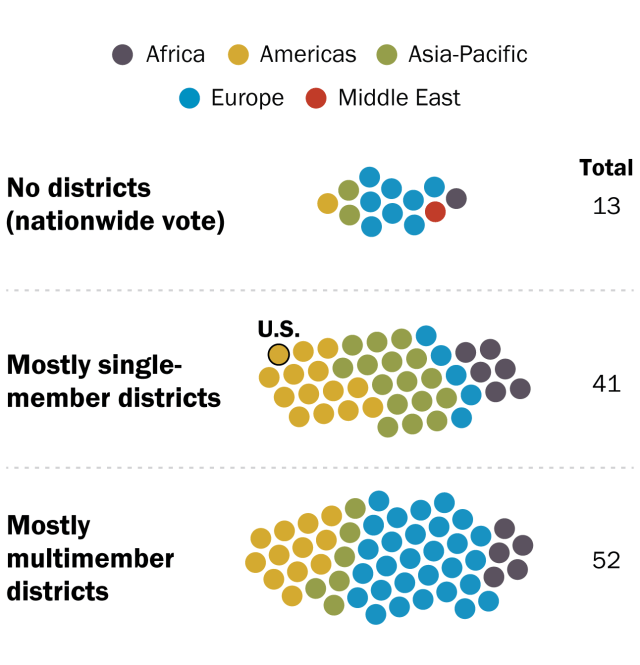
U.S. is among 41 democracies that exclusively or primarily use single-member districts
Democracies that use __ in electing national legislators
Note: Data is based on 106 countries classified as democracies and includes some fully self-governing territories whose sovereign status is disputed.
Source: Pew Research Center analysis.
U.S. is among 41 democracies that exclusively or primarily use single-member districts
Democracies that use __ in electing national legislators
DemocracyDistrict typeRegionAntigua and BarbudaMostly single-member districtsAmericasAustraliaMostly single-member districtsAsia-PacificBahamasMostly single-member districtsAmericasBarbadosMostly single-member districtsAmericasBelizeMostly single-member districtsAmericasBhutanMostly single-member districtsAsia-PacificBoliviaMostly single-member districtsAmericasBotswanaMostly single-member districtsAfricaCanadaMostly single-member districtsAmericasDominicaMostly single-member districtsAmericasFranceMostly single-member districtsEuropeGermanyMostly single-member districtsEuropeGhanaMostly single-member districtsAfricaGrenadaMostly single-member districtsAmericasHungaryMostly single-member districtsEuropeIndiaMostly single-member districtsAsia-PacificJamaicaMostly single-member districtsAmericasJapanMostly single-member districtsAsia-PacificLesothoMostly single-member districtsAfricaLiberiaMostly single-member districtsAfricaLithuaniaMostly single-member districtsEuropeMalawiMostly single-member districtsAfricaMalaysiaMostly single-member districtsAsia-PacificMarshall IslandsMostly single-member districtsAsia-PacificMicronesia, Federated StatesMostly single-member districtsAsia-PacificNepalMostly single-member districtsAsia-PacificNew ZealandMostly single-member districtsAsia-PacificPalauMostly single-member districtsAsia-PacificPhilippinesMostly single-member districtsAsia-PacificSamoaMostly single-member districtsAsia-PacificSeychellesMostly single-member districtsAfricaSolomon IslandsMostly single-member districtsAsia-PacificSouth KoreaMostly single-member districtsAsia-PacificSt. Kitts and NevisMostly single-member districtsAmericasSt. LuciaMostly single-member districtsAmericasSt. Vincent and the GrenadinesMostly single-member districtsAmericasTaiwanMostly single-member districtsAsia-PacificTongaMostly single-member districtsAsia-PacificTrinidad and TobagoMostly single-member districtsAmericasUnited KingdomMostly single-member districtsEuropeUnited StatesMostly single-member districtsAmericasAlbaniaMostly multimember districtsEuropeAndorraMostly multimember districtsEuropeArgentinaMostly multimember districtsAmericasAustriaMostly multimember districtsEuropeBelgiumMostly multimember districtsEuropeBrazilMostly multimember districtsAmericasBulgariaMostly multimember districtsEuropeCape VerdeMostly multimember districtsAfricaChileMostly multimember districtsAmericasColombiaMostly multimember districtsAmericasCosta RicaMostly multimember districtsAmericasCroatiaMostly multimember districtsEuropeCyprusMostly multimember districtsEuropeCzech RepublicMostly multimember districtsEuropeDenmarkMostly multimember districtsEuropeDominican RepublicMostly multimember districtsAmericasEcuadorMostly multimember districtsAmericasEstoniaMostly multimember districtsEuropeFinlandMostly multimember districtsEuropeGreeceMostly multimember districtsEuropeGuyanaMostly multimember districtsAmericasIcelandMostly multimember districtsEuropeIrelandMostly multimember districtsEuropeItalyMostly multimember districtsEuropeKiribatiMostly multimember districtsAsia-PacificLatviaMostly multimember districtsEuropeLiechtensteinMostly multimember districtsEuropeLuxembourgMostly multimember districtsEuropeMaltaMostly multimember districtsEuropeMauritiusMostly multimember districtsAfricaMongoliaMostly multimember districtsAsia-PacificNauruMostly multimember districtsAsia-PacificNorth MacedoniaMostly multimember districtsEuropeNorthern CyprusMostly multimember districtsEuropeNorwayMostly multimember districtsEuropePanamaMostly multimember districtsAmericasParaguayMostly multimember districtsAmericasPeruMostly multimember districtsAmericasPolandMostly multimember districtsEuropePortugalMostly multimember districtsEuropeRomaniaMostly multimember districtsEuropeSao Tome and PrincipeMostly multimember districtsAfricaSenegalMostly multimember districtsAfricaSloveniaMostly multimember districtsEuropeSouth AfricaMostly multimember districtsAfricaSpainMostly multimember districtsEuropeSri LankaMostly multimember districtsAsia-PacificSwedenMostly multimember districtsEuropeSwitzerlandMostly multimember districtsEuropeTuvaluMostly multimember districtsAsia-PacificUruguayMostly multimember districtsAmericasVanuatuMostly multimember districtsAsia-PacificArmeniaNo districts (nationwide vote)EuropeEast TimorNo districts (nationwide vote)Asia-PacificFijiNo districts (nationwide vote)Asia-PacificIsraelNo districts (nationwide vote)Middle EastKosovoNo districts (nationwide vote)EuropeMoldovaNo districts (nationwide vote)EuropeMonacoNo districts (nationwide vote)EuropeMontenegroNo districts (nationwide vote)EuropeNamibiaNo districts (nationwide vote)AfricaNetherlandsNo districts (nationwide vote)EuropeSan MarinoNo districts (nationwide vote)EuropeSlovakiaNo districts (nationwide vote)EuropeSurinameNo districts (nationwide vote)AmericasNote: Data is based on 106 countries classified as democracies and includes some fully self-governing territories whose sovereign status is disputed.
Source: Pew Research Center analysis.
For one thing, only 40 democracies besides the U.S. elect all or even a substantial share of their lawmakers from single-member districts. Most countries – especially those that use proportional representation – rely on multimember districts or else vote nationwide. (This analysis looks at districting in the lower chamber of bicameral legislatures, like the U.S. House of Representatives, or the sole chamber in unicameral systems.)
Of the democracies that rely on single-member districts, only in the U.S. and the Federated States of Micronesia (again!) do state legislatures primarily draw the district lines. In most of the rest, the main responsibility lies with independent boundary commissions (22) or national election agencies (9).
Fifty-two countries in our dataset rely mainly on multimember districts. More than half of those (27) base those districts on existing provinces, regions or similar subdivisions. And in 13 countries, there aren’t any districts at all: The entire legislature is elected proportionally in a single, nationwide vote.
U.S. lawmakers represent more people than almost anywhere else.
Representative democracy is based on the idea that legislators represent, in some sense, the people. But how many constituents can an individual lawmaker effectively represent?
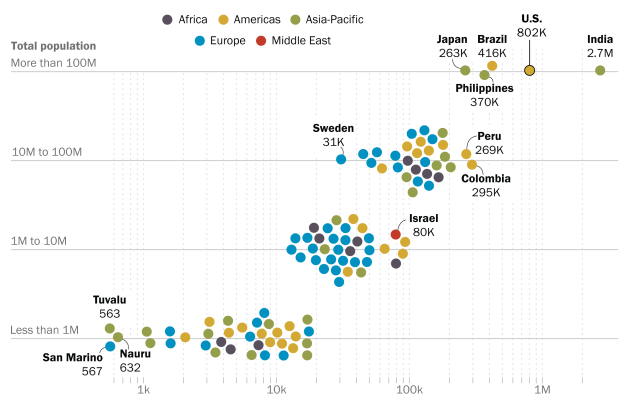
Based on United Nations population projections, each of the 435 voting members of the U.S. House of Representatives represents about 802,000 people. That’s a higher “representation ratio” than any other democracy except India, the world’s most populous country. The 543 members of the Lok Sabha, the lower house of India’s Parliament, each represent an average of 2.72 million constituents.
The U.S. has the second-highest representation ratio of any democracy
Average number of people per lawmaker in the lower or sole chamber of national legislature
Note: Representation ratio calculated by dividing each country’s 2025 population by the current number of seats in its national legislature, or in the lower chamber of a bicameral legislature. Nonvoting members are excluded from seat counts. Data is based on 106 countries classified as democracies and includes some fully self-governing territories whose sovereign status is disputed.
Source: Pew Research Center analysis using probabilistic population projections from the UN Population Division.
The U.S. has the second-highest representation ratio of any democracy
Average number of people per lawmaker in the lower or sole chamber of national legislature
DemocracyRepresentation ratioPopulationRegionAlbania196502751000EuropeAndorra300084000EuropeAntigua and Barbuda558895000AmericasArgentina17900446004000AmericasArmenia273932931000Asia-PacificAustralia18151327227000Asia-PacificAustria497659107000EuropeBahamas9878405000AmericasBarbados9433283000AmericasBelgium7850011775000EuropeBelize13839429000AmericasBhutan17064802000Asia-PacificBolivia9806912749000AmericasBotswana400462603000AfricaBrazil416302213563000AmericasBulgaria277836668000EuropeCanada11798340468000AmericasCape Verde7361530000AfricaChile12868419946000AmericasColombia29473253936000AmericasCosta Rica907895175000AmericasCroatia253113822000EuropeCyprus17446977000Asia-PacificCzech Republic5264010528000EuropeDenmark336546024000EuropeDominica206366000AmericasDominican Republic6110511610000AmericasEast Timor2210818445000Asia-PacificEcuador1221521331000AmericasEstonia13178937000EuropeFiji170365622000Asia-PacificFinland2811066746000EuropeFrance11567883644000EuropeGermany13276835698000EuropeGhana1293419897000AfricaGreece32990117000EuropeGrenada7800841000AmericasGuyana129389586000AmericasHungary48171402000EuropeIceland63811476626000EuropeIndia27244025357000Asia-PacificIreland307879648000EuropeIsrael8040058926000Middle EastItaly1473152833000EuropeJamaica44968122428000AmericasJapan263286138000Asia-PacificKiribati30671667000Asia-PacificKosovo138921836000EuropeLatvia183602389000EuropeLesotho199085854000AfricaLiberia8019240000AfricaLiechtenstein16002797000EuropeLithuania19837687000EuropeLuxembourg1145022786000EuropeMalawi9950236385000AfricaMalaysia163896549000Asia-PacificMalta819435000EuropeMarshall Islands10611265000Asia-PacificMauritius19167114000AfricaMicronesia, Federated States81432961000Asia-PacificMoldova2931738000EuropeMonaco15833557000EuropeMongolia28230626000Asia-PacificMontenegro77283153000EuropeNamibia3284412000AfricaNauru63229629000Asia-PacificNepal10774218449000Asia-PacificNetherlands1229935287000EuropeNew Zealand429841804000Asia-PacificNorth Macedonia15033405000EuropeNorthern Cyprus81005653000Asia-PacificNorway3345018000EuropePalau11254626000Asia-PacificPanama651557095000AmericasParaguay8868834922000AmericasPeru268631117724000AmericasPhilippines37020137843000Asia-PacificPoland8226710395000EuropePortugal4519618801000EuropeRomania56801221000EuropeSamoa433334000Asia-PacificSan Marino567245000EuropeSao Tome and Principe445519367000AfricaSenegal117376135000AfricaSeychelles39715451000AfricaSlovakia363402115000EuropeSlovenia23500858000EuropeSolomon Islands1716065453000Asia-PacificSouth Africa16363351600000AfricaSouth Korea17200047851000Asia-PacificSpain13671723348000EuropeSri Lanka10376947000Asia-PacificSt. Kitts and Nevis3133180000AmericasSt. Lucia1058899000AmericasSt. Vincent and the Grenadines4304645000AmericasSuriname1264710701000AmericasSweden306629008000EuropeSwitzerland4504023011000EuropeTaiwan2036371437000Asia-PacificTonga3433103000Asia-PacificTrinidad and Tobago369021513000AmericasTuvalu5639000Asia-PacificUnited Kingdom10758869932000EuropeUnited States802379349035000AmericasUruguay341723383000AmericasVanuatu6596343000Asia-Pacific* Population projections for the Turkish Republic of Northern Cyprus are not available from the United Nations. The projections above for Northern Cyprus and the Republic of Cyprus (the internationally recognized government that controls two-thirds of the island) were derived by splitting the projection for the entire island based on the ratio of the 2021 population estimates for the two places.
Note: Representation ratio calculated by dividing each country’s 2025 population by the current number of seats in its national legislature, or in the lower chamber of a bicameral legislature. Nonvoting members are excluded from seat counts. Data is based on 106 countries classified as democracies and includes some fully self-governing territories whose sovereign status is disputed.
Source: Pew Research Center analysis using probabilistic population projections from the UN Population Division.
At the other extreme, the 16 members of Tuvalu’s Parliament each represent an average of just 563 people.
Up to the 1910s, the number of U.S. representatives grew steadily as the population expanded and more states joined the Union. But today’s House is the same size it was over a century ago, even though the population has more than tripled.
The median representation ratio for all 106 democracies was about 31,000 constituents per lawmaker. For the U.S. to have that representation ratio, the House would have to balloon to 11,360 members – far larger than any country’s current legislature.
In the U.S., Election Day is a regular day.
Since the mid-19th century, Tuesday has been the standard day for U.S. elections (with certain exceptions). Back when the nation was primarily rural, getting to a polling place often required long trips there and back. Sunday was out because many people were in church, and Wednesday was farmers market day. Tuesday seemed like the best fit.
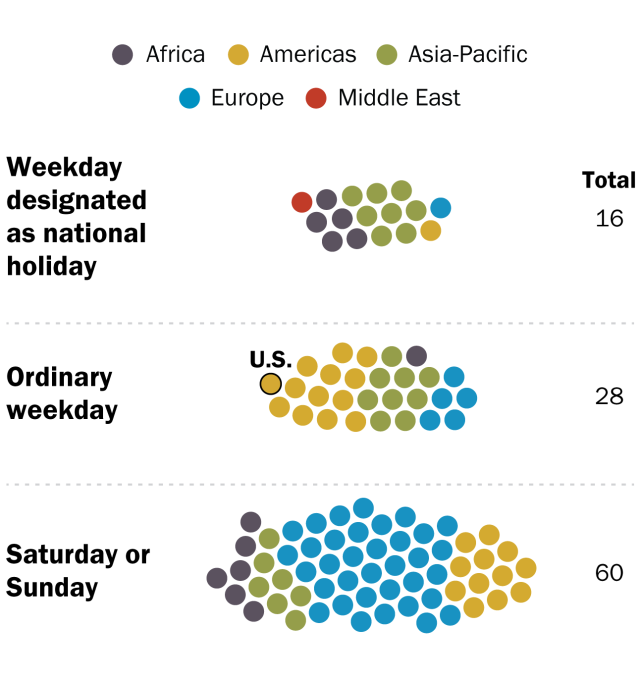
Election Day around the world
Democracies that typically hold national elections on …
Note: The Czech Republic and Suriname are not shown because they have different election procedures. Data is based on 106 countries classified as democracies and includes some fully self-governing territories whose sovereign status is disputed.
Source: Pew Research Center analysis.
Election Day around the world
Democracies that typically hold national elections on …
DemocracyElection dayRegionAlbaniaSaturday or SundayEuropeAndorraSaturday or SundayEuropeAntigua and BarbudaOrdinary weekdayAmericasArgentinaSaturday or SundayAmericasArmeniaSaturday or SundayEuropeAustraliaSaturday or SundayAsia-PacificAustriaSaturday or SundayEuropeBahamasOrdinary weekdayAmericasBarbadosOrdinary weekdayAmericasBelgiumSaturday or SundayEuropeBelizeOrdinary weekdayAmericasBhutanOrdinary weekdayAsia-PacificBoliviaSaturday or SundayAmericasBotswanaWeekday designated as national holidayAfricaBrazilSaturday or SundayAmericasBulgariaSaturday or SundayEuropeCanadaOrdinary weekdayAmericasCape VerdeSaturday or SundayAfricaChileSaturday or SundayAmericasColombiaSaturday or SundayAmericasCosta RicaSaturday or SundayAmericasCroatiaSaturday or SundayEuropeCyprusSaturday or SundayEuropeCzech Republic*OtherEuropeDenmarkOrdinary weekdayEuropeDominicaOrdinary weekdayAmericasDominican RepublicSaturday or SundayAmericasEast TimorSaturday or SundayAsia-PacificEcuadorSaturday or SundayAmericasEstoniaSaturday or SundayEuropeFijiWeekday designated as national holidayAsia-PacificFinlandSaturday or SundayEuropeFranceSaturday or SundayEuropeGermanySaturday or SundayEuropeGhanaSaturday or SundayAfricaGreeceSaturday or SundayEuropeGrenadaOrdinary weekdayAmericasGuyanaWeekday designated as national holidayAmericasHungarySaturday or SundayEuropeIcelandSaturday or SundayEuropeIndiaOrdinary weekdayAsia-PacificIrelandOrdinary weekdayEuropeIsraelWeekday designated as national holidayMiddle EastItalySaturday or SundayEuropeJamaicaOrdinary weekdayAmericasJapanSaturday or SundayAsia-PacificKiribatiOrdinary weekdayAsia-PacificKosovoSaturday or SundayEuropeLatviaSaturday or SundayEuropeLesothoWeekday designated as national holidayAfricaLiberiaOrdinary weekdayAfricaLiechtensteinSaturday or SundayEuropeLithuaniaSaturday or SundayEuropeLuxembourgSaturday or SundayEuropeMalawiWeekday designated as national holidayAfricaMalaysiaSaturday or SundayAsia-PacificMaltaSaturday or SundayEuropeMarshall IslandsOrdinary weekdayAsia-PacificMauritiusSaturday or SundayAfricaMicronesia, Federated StatesOrdinary weekdayAsia-PacificMoldovaSaturday or SundayEuropeMonacoSaturday or SundayEuropeMongoliaWeekday designated as national holidayAsia-PacificMontenegroSaturday or SundayEuropeNamibiaWeekday designated as national holidayAfricaNauruSaturday or SundayAsia-PacificNepalWeekday designated as national holidayAsia-PacificNetherlandsOrdinary weekdayEuropeNew ZealandSaturday or SundayAsia-PacificNorth MacedoniaWeekday designated as national holidayEuropeNorthern CyprusSaturday or SundayEuropeNorwayOrdinary weekdayEuropePalauOrdinary weekdayAsia-PacificPanamaSaturday or SundayAmericasParaguaySaturday or SundayAmericasPeruSaturday or SundayAmericasPhilippinesWeekday designated as national holidayAsia-PacificPolandSaturday or SundayEuropePortugalSaturday or SundayEuropeRomaniaSaturday or SundayEuropeSamoaWeekday designated as national holidayAsia-PacificSan MarinoSaturday or SundayEuropeSao Tome and PrincipeSaturday or SundayAfricaSenegalSaturday or SundayAfricaSeychellesSaturday or SundayAfricaSlovakiaSaturday or SundayEuropeSloveniaSaturday or SundayEuropeSolomon IslandsWeekday designated as national holidayAsia-PacificSouth AfricaWeekday designated as national holidayAfricaSouth KoreaWeekday designated as national holidayAsia-PacificSpainSaturday or SundayEuropeSri LankaOrdinary weekdayAsia-PacificSt. Kitts and NevisOrdinary weekdayAmericasSt. LuciaOrdinary weekdayAmericasSt. Vincent and the GrenadinesOrdinary weekdayAmericasSuriname**OtherAmericasSwedenSaturday or SundayEuropeSwitzerlandSaturday or SundayEuropeTaiwanSaturday or SundayAsia-PacificTongaOrdinary weekdayAsia-PacificTrinidad and TobagoOrdinary weekdayAmericasTuvaluOrdinary weekdayAsia-PacificUnited KingdomOrdinary weekdayEuropeUnited StatesOrdinary weekdayAmericasUruguaySaturday or SundayAmericasVanuatuWeekday designated as national holidayAsia-Pacific* The Czech Republic typically holds elections over a 24-hour period from Friday afternoon to Saturday afternoon.
** Suriname holds elections on a fixed date: May 25, which happened to fall on a Sunday in the most recent election year.
Note: The Czech Republic and Suriname are not shown because they have different election procedures. Data is based on 106 countries classified as democracies and includes some fully self-governing territories whose sovereign status is disputed.
Source: Pew Research Center analysis.
More recently, some lawmakers have proposed moving Election Day to a weekend or making it a national holiday. Supporters say the current schedule often forces people to take time off work to vote, and making Election Day a day off for everyone would boost turnout. (As of 2023, 12 states and Puerto Rico already make Election Day a paid day off for state employees; Kentucky also does so in presidential election years.)
As it stands, the U.S. is one of 28 democracies that routinely holds national elections on non-holiday weekdays. By contrast, 60 countries typically hold elections on Saturdays or Sundays. (Then there’s the Czech Republic, which typically holds elections over a 24-hour period from Friday afternoon to Saturday afternoon.) Sixteen other countries hold elections on weekdays but declare them public holidays.
Some countries hold elections on a fixed date instead of a set day of the week. Suriname, for instance, has held its general election on May 25 every five years since 2000. Its most recent election, in 2025, happened to fall on a Sunday, but that was by chance rather than by deliberate choice.
The U.S. capital city doesn’t have full representation.
Washington, D.C., is the only national capital of any democracy whose residents have no voting representation in the national legislature.
The capital being a separate district isn’t unusual on its own. Nearly four dozen other democracies also give their capital cities some kind of special status. For example, they may be:
Autonomous municipalities (such as Buenos Aires, Argentina) Distinct units of local government (such as Paris, France) The equivalent of states or provinces (such as Berlin, Germany) Capital districts apart from other states or provinces (such as Canberra, Australia)But the people who live in all of those other capitals, as well as capitals that lack any special status, get to elect lawmakers just like people in the rest of their country. Not so for the 694,000 residents of D.C., whose lone delegate to Congress can participate in committees but has no vote on the House floor.
Granting D.C. voting representation would require either making it a state or changing the Constitution. A proposed amendment that would have given D.C. two senators and a representative failed in the 1980s. The only other country whose capital elects no lawmakers is Palau, but there’s a good reason for that: Ngerulmud, the island nation’s capital area, has no resident population, just a cluster of government office buildings.
The U.S. has the strictest limit on its national debt – on paper, at least.
It’s common for countries to try to limit how much debt they (and sometimes their local governments) can take on. Two-thirds of the 106 democracies (70) have some sort of debt limit, though some are more aspirations or goals rather than hard caps. (This figure includes all 27 members of the European Union, which are bound by the EU’s Stability and Growth Pact even in the absence of any domestic debt limit.)
Most of those 70 countries define their limits, in laws or formal policy documents, as a percentage of gross domestic product (GDP). Defining the debt limit this way allows it to grow with the economy.
In contrast, the United States and Denmark legally define their limits in absolute terms. And Denmark’s limit – 2 trillion kroner, or about $309.4 billion – is so far above its actual debt that it’s largely irrelevant.
The U.S. debt limit is much more rigid and often affects how its democracy functions. The debt limit is currently $41.1 trillion, but large and persistent budget deficits require the country to borrow more each year. That means Congress has to raise the debt limit every so often, which makes it a political issue.
For decades, increasing the debt limit was fairly routine, but in recent years both Republican and Democratic lawmakers have held up the process to try to win policy concessions. That has led to repeated clashes between Congress and the White House, contributed to government shutdowns, and brought the country close enough to defaulting on its national debt to unnerve the investors and financial markets its economy depends on.
Congress could by law change the debt limit to a percentage formula or eliminate it entirely. But no matter which party controls the legislature, it has shown little interest in giving up what many see as key leverage over the executive branch.
Comments (0)