Having your
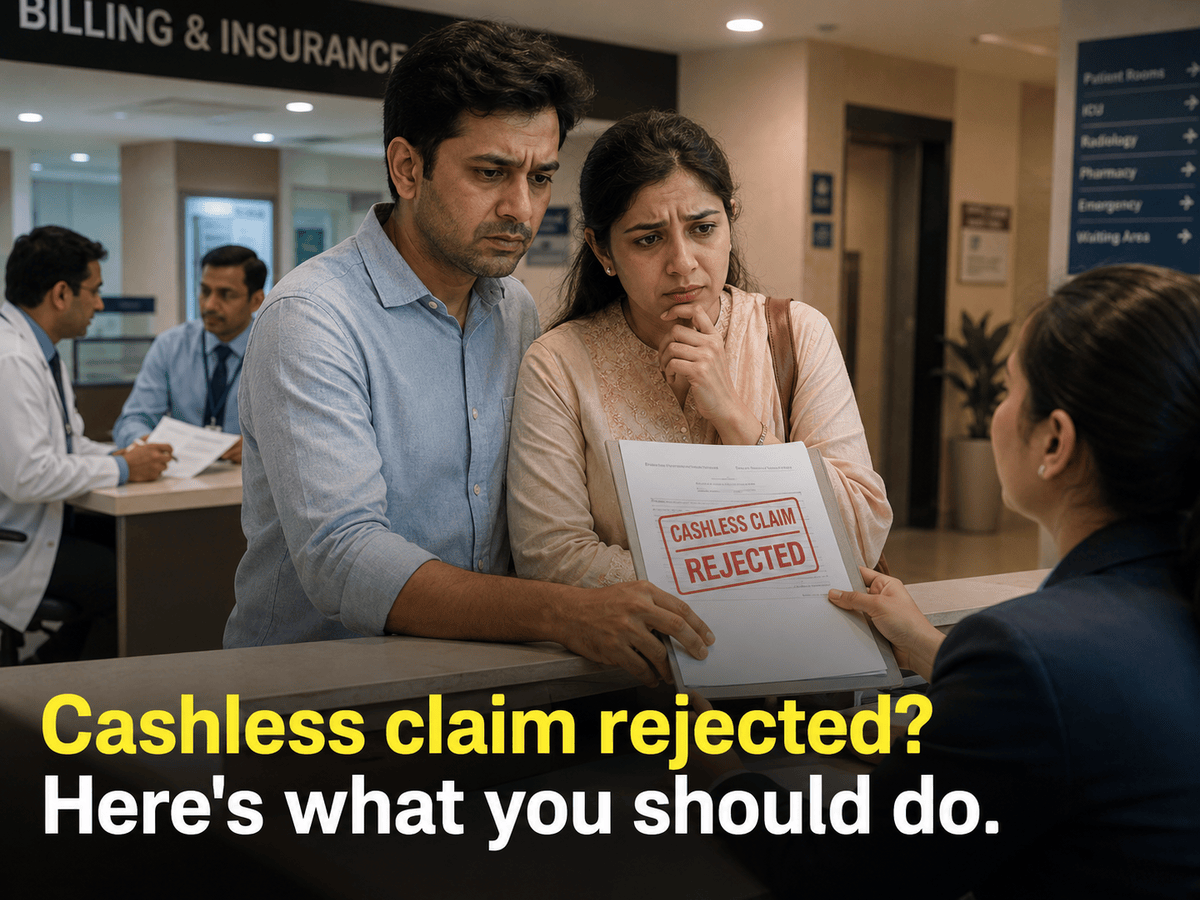
cashless health insurance claim turned down, especially during a medical emergency, can be really stressful. But before you panic about your insurer not covering it, remember that a lot of cashless claims are rejected because of documentation or procedural problems, and these can often be fixed.
Keep reading to find out why cashless claims get rejected, what you should do immediately, and how you can still get your claim settled.
Why do cashless health insurance claims get rejected?
A cashless claim rejection is often mistaken for a denial of the insurance claim itself. However, a cashless rejection typically occurs because of a procedural or documentation problem rather than indicating that the claim won’t be paid.
“It can happen if the treatment hospital is not on the insurer's current cashless network, as network lists are updated from time to time," says Dr Puneet Biblani, Head – Claim, ManipalCigna Health Insurance.
It can also happen if the documents shared at the time of admission are incomplete or unclear, such as a missing diagnosis, treatment plan, or cost estimate, according to him.
Sometimes, the insurer or third-party administrator (TPA) may simply require additional medical justification from the treating doctor before approving the request.
A few other reasons include the treatment or room category exceeding the policy limits, waiting periods applicable to a particular illness, mismatches in patient records, or discrepancies between the medical information disclosed while buying the policy and the details available during treatment.
"Most of these situations are administrative in nature and can usually be resolved with the right follow-up," he adds.
Does rejection of a cashless claim mean your health insurance claim is also rejected?
No. A cashless claim rejection does not automatically mean the insurer has rejected the insurance claim itself.
If the cashless facility is denied, the policyholder can pay the hospital bill and later submit a reimbursement claim, provided the treatment is covered by the policy.
"The claim will be adjudicated and paid, provided it is eligible as per the terms and conditions of the policy," says Biblani.
Cashless claim vs reimbursement claimFeatureCashless claimReimbursement claim
Where you can goOnly at hospitals in the insurer's network.Any hospital you choose.Who pays the hospitalThe insurer pays them directly.You pay everything out of pocket first.When it gets approvedBefore or during your hospital stay.After you are discharged and home.Paperwork hassleThe hospital handles most of it for you.You must collect and submit every single receipt.Your immediate costJust minor non-medical fees.The entire hospital bill upfront.Waiting for the money
Sorted out by the time you leave.It takes about 15 to 30 days after you apply.Why it usually gets rejectedLack of immediate medical data or documentation.The policyholder misses the submission deadline, loses original bills, or the treatment is not covered.Source: ProbusWhat should you do immediately if your cashless claim is rejected?
The first step is to find out the exact reason for the rejection from the insurer, TPA or the hospital's insurance desk.
"Many cases involve missing documents or clarifications that can be quickly resubmitted," says Rakesh Jain, CEO, IndusInd General Insurance.
The next course of action depends on whether the admission is planned or an emergency.
“For planned treatment, the insurer is informed in advance with a pre-authorisation request, while for emergencies, the patient is admitted first and the hospital submits the cashless request soon after. If the request gets declined, it helps to ask for the exact reason in writing rather than relying only on a verbal update, since many cashless holds are simply asking for an extra report or clarification rather than a final refusal. If more medical justification is needed, getting the treating doctor involved quickly allows the hospital to resubmit with the right details,” says Biblani.
If treatment cannot be postponed, the policyholder can proceed with the treatment by paying the hospital bill and later opting for reimbursement.
All supporting documents, including the discharge summary, itemised bills, prescriptions, diagnostic reports and the written cashless rejection communication, should be preserved carefully. The date on which the final document is submitted should also be recorded, as this determines the reimbursement settlement timeline, according to Biblani.
What if your reimbursement claim also gets rejected?
If the reimbursement claim is denied, policyholders should first obtain the rejection letter from the insurer and carefully review the reason mentioned along with the corresponding policy clause.
“Rejections may stem from missing documents, inadequate medical justification, or partial admissibility assessments,” says Jain.
If the rejection is because of incomplete documentation or insufficient information, the missing details should be submitted instead of filing the entire claim again.
"If the matter is not resolved, the next step is writing to the insurer's grievance redressal team with the full set of papers and earlier communication. If this still does not help, the policyholder can escalate through IRDAI's Bima Bharosa grievance portal, and after that, approach the Insurance Ombudsman for their region, which is a free option available to every policyholder," says Biblani.
If the dispute remains unresolved, the policyholder may approach the consumer forum or pursue other legal remedies.
What can policyholders do to avoid claim rejection?
Policyholders can improve their chances of a smooth claim settlement by following a few simple steps:Read the policy document carefully and understand its coverage, exclusions, waiting periods, and limits.Confirm that the hospital is part of the insurer's latest cashless network before a planned admission.Inform the insurer on time and complete the pre-authorisation process wherever applicable.Disclose your complete medical history, including pre-existing diseases, while buying the policy.Preserve all medical records, bills and prescriptions from admission to discharge.Check that the claim form and supporting documents are complete before submission.Verify whether the proposed treatment is covered under the policy and whether any waiting period or sub-limit applies.